
Tailoring spin-polarized properties of HfFeX (X = Sn, Ge) half-Heusler alloys for spintronic and optoelectronic applications via DFT
IF 4.9
3区 材料科学
Q2 CHEMISTRY, MULTIDISCIPLINARY
Journal of Physics and Chemistry of Solids
Pub Date : 2026-06-01
Epub Date: 2026-02-07
DOI:10.1016/j.jpcs.2026.113574
引用次数: 0
Abstract
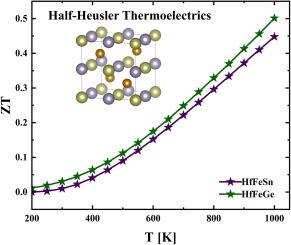
In this study, we use first-principles simulations to investigate the electrical, magnetic, mechanical, and thermoelectric properties of the half-Heusler alloys HfFeSn and HfFeGe. The equilibrium lattice constants for HfFeX (X = Sn, Ge) were found to be 6.2148 and 5.9505 Å, respectively, after structural optimization of these compounds. Both materials’ dynamical stability is confirmed by phonon dispersion analysis, and their mechanical stability is indicated by the obtained elastic constants. We used both the GGA and TB-mBJ exchange–correlation functionals to study the electronic structure. At the Fermi level, the density of states exhibits full spin polarization. Additionally, the presence of a finite band gap in the spin-down channel, which indicates semiconducting nature, and metallic behavior in the spin-up channel, confirms the half-metallic behavior. In their most stable configuration, the half-Heusler compounds display ferromagnetic ordering, with the vanadium atoms primarily responsible for this magnetism. Furthermore, an evaluation of the thermoelectric performance produced remarkable figure of merit values of 0.45 for HfFeSn and 0.50 for HfFeGe at 1000 K. These findings imply that the materials under investigation have a great deal of promise for use in spintronic and thermoelectric technologies.
HfFeX (X = Sn, Ge)半heusler合金在自旋电子和光电子应用中的自旋极化特性
在这项研究中,我们使用第一性原理模拟研究了半heusler合金HfFeSn和HfFeGe的电、磁、机械和热电性能。经过结构优化,HfFeX (X = Sn, Ge)的平衡晶格常数分别为6.2148和5.9505 Å。声子色散分析证实了两种材料的动力学稳定性,得到的弹性常数表明了两种材料的力学稳定性。我们使用GGA和TB-mBJ交换相关泛函来研究其电子结构。在费米能级,态的密度表现出充分的自旋极化。此外,在自旋向下通道中存在有限带隙,这表明半导体性质,而在自旋向上通道中存在金属行为,证实了半金属行为。在它们最稳定的结构中,半赫斯勒化合物显示出铁磁有序,钒原子主要负责这种磁性。此外,对热电性能的评价产生了显著的优点值,HfFeSn在1000 K时为0.45,HfFeGe为0.50。这些发现表明,所研究的材料在自旋电子和热电技术中具有很大的应用前景。
本文章由计算机程序翻译,如有差异,请以英文原文为准。
求助全文
约1分钟内获得全文
求助全文
来源期刊
CiteScore
7.80
自引率
2.50%
发文量
605
审稿时长
40 days
期刊介绍:
The Journal of Physics and Chemistry of Solids is a well-established international medium for publication of archival research in condensed matter and materials sciences. Areas of interest broadly include experimental and theoretical research on electronic, magnetic, spectroscopic and structural properties as well as the statistical mechanics and thermodynamics of materials. The focus is on gaining physical and chemical insight into the properties and potential applications of condensed matter systems.
Within the broad scope of the journal, beyond regular contributions, the editors have identified submissions in the following areas of physics and chemistry of solids to be of special current interest to the journal:
Low-dimensional systems
Exotic states of quantum electron matter including topological phases
Energy conversion and storage
Interfaces, nanoparticles and catalysts.
 求助内容:
求助内容: 应助结果提醒方式:

 京公网安备 11010802042870号


