
To balance between efficiency and fairness: leveraging CSR as optimal distinctive instrument
IF 9.8
1区 管理学
Q1 BUSINESS
Journal of Business Research
Pub Date : 2026-04-01
Epub Date: 2026-02-14
DOI:10.1016/j.jbusres.2026.116052
引用次数: 0
Abstract
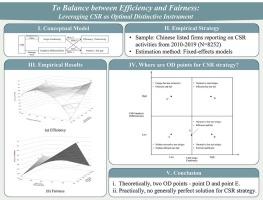
While corporate social responsibility (CSR) has become strategically vital, there is limited understanding of how to balance its conformity and differentiation. Using 8,252 firm-year observations of Chinese listed firms from 2010 to 2019, we examine how CSR scope conformity and emphasis differentiation affect firm efficiency and fairness based on optimal distinctiveness theory (ODT). In terms of efficiency, we find inverted U-shaped relationship between CSR scope conformity and total factor productivity (TFP), alleviated by CSR emphasis differentiation, and U-shaped relationship between CSR emphasis differentiation and TFP. In terms of fairness, we find that both CSR scope conformity and emphasis differentiation increase the executive-to-employee pay gap, through different channels; scope conformity increases the normal pay gap, while emphasis differentiation increases the excess pay gap, which is amplified by conformity. Thus, we can identify two OD configurations in theoretical terms. In practice, however, there is no general OD solution fits for all firms.
平衡效率与公平:利用企业社会责任作为最优的独特工具
虽然企业社会责任(CSR)在战略上变得至关重要,但人们对如何平衡其一致性和差异性的理解有限。本文基于最优独特性理论(ODT),利用2010 - 2019年8252家中国上市公司的年度观察数据,研究了企业社会责任范围整合和重点分化对企业效率和公平的影响。在效率方面,企业社会责任范围整合与全要素生产率(TFP)呈倒u型关系,并被企业社会责任重点分化所缓解;企业社会责任重点分化与全要素生产率呈u型关系。在公平性方面,我们发现企业社会责任范围一致性和重点差异化都通过不同的渠道增加了高管与员工的薪酬差距;范围整合增加了正常薪酬差距,而强调差异化增加了超额薪酬差距,而超额薪酬差距又被整合放大。因此,我们可以在理论上确定两种OD构型。然而,在实践中,没有一个通用的OD解决方案适合所有公司。
本文章由计算机程序翻译,如有差异,请以英文原文为准。
求助全文
约1分钟内获得全文
求助全文
来源期刊
Journal of Business Research
BUSINESS-
CiteScore
20.30
自引率
10.60%
发文量
956
期刊介绍:
The Journal of Business Research aims to publish research that is rigorous, relevant, and potentially impactful. It examines a wide variety of business decision contexts, processes, and activities, developing insights that are meaningful for theory, practice, and/or society at large. The research is intended to generate meaningful debates in academia and practice, that are thought provoking and have the potential to make a difference to conceptual thinking and/or practice. The Journal is published for a broad range of stakeholders, including scholars, researchers, executives, and policy makers. It aids the application of its research to practical situations and theoretical findings to the reality of the business world as well as to society. The Journal is abstracted and indexed in several databases, including Social Sciences Citation Index, ANBAR, Current Contents, Management Contents, Management Literature in Brief, PsycINFO, Information Service, RePEc, Academic Journal Guide, ABI/Inform, INSPEC, etc.
 求助内容:
求助内容: 应助结果提醒方式:

 京公网安备 11010802042870号


