
The daily growth band patterns of Tridacna derasa – Evidence from culture experiments
IF 12.7
1区 地球科学
Q1 GEOSCIENCES, MULTIDISCIPLINARY
引用次数: 0
Abstract
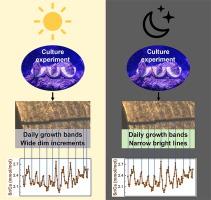
Biogeochemical archives, such as tree rings and corals, with yearly-to-monthly resolution, have been used to reconstruct past climate change. However, they can not reconstruct weather events that occurred on daily-hourly time scales. Tridacna, the largest bivalve in the world, inhabiting the tropical and subtropical Pacific-Indian Ocean regions, exhibits daily growth bands measuring ∼5 to ∼60 μm and has the facility for reconstructing past extreme weather events. However, the precise daily growth band patterns across a day remain unclear, hindering any comprehensive understanding of the daily growth band patterns of Tridacna and their climatic implications. In this study, a 30-day controlled culture experiment on Tridacna derasa was carried out to address this and explore the main factors influencing the hourly Sr/Ca profiles. Results demonstrated that wide dim increments formed during daytime while narrow bright lines formed at nighttime. The hourly Sr/Ca profiles exhibited clear daily cycles synchronized with light cycles, with higher Sr/Ca at night and lower Sr/Ca values during daytime. The Sr/Ca ratios were not constant even under constant water temperature and light intensity, suggesting a limited influence of external environment factors and highlighting the role of internal biological regulation in Sr/Ca variation. A hypothesis was proposed here: During daylight, light-driven enzymatic activity coupled with H+ removal mechanisms regulates and lowers the Sr/Ca ratio, but the enzyme species and activities may be different, thus leading the variability of Sr/Ca at the identical light intensity; During nights, the organic matrix regulation mechanisms in extrapallial fluid (EPF) predominates, leading to higher Sr/Ca values, but the composition and concentration of organic matrix are not constant, leading to the variability of nightly Sr/Ca. Our findings provide a research foundation for paleoweather/paleoenvironment studies based on Tridacna.
海砗磲的日生长带模式——来自培养实验的证据
生物地球化学档案,如年轮和珊瑚,每年到每月的分辨率,被用来重建过去的气候变化。然而,他们不能重建每天每小时时间尺度上发生的天气事件。生活在太平洋-印度洋热带和亚热带地区的砗磲是世界上最大的双壳类动物,其日生长带为~ 5 ~ ~ 60 μm,具有重现过去极端天气的能力。然而,精确的日生长带在一天内的模式仍然不清楚,阻碍了任何全面了解Tridacna的日生长带模式及其气候影响。为了解决这一问题,本研究对水蛭进行了30 d对照培养试验,探讨了影响每小时Sr/Ca曲线的主要因素。结果表明,在白天形成宽的暗淡增量,而在夜间形成窄的亮线。每小时Sr/Ca曲线表现出与光照周期同步的明显日循环,夜间Sr/Ca较高,白天Sr/Ca较低。在一定的水温和光照条件下,Sr/Ca比值也不是恒定的,表明外部环境因素对Sr/Ca的影响有限,内部生物调控在Sr/Ca变化中的作用较为突出。本文提出一种假设:在日光下,光驱动的酶活性结合H+去除机制调节和降低了Sr/Ca比,但酶的种类和活性可能不同,从而导致Sr/Ca在相同光强下的变异性;在夜间,头盖骨外液(EPF)中的有机基质调节机制占主导地位,导致Sr/Ca值较高,但有机基质的组成和浓度不恒定,导致夜间Sr/Ca值的变化。研究结果为三里纲古气候古环境研究提供了研究基础。
本文章由计算机程序翻译,如有差异,请以英文原文为准。
求助全文
约1分钟内获得全文
求助全文
来源期刊
Geoscience frontiers
Earth and Planetary Sciences-General Earth and Planetary Sciences
CiteScore
17.80
自引率
3.40%
发文量
147
审稿时长
35 days
期刊介绍:
Geoscience Frontiers (GSF) is the Journal of China University of Geosciences (Beijing) and Peking University. It publishes peer-reviewed research articles and reviews in interdisciplinary fields of Earth and Planetary Sciences. GSF covers various research areas including petrology and geochemistry, lithospheric architecture and mantle dynamics, global tectonics, economic geology and fuel exploration, geophysics, stratigraphy and paleontology, environmental and engineering geology, astrogeology, and the nexus of resources-energy-emissions-climate under Sustainable Development Goals. The journal aims to bridge innovative, provocative, and challenging concepts and models in these fields, providing insights on correlations and evolution.
 求助内容:
求助内容: 应助结果提醒方式:

 京公网安备 11010802042870号


