
Vigorous exertion, regular exercise training, and the risk of sudden cardiac death due to myocardial infarction in Swedish men
IF 2.1
Q3 PERIPHERAL VASCULAR DISEASE
International Journal of Cardiology Cardiovascular Risk and Prevention
Pub Date : 2026-06-01
Epub Date: 2026-02-03
DOI:10.1016/j.ijcrp.2026.200588
引用次数: 0
Abstract
Background
Although physical activity is associated with cardiovascular health benefits and reduced all-cause mortality, vigorous exertion is also recognized as a trigger for sudden cardiac death (SCD). This study investigated vigorous exertion as a trigger for SCD resulting from myocardial infarction (MI) and the potential modifying effect of habitual vigorous exercise training among Swedish men who subsequently experienced SCD due to MI.
Methods
This prospective nested case-crossover study was performed within the Västerbotten Intervention Programme cohort from 1985 to 2006 and included male participants who later experienced SCD caused by MI. The risk of SCD during and within 30 min of vigorous exertion was compared with the risk during periods of non-exertion. Participants were categorized into three groups according to baseline frequency of habitual vigorous exercise training to assess effect modification.
Results
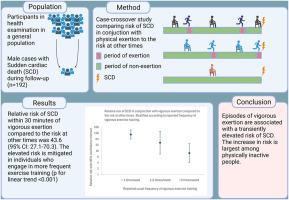
We included 192 men with SCD caused by MI, with a mean time from screening to event of 6.5 years. A majority of cases reported physical inactivity, with 161 cases reporting no exercise or <1 exercise event per week. 24 men suffered SCD in relation to vigorous exertion, yielding a relative risk of 43.6 (95% CI: 27.1-70.3) compared to non-exertion. The highest relative risk (107.7 [95% CI: 63.4-182.9]) was found among physically inactive men and was mitigated by a higher frequency of habitual exercise training at baseline.
Conclusion
Among Swedish men who experienced SCD caused by MI, vigorous exertion was associated with a transiently increased risk, which was mitigated by higher levels of habitual vigorous exercise training.
瑞典男性剧烈运动、定期运动训练与心肌梗死所致心源性猝死的风险
背景:虽然体力活动与心血管健康益处和降低全因死亡率有关,但剧烈运动也被认为是心源性猝死(SCD)的触发因素。本研究调查了剧烈运动作为心肌梗死(MI)引起的SCD的触发因素,以及习惯剧烈运动训练对随后因MI而发生SCD的瑞典男性的潜在改善作用。方法本前瞻性嵌套病例交叉研究在Västerbotten干预计划队列中进行,从1985年到2006年,包括后来因MI而发生SCD的男性参与者将剧烈运动与不运动期间的风险进行比较。参与者根据习惯性剧烈运动训练的基线频率分为三组,以评估效果的改变。结果我们纳入了192例由心肌梗死引起的SCD患者,从筛查到发病的平均时间为6.5年。大多数病例报告缺乏身体活动,161例报告不运动或每周1次运动。24名男性因剧烈运动而患SCD,与不剧烈运动相比,相对风险为43.6 (95% CI: 27.1-70.3)。在不运动的男性中发现了最高的相对风险(107.7 [95% CI: 63.4-182.9]),并且在基线时通过更高频率的习惯性运动训练来减轻。结论:在经历心肌梗死引起的SCD的瑞典男性中,剧烈运动与短暂性风险增加相关,而高水平的习惯性剧烈运动训练可以减轻这种风险。
本文章由计算机程序翻译,如有差异,请以英文原文为准。
求助全文
约1分钟内获得全文
求助全文
来源期刊

International Journal of Cardiology Cardiovascular Risk and Prevention
Cardiology and Cardiovascular Medicine
CiteScore
3.00
自引率
0.00%
发文量
0
审稿时长
72 days
 求助内容:
求助内容: 应助结果提醒方式:

 京公网安备 11010802042870号


