
Impact of hypertension on associations of all-cause mortality with admission lipoprotein (a) in acute decompensated heart failure
IF 3
Q3 PERIPHERAL VASCULAR DISEASE
International Journal of Cardiology Cardiovascular Risk and Prevention
Pub Date : 2026-06-01
Epub Date: 2026-02-07
DOI:10.1016/j.ijcrp.2026.200594
引用次数: 0
Abstract
Background and aims
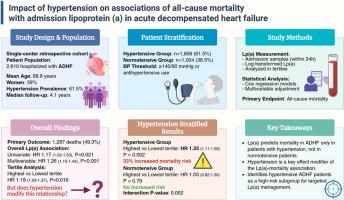
Serum lipoprotein(a) [Lp(a)] is recognized as an independent risk factor for cardiovascular disease. However, whether hypertension modifies the association between Lp(a) and adverse outcomes in acute decompensated heart failure (ADHF) remains unclear. We investigated how hypertension status influences the relationship between Lp(a) and all-cause mortality in ADHF.
Methods
We conducted a single-center retrospective observational study including 2610 patients hospitalized with ADHF. We normalized the distribution of Lp(a) by a logarithmic transformation and assessed the risk of all-cause mortality with Lp(a), using Cox regression with adjustment for potential confounders.
Results
Among 2610 patients (39.0% women; mean age, 68.8 years), 1606 (61.5%) had hypertension. Over 4.1 years (median), 1287 deaths occurred. In all patients, log-transformed Lp(a) was significantly associated with mortality (adjusted HR 1.21; 95% CI, 1.05-1.39; P = 0.007), with the highest tertile showing increased risk compared to the lowest tertile (HR 1.19; 95% CI, 1.03-1.37; P = 0.016). In ADHF combined with hypertension, Lp(a) conferred higher risk of mortality (HR, 1.35; 95% CI, 1.13-1.62; P = 0.001); and the highest tertile of Lp(a) was associated with higher risk of mortality (HR, 1.33; 95% CI, 1.11-1.59; P = 0.002) compared with the lowest tertile. However, there were no associations between mortality and Lp(a) in those without hypertension (P ≥ 0.41). The interaction between hypertension with Lp(a) was significant for mortality (P = 0.002).
Conclusions
Increased admission Lp(a) levels were associated with a higher risk of all-cause mortality in ADHF patients with hypertension. Further studies are needed to explore the mechanistic links among Lp(a), hypertension and ADHF.
高血压对急性失代偿性心力衰竭患者入院脂蛋白(a)的全因死亡率的影响
背景与目的血清脂蛋白(a) [Lp(a)]被认为是心血管疾病的独立危险因素。然而,高血压是否会改变Lp(a)与急性失代偿性心力衰竭(ADHF)不良结局之间的关系尚不清楚。我们研究了高血压状态如何影响ADHF患者Lp(a)和全因死亡率之间的关系。方法采用单中心回顾性观察研究,纳入住院ADHF患者2610例。我们通过对数变换将Lp(a)的分布归一化,并使用Cox回归对潜在混杂因素进行校正,评估Lp(a)的全因死亡率风险。结果2610例患者(女性39.0%,平均年龄68.8岁)中有高血压1606例(61.5%)。在4.1年(中位数)期间,发生了1287例死亡。在所有患者中,对数转化的Lp(a)与死亡率显著相关(校正后的风险比1.21;95% CI, 1.05-1.39; P = 0.007),与最低的五分之一相比,最高的五分之一显示出更高的风险(风险比1.19;95% CI, 1.03-1.37; P = 0.016)。在ADHF合并高血压患者中,Lp(a)具有更高的死亡风险(HR, 1.35; 95% CI, 1.13-1.62; P = 0.001);Lp(a)的最高分位数比最低分位数的死亡率更高(HR, 1.33; 95% CI, 1.11-1.59; P = 0.002)。然而,无高血压患者的死亡率与Lp(a)无相关性(P≥0.41)。高血压与Lp(a)之间的相互作用对死亡率有显著影响(P = 0.002)。结论入院时Lp(a)水平升高与ADHF合并高血压患者全因死亡率增高相关。Lp(a)与高血压和ADHF之间的机制联系有待进一步研究。
本文章由计算机程序翻译,如有差异,请以英文原文为准。
求助全文
约1分钟内获得全文
求助全文
来源期刊

International Journal of Cardiology Cardiovascular Risk and Prevention
Cardiology and Cardiovascular Medicine
CiteScore
3.00
自引率
0.00%
发文量
0
审稿时长
72 days
 求助内容:
求助内容: 应助结果提醒方式:

 京公网安备 11010802042870号


