
The impact of pullback measurement on treatment decision in significant coronary artery disease: Insights from a retrospective multicentric study
IF 2.5
Q2 CARDIAC & CARDIOVASCULAR SYSTEMS
IJC Heart and Vasculature
Pub Date : 2026-04-01
Epub Date: 2026-02-10
DOI:10.1016/j.ijcha.2026.101887
引用次数: 0
Abstract
Background
Optimal management of coronary artery disease (CAD) requires tailoring treatment strategies to lesion characteristics. Intracoronary pullback enables hemodynamic mapping of coronary lesions, potentially improving therapeutic decision-making, particularly in distinguishing focal from diffuse disease.
Objectives
To evaluate how pullback measurement influences overall treatment strategy—optimal medical therapy (OMT), percutaneous coronary intervention (PCI), or coronary artery bypass grafting (CABG)—in patients with significant CAD.
Methods
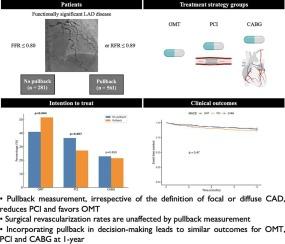
We conducted a retrospective, multicenter cohort study including 842 patients with stable angina, unstable angina, or non-ST-elevation myocardial infarction (NSTEMI) and functionally significant left anterior descending artery (LAD) disease. Patients were stratified into two groups: one group (PB group, n = 561) had pullback measurement, and the other (Conventional group, n = 281) not. Outcomes included treatment strategy, major adverse cardiovascular events (MACE), and all-cause mortality at 1 year.
Results
Pullback led to more Heart Team discussions (66.3% vs. 58.7%; p = 0.033), greater adoption of OMT (51.5% vs. 40.9%; p = 0.004), and lower PCI rates (27.1% vs. 36.3%; p = 0.007). CABG rates remained unaffected. Pullback independently increased the odds of OMT and reduced the odds of PCI (OR = 0.58, p = 0.003), while three-vessel disease strongly predicted CABG (OR = 2.51; p < 0.001). At 1 year, the PB group had higher mortality (4.3% vs. 1.1%, p = 0.013), but similar MACE compared to the Conventional group. However, clinical outcomes did not differ between treatment groups.
Conclusions
Intracoronary pullback favours a conservative treatment strategy. MACE rates are not increased at 1 year.
回拉测量对重大冠状动脉疾病治疗决策的影响:来自一项回顾性多中心研究的见解
背景:冠状动脉疾病(CAD)的最佳管理需要根据病变特征定制治疗策略。冠状动脉内回拉使得冠状动脉病变的血流动力学制图,潜在地改善治疗决策,特别是在区分局灶性疾病和弥漫性疾病方面。目的评估回拉测量对严重CAD患者的整体治疗策略——最佳药物治疗(OMT)、经皮冠状动脉介入治疗(PCI)或冠状动脉旁路移植术(CABG)的影响。方法我们进行了一项回顾性、多中心队列研究,纳入了842例稳定性心绞痛、不稳定性心绞痛或非st段抬高型心肌梗死(NSTEMI)和功能显著的左前降支(LAD)疾病患者。将患者分为两组:一组(PB组,n = 561)有回拉测量,另一组(常规组,n = 281)没有。结果包括治疗策略、主要不良心血管事件(MACE)和1年时的全因死亡率。结果回撤导致更多的心脏小组讨论(66.3%对58.7%,p = 0.033),更多的采用OMT(51.5%对40.9%,p = 0.004),更低的PCI率(27.1%对36.3%,p = 0.007)。CABG率未受影响。回拉独立增加了OMT的几率,降低了PCI的几率(OR = 0.58, p = 0.003),而三支血管疾病强烈预测CABG (OR = 2.51; p < 0.001)。1年时,PB组死亡率较高(4.3% vs. 1.1%, p = 0.013),但MACE与常规组相似。然而,临床结果在治疗组之间没有差异。结论冠状动脉后撤有利于保守治疗。MACE利率在1年内不会增加。
本文章由计算机程序翻译,如有差异,请以英文原文为准。
求助全文
约1分钟内获得全文
求助全文
来源期刊
IJC Heart and Vasculature
Medicine-Cardiology and Cardiovascular Medicine
CiteScore
4.90
自引率
10.30%
发文量
216
审稿时长
56 days
期刊介绍:
IJC Heart & Vasculature is an online-only, open-access journal dedicated to publishing original articles and reviews (also Editorials and Letters to the Editor) which report on structural and functional cardiovascular pathology, with an emphasis on imaging and disease pathophysiology. Articles must be authentic, educational, clinically relevant, and original in their content and scientific approach. IJC Heart & Vasculature requires the highest standards of scientific integrity in order to promote reliable, reproducible and verifiable research findings. All authors are advised to consult the Principles of Ethical Publishing in the International Journal of Cardiology before submitting a manuscript. Submission of a manuscript to this journal gives the publisher the right to publish that paper if it is accepted. Manuscripts may be edited to improve clarity and expression.
 求助内容:
求助内容: 应助结果提醒方式:

 京公网安备 11010802042870号


