
Highly selective catalytic hydrogenation conversion of CO2 to CO over lanthanum-doped supported ruthenium catalysts
IF 6.5
2区 环境科学与生态学
Q1 ENVIRONMENTAL SCIENCES
Journal of Environmental Sciences-china
Pub Date : 2026-05-01
Epub Date: 2025-05-25
DOI:10.1016/j.jes.2025.05.053
引用次数: 0
Abstract
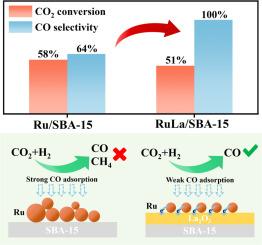
The selective catalytic hydrogenation of CO2 to CO via the RWGS reaction is an effective avenue for resource utilization of CO2. In this study, we prepared serial La2O3-doped Ru catalysts (i.e., RuLa/SBA-15) using a facile sequential impregnation method, and applied it for the selective hydrogenation conversion of CO2 into CO. The La2O3 doping remarkably promotes the dispersion of Ru nanoparticles and induces the formation of electron-deficient Ru species (Run+). In-situ DRIFTS study reveals that the hydrogenation of CO2 over Ru catalysts with and without La2O3 doping proceeds through different pathways. Both CO and CH4 are formed on non-doped Ru/SBA-15 with formate as the key intermediate, but only CO is generated on RuLa/SBA-15 via carbonate as the intermediate because of the weakened CO adsorption on Run+. Thus, RuLa/SBA-15 exhibits outstanding CO selectivity for the hydrogenation of CO2 without significant decline of activity. It achieves a CO2 conversion of 51 % at 600 °C and nearly 100 % of CO selectivity across the examined reaction temperature of 300–600 °C, surpassing the performances of the non-doped counterpart (CO2 conversion of 58 % at 600 °C and CO selectivity ranging from 2 %-63 %). This study provides a facile and cost-effective strategy to tune the structure of Ru catalysts for the hydrogenation conversion of CO2 to obtain value-added products.
镧掺杂负载钌催化剂上CO2到CO的高选择性催化加氢转化
通过RWGS反应选择性催化CO2加氢制CO是CO2资源化利用的有效途径。在本研究中,我们采用简单的顺序浸渍法制备了一系列La2O3掺杂的Ru催化剂(即RuLa/SBA-15),并将其应用于CO2选择性加氢转化为CO。La2O3掺杂显著促进了Ru纳米颗粒的分散,诱导了缺电子Ru物质(Run+)的形成。原位DRIFTS研究表明,掺杂和未掺杂La2O3的Ru催化剂上CO2的加氢通过不同的途径进行。在未掺杂的Ru/SBA-15上,以甲酸盐为关键中间体生成CO和CH4,但由于Run+对CO的吸附减弱,以碳酸盐为中间体在rua /SBA-15上只生成CO。因此,RuLa/SBA-15对CO2的加氢表现出出色的CO选择性,而活性没有明显下降。在600°C下,它的CO2转化率为51%,在300-600°C的反应温度下,CO选择性接近100%,超过了未掺杂的对应物的性能(600°C下CO2转化率为58%,CO选择性范围为2% - 63%)。该研究为调整Ru催化剂的结构以实现CO2加氢转化以获得高附加值产品提供了一种简单而经济的策略。
本文章由计算机程序翻译,如有差异,请以英文原文为准。
求助全文
约1分钟内获得全文
求助全文
来源期刊
Journal of Environmental Sciences-china
环境科学-环境科学
CiteScore
13.70
自引率
0.00%
发文量
6354
审稿时长
2.6 months
期刊介绍:
The Journal of Environmental Sciences is an international journal started in 1989. The journal is devoted to publish original, peer-reviewed research papers on main aspects of environmental sciences, such as environmental chemistry, environmental biology, ecology, geosciences and environmental physics. Appropriate subjects include basic and applied research on atmospheric, terrestrial and aquatic environments, pollution control and abatement technology, conservation of natural resources, environmental health and toxicology. Announcements of international environmental science meetings and other recent information are also included.
 求助内容:
求助内容: 应助结果提醒方式:

 京公网安备 11010802042870号


