
Valorization of agricultural residues for bioplastic production by bacteria isolated from plastic dumpsites: Integrating waste streams into the circular bioeconomy
Q1 Immunology and Microbiology
引用次数: 0
Abstract
Polyhydroxybutyrate (PHB) is a biodegradable polymer produced by bacteria under nutrient-limiting conditions, offering a sustainable alternative to petroleum plastics. This study investigated PHB production by bacterial isolates from plastic-contaminated soils. Forty isolates were screened using Sudan Black B, Nile Blue A, and Nile Red; 12 tested positive, and 11 promising strains belonging to genera, Corynebacterium, Bacillus, Micrococcus, Arthrobacter, and Sinomonas were selected for detailed study. Cultivation in nutrient-limiting medium with 2% sugars (fructose, glucose, sucrose, galactose, mannitol) or agro-wastes (cassava wastewater, cassava and potato peels) revealed strain- and substrate-dependent PHB accumulation, peaking at 24–96 h. Micrococcus sp. OO(14)-5 produced the highest PHB content (0.15 g/L) on mannitol, while Corynebacterium sp. FT(1)-6 and Bacillus sp. GO(10)-6 yielded 3.2–3.4 g/L and ∼60% PHB/CDW on cassava wastewater. Other isolates produced >2.7 g/L on peels. Fourier-transform infrared spectroscopy confirmed PHB. These findings highlight low-cost agro-wastes as effective substrates for sustainable PHB production.
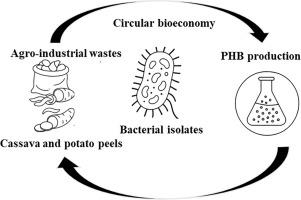
从塑料垃圾场分离的细菌对农业残留物进行生物塑料生产的增值:将废物流纳入循环生物经济
聚羟基丁酸酯(PHB)是一种在营养限制条件下由细菌产生的可生物降解聚合物,是石油塑料的可持续替代品。研究了从塑料污染土壤中分离出的细菌产生PHB的情况。用苏丹黑B、尼罗河蓝A和尼罗河红筛选出40株分离物;选取杆状杆菌属、芽孢杆菌属、微球菌属、节杆菌属、单胞菌属等11株有潜力的菌株进行详细研究。在含2%糖(果糖、葡萄糖、蔗糖、半乳糖、甘露醇)或农业废弃物(木薯废水、木薯和马铃薯皮)的限营养培养基中培养,发现菌株和底物依赖PHB积累,在24-96 h达到峰值。微球菌OO(14)-5在甘露醇上产生最高的PHB含量(0.15 g/L),而棒状杆菌FT(1)-6和芽孢杆菌GO(10)-6在木薯废水上产生3.2-3.4 g/L和~ 60% PHB/CDW。其他分离株在果皮上的产量为2.7 g/L。傅里叶变换红外光谱证实PHB。这些发现突出表明,低成本的农业废弃物是可持续生产PHB的有效基质。
本文章由计算机程序翻译,如有差异,请以英文原文为准。
求助全文
约1分钟内获得全文
求助全文
来源期刊
Biotechnology Reports
Immunology and Microbiology-Applied Microbiology and Biotechnology
CiteScore
15.80
自引率
0.00%
发文量
79
审稿时长
55 days
期刊介绍:
Biotechnology Reports covers all aspects of Biotechnology particularly those reports that are useful and informative and that will be of value to other researchers in related fields. Biotechnology Reports loves ground breaking science, but will also accept good science that can be of use to the biotechnology community. The journal maintains a high quality peer review where submissions are considered on the basis of scientific validity and technical quality. Acceptable paper types are research articles (short or full communications), methods, mini-reviews, and commentaries in the following areas: Healthcare and pharmaceutical biotechnology Agricultural and food biotechnology Environmental biotechnology Molecular biology, cell and tissue engineering and synthetic biology Industrial biotechnology, biofuels and bioenergy Nanobiotechnology Bioinformatics & systems biology New processes and products in biotechnology, bioprocess engineering.
 求助内容:
求助内容: 应助结果提醒方式:

 京公网安备 11010802042870号


