
PlatROB: An open-source, modular, and low-cost hardware platform for mobile robotics and AI education
IF 2.1
Q3 ENGINEERING, ELECTRICAL & ELECTRONIC
引用次数: 0
Abstract
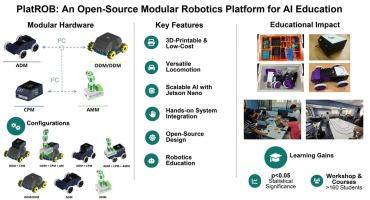
This paper introduces PlatROB, an open-source, modular, and low-cost educational robotics platform designed to facilitate hands-on learning in robotics and AI through system integration. PlatROB comprises four 3D-printable, classroom-ready modules: an Ackermann Drive Module (ADM), an Omnidirectional/Differential Drive Module (ODM/DDM), a Control and Processing Module (CPM) with NVIDIA Jetson Nano, and a 4-DoF Articulated Manipulation Module (AMM). Inter-module communication uses standardized I2C over DB9 connectors, integrating Arduino microcontrollers, motor drivers, encoders, IMUs, and ultrasonic sensors. Module costs range from $129 to $341. Performance validation shows the ADM supports 10 kg payload, achieves 25 cm turning radius and has 120 min autonomy (3 kg load), while the CPM sustains 40–100 min operation depending on neural-network workloads. The AMM provides 450 g payload capacity for introductory manipulation tasks. Successfully deployed in workshops and university courses with over 160 learners, demonstrating significant learning gains (p < 0.05) across academic levels and enabling teleoperation and autonomous navigation projects. All mechanical and electronic design files, build manuals, and validation code are open-source to support replication in resource-constrained settings. By providing a scalable, documented hardware-software stack compatible with ROS/ROS2, PlatROB lowers barriers to experiential learning in SLAM, perception, and advanced autonomy.
PlatROB:一个开源、模块化、低成本的移动机器人和人工智能教育硬件平台
本文介绍了PlatROB,一个开源、模块化、低成本的教育机器人平台,旨在通过系统集成促进机器人和人工智能的实践学习。PlatROB包括四个3d打印的教室准备模块:阿克曼驱动模块(ADM),全向/差分驱动模块(ODM/DDM),控制和处理模块(CPM)与NVIDIA Jetson Nano,和一个4自由度关节操纵模块(AMM)。模块间通信使用标准化的I2C通过DB9连接器,集成Arduino微控制器,电机驱动器,编码器,imu和超声波传感器。模块费用从129美元到341美元不等。性能验证表明,ADM支持10公斤载荷,实现25厘米转弯半径,具有120分钟的自主性(3公斤载荷),而CPM根据神经网络负载维持40-100分钟的运行。AMM为入门操作任务提供450克有效载荷能力。成功部署在研讨会和大学课程中,超过160名学习者,展示了跨学术水平的显着学习收益(p < 0.05),并实现了远程操作和自主导航项目。所有机械和电子设计文件、构建手册和验证代码都是开源的,以支持资源受限设置中的复制。通过提供与ROS/ROS2兼容的可扩展的、文档化的软硬件堆栈,PlatROB降低了SLAM、感知和高级自主体验学习的障碍。
本文章由计算机程序翻译,如有差异,请以英文原文为准。
求助全文
约1分钟内获得全文
求助全文
来源期刊
HardwareX
Engineering-Industrial and Manufacturing Engineering
CiteScore
4.10
自引率
18.20%
发文量
124
审稿时长
24 weeks
期刊介绍:
HardwareX is an open access journal established to promote free and open source designing, building and customizing of scientific infrastructure (hardware). HardwareX aims to recognize researchers for the time and effort in developing scientific infrastructure while providing end-users with sufficient information to replicate and validate the advances presented. HardwareX is open to input from all scientific, technological and medical disciplines. Scientific infrastructure will be interpreted in the broadest sense. Including hardware modifications to existing infrastructure, sensors and tools that perform measurements and other functions outside of the traditional lab setting (such as wearables, air/water quality sensors, and low cost alternatives to existing tools), and the creation of wholly new tools for either standard or novel laboratory tasks. Authors are encouraged to submit hardware developments that address all aspects of science, not only the final measurement, for example, enhancements in sample preparation and handling, user safety, and quality control. The use of distributed digital manufacturing strategies (e.g. 3-D printing) is encouraged. All designs must be submitted under an open hardware license.
 求助内容:
求助内容: 应助结果提醒方式:

 京公网安备 11010802042870号


