
Ultrasound-driven structural and functional modifications of grape seed protein revealed by power- and duration-dependent experiments
IF 11
1区 农林科学
Q1 CHEMISTRY, APPLIED
引用次数: 0
Abstract
The study aimed to investigate the effects of ultrasound treatment, varying in power and duration, on the solution behavior, multi-level structure, and functional properties of grape seed protein (GSP). Ultrasound significantly enhanced the functional properties of GSP, with optimal improvements at 400 W for 10 min. However, excessive treatment reduced these benefits. SDS-PAGE analysis confirmed the integrity of the primary protein structure after treatment. Circular dichroism spectroscopy revealed a reduction in ordered/stable protein secondary structures (α-helix and β-sheet content, significantly decreased by 24.86% and 21.03% under the optimal ultrasound conditions, respectively, compared to untreated GSP), which was further corroborated by Fourier transform infrared spectroscopy. Intrinsic fluorescence spectroscopy demonstrated significant alterations in the tertiary structure of GSP. Ultrasound treatment improved free sulfhydryl content and surface hydrophobicity (significantly increased by 41.05% and 45.27%, respectively), thereby decreasing protein aggregation. Ultrasound treatment also reduced particle size and increased zeta potential (significantly changed by 54.97% and 24.58%, respectively), promoting protein unfolding and exposure of hydrophobic groups. These structural changes improved its solubility, gel strength, emulsifying and foaming properties, digestibility, and antioxidant activity. Notably, ultrasonication did not induce noticeable oxidative damage to the protein, as the carbonyl groups content increased by only approximately 20%. Collectively, these results demonstrate that properly controlled ultrasound treatment can significantly optimize the structure of GSP, thereby enhancing its functional performance and expanding its potential applications in the food industry.
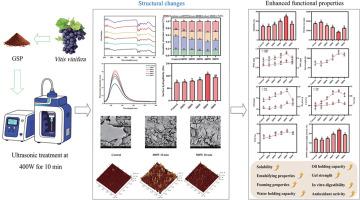
超声驱动的葡萄籽蛋白的结构和功能修饰,通过功率和持续时间依赖实验揭示
本研究旨在探讨不同功率和时间超声处理对葡萄籽蛋白(GSP)溶液行为、多层次结构和功能特性的影响。超声显著增强了GSP的功能特性,在400 W下10 min的改善效果最佳。然而,过度治疗降低了这些益处。SDS-PAGE分析证实了处理后初级蛋白结构的完整性。圆二色光谱显示,与未处理的GSP相比,最佳超声条件下有序/稳定的蛋白质二级结构(α-螺旋和β-片)含量分别显著降低了24.86%和21.03%,傅里叶变换红外光谱进一步证实了这一点。本征荧光光谱显示GSP的三级结构发生了显著变化。超声处理提高了游离巯基含量和表面疏水性(分别显著提高41.05%和45.27%),从而降低了蛋白质聚集。超声处理还降低了颗粒大小,增加了zeta电位(分别显著改变54.97%和24.58%),促进了蛋白质的展开和疏水基团的暴露。这些结构变化改善了其溶解度、凝胶强度、乳化和发泡性能、消化率和抗氧化活性。值得注意的是,超声波对蛋白质没有引起明显的氧化损伤,因为羰基含量仅增加了约20%。综上所述,合理控制超声处理可以显著优化GSP的结构,从而增强其功能性能,扩大其在食品工业中的潜在应用。
本文章由计算机程序翻译,如有差异,请以英文原文为准。
求助全文
约1分钟内获得全文
求助全文
来源期刊
Food Hydrocolloids
工程技术-食品科技
CiteScore
19.90
自引率
14.00%
发文量
871
审稿时长
37 days
期刊介绍:
Food Hydrocolloids publishes original and innovative research focused on the characterization, functional properties, and applications of hydrocolloid materials used in food products. These hydrocolloids, defined as polysaccharides and proteins of commercial importance, are added to control aspects such as texture, stability, rheology, and sensory properties. The research's primary emphasis should be on the hydrocolloids themselves, with thorough descriptions of their source, nature, and physicochemical characteristics. Manuscripts are expected to clearly outline specific aims and objectives, include a fundamental discussion of research findings at the molecular level, and address the significance of the results. Studies on hydrocolloids in complex formulations should concentrate on their overall properties and mechanisms of action, while simple formulation development studies may not be considered for publication.
The main areas of interest are:
-Chemical and physicochemical characterisation
Thermal properties including glass transitions and conformational changes-
Rheological properties including viscosity, viscoelastic properties and gelation behaviour-
The influence on organoleptic properties-
Interfacial properties including stabilisation of dispersions, emulsions and foams-
Film forming properties with application to edible films and active packaging-
Encapsulation and controlled release of active compounds-
The influence on health including their role as dietary fibre-
Manipulation of hydrocolloid structure and functionality through chemical, biochemical and physical processes-
New hydrocolloids and hydrocolloid sources of commercial potential.
The Journal also publishes Review articles that provide an overview of the latest developments in topics of specific interest to researchers in this field of activity.
 求助内容:
求助内容: 应助结果提醒方式:

 京公网安备 11010802042870号


