
Rapid magnetic solid-phase extraction approach employing a modified graphene oxide nanomaterial for the determination of 20 pharmaceuticals and transformation products in treated urban wastewater
IF 6.7
1区 化学
Q1 CHEMISTRY, ANALYTICAL
引用次数: 0
Abstract
A magnetic solid-phase extraction (MSPE) method based on a green magnetic graphene oxide material (d-M@GO) was developed and validated for the simultaneous determination of 20 contaminants of emerging concern (CECs), including pharmaceuticals and transformation products, in wastewater using liquid chromatography–high-resolution mass spectrometry (LC-HRMS). The adsorption behaviour of analytes on d-M@GO was investigated through kinetic and equilibrium modelling, indicating mass-transfer-limited adsorption consistent with a linear isotherm. A two-zone kinetic model, accounting for fast and slow adsorption regions, provided the best fitting for most compounds, confirming the coexistence of easily accessible and diffusion-limited adsorption sites.
The MSPE procedure was optimised to establish the most efficient adsorption and elution conditions. Method validation in treated urban wastewater demonstrated its suitability as a green alternative to conventional solid-phase extraction. Eighteen of the twenty analytes showed recoveries between 70% and 120%, with RSDs below 20%. Low method quantification limits (MQLs) were determined, ranging from 2 to 20 ng/L. Application of the method for the analysis of five wastewater samples enabled the quantification of up to 19 analytes at concentrations ranging from 6.37 to 1321 ng/L. In addition, non-target screening using MS-DIAL open-source software (a platform for untargeted metabolomics and lipidomics data processing) expanded the analytical scope, allowing the tentative identification of 24 additional CECs, five of which were confirmed using reference standards. The combination of target and non-target analyses demonstrates the capability of the method for comprehensive monitoring of CECs in wastewater. With a 60–70% lower carbon footprint than conventional SPE approaches, the d-M@GO-MSPE–LC-HRMS workflow represents a robust, rapid, and sustainable solution.
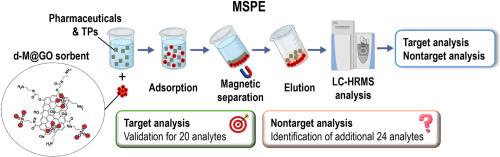
采用改性氧化石墨烯纳米材料的快速磁固相萃取法测定处理过的城市废水中的20种药物和转化产物
基于绿色磁性氧化石墨烯材料(d-M@GO)的磁固相萃取(MSPE)方法被开发并验证,用于使用液相色谱-高分辨率质谱(LC-HRMS)同时测定废水中的20种新关注污染物(CECs),包括药品和转化产品。通过动力学和平衡模型研究了分析物在d-M@GO上的吸附行为,表明传质限制吸附符合线性等温线。考虑快速和慢速吸附区域的两区动力学模型对大多数化合物提供了最佳拟合,证实了容易接近和扩散限制的吸附位点共存。优化了MSPE的吸附和洗脱条件。方法在处理后的城市废水中验证了其作为传统固相萃取的绿色替代品的适用性。其中18种加样回收率在70% ~ 120%之间,rsd < 20%。测定了低定量限(MQLs),范围为2 ~ 20 ng/L。应用该方法对5个废水样品进行分析,可以定量分析多达19种浓度范围为6.37至1321 ng/L的分析物。此外,使用MS-DIAL开源软件(非靶向代谢组学和脂质组学数据处理平台)进行非靶标筛选扩大了分析范围,允许初步鉴定24个额外的CECs,其中5个使用参考标准得到确认。目标分析和非目标分析相结合,证明了该方法综合监测废水中CECs的能力。与传统的SPE方法相比,d-M@GO-MSPE -LC-HRMS的碳足迹降低了60-70%,是一种强大、快速、可持续的解决方案。
本文章由计算机程序翻译,如有差异,请以英文原文为准。
求助全文
约1分钟内获得全文
求助全文
来源期刊
Talanta
化学-分析化学
CiteScore
12.30
自引率
4.90%
发文量
861
审稿时长
29 days
期刊介绍:
Talanta provides a forum for the publication of original research papers, short communications, and critical reviews in all branches of pure and applied analytical chemistry. Papers are evaluated based on established guidelines, including the fundamental nature of the study, scientific novelty, substantial improvement or advantage over existing technology or methods, and demonstrated analytical applicability. Original research papers on fundamental studies, and on novel sensor and instrumentation developments, are encouraged. Novel or improved applications in areas such as clinical and biological chemistry, environmental analysis, geochemistry, materials science and engineering, and analytical platforms for omics development are welcome.
Analytical performance of methods should be determined, including interference and matrix effects, and methods should be validated by comparison with a standard method, or analysis of a certified reference material. Simple spiking recoveries may not be sufficient. The developed method should especially comprise information on selectivity, sensitivity, detection limits, accuracy, and reliability. However, applying official validation or robustness studies to a routine method or technique does not necessarily constitute novelty. Proper statistical treatment of the data should be provided. Relevant literature should be cited, including related publications by the authors, and authors should discuss how their proposed methodology compares with previously reported methods.
 求助内容:
求助内容: 应助结果提醒方式:

 京公网安备 11010802042870号


