
Facile fabrication of Fe-BTC/PANI/g-C3N4 nanocomposite for improving electrochemical properties of supercapacitors
IF 8.3
2区 工程技术
Q1 CHEMISTRY, PHYSICAL
International Journal of Hydrogen Energy
Pub Date : 2026-03-17
Epub Date: 2026-02-13
DOI:10.1016/j.ijhydene.2026.154019
引用次数: 0
Abstract
Escalating global energy demands and environmental challenges have intensified research efforts toward the development of advanced energy storage technologies. Supercapacitors (SCs) have gained prominence as potential energy storage systems because of their superior power density, rapid charge–discharge performance, and remarkable cycling durability. In this study, a novel hybrid nanocomposite electrode composed of Fe-BTC, polyaniline (PANI), and graphitic carbon nitride (g-C3N4) (referred to as FPG) was synthesized for supercapacitor applications. The structural configuration and morphological traits of the FPG nanocomposite were thoroughly investigated using Fourier transform infrared spectroscopy, X-ray diffraction analysis, field emission scanning electron microscopy, transmission electron microscopy, and Brunauer−Emmett−Teller method. Electrochemical performance was evaluated through cyclic voltammetry, galvanostatic charge-discharge, and electrochemical impedance spectroscopy. The FPG electrode exhibited a specific capacitance of 790 F/g at 1 A/g, significantly outperforming the individual components. Furthermore, the composite exhibited excellent cycling stability, retaining 92% of its initial capacitance after 1000 cycles. These enhancements are attributed to the synergistic effects between Fe-BTC, PANI, and g-C3N4, which improve conductivity, active surface area, and ion transport. These observations highlight the potential of the FPG nanocomposite to function as an efficient electrode material in high-performance supercapacitors.
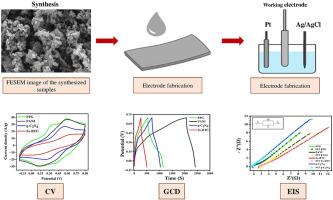
Fe-BTC/PANI/g-C3N4纳米复合材料的制备及其对超级电容器电化学性能的改善
不断升级的全球能源需求和环境挑战加大了对先进储能技术的研究力度。超级电容器(SCs)由于其优越的功率密度、快速的充放电性能和卓越的循环耐久性而成为潜在的储能系统。在这项研究中,合成了一种由Fe-BTC、聚苯胺(PANI)和石墨氮化碳(g-C3N4)(简称FPG)组成的新型杂化纳米复合电极,用于超级电容器的应用。利用傅里叶变换红外光谱、x射线衍射分析、场发射扫描电镜、透射电镜和Brunauer - Emmett - Teller方法对FPG纳米复合材料的结构构型和形态特征进行了深入的研究。通过循环伏安法、恒流充放电法和电化学阻抗法对其电化学性能进行了评价。FPG电极在1 a /g时的比电容为790 F/g,显著优于单个元件。此外,该复合材料表现出优异的循环稳定性,在1000次循环后仍保持92%的初始电容。这些增强是由于Fe-BTC, PANI和g-C3N4之间的协同作用,从而提高了电导率,活性表面积和离子传输。这些观察结果突出了FPG纳米复合材料作为高性能超级电容器中有效电极材料的潜力。
本文章由计算机程序翻译,如有差异,请以英文原文为准。
求助全文
约1分钟内获得全文
求助全文
来源期刊
International Journal of Hydrogen Energy
工程技术-环境科学
CiteScore
13.50
自引率
25.00%
发文量
3502
审稿时长
60 days
期刊介绍:
The objective of the International Journal of Hydrogen Energy is to facilitate the exchange of new ideas, technological advancements, and research findings in the field of Hydrogen Energy among scientists and engineers worldwide. This journal showcases original research, both analytical and experimental, covering various aspects of Hydrogen Energy. These include production, storage, transmission, utilization, enabling technologies, environmental impact, economic considerations, and global perspectives on hydrogen and its carriers such as NH3, CH4, alcohols, etc.
The utilization aspect encompasses various methods such as thermochemical (combustion), photochemical, electrochemical (fuel cells), and nuclear conversion of hydrogen, hydrogen isotopes, and hydrogen carriers into thermal, mechanical, and electrical energies. The applications of these energies can be found in transportation (including aerospace), industrial, commercial, and residential sectors.
 求助内容:
求助内容: 应助结果提醒方式:

 京公网安备 11010802042870号


