
Preparation of phosphor bronze powders by arc erosion of wires: Microstructure and mechanical properties
IF 5.5
2区 工程技术
Q2 ENGINEERING, CHEMICAL
引用次数: 0
Abstract
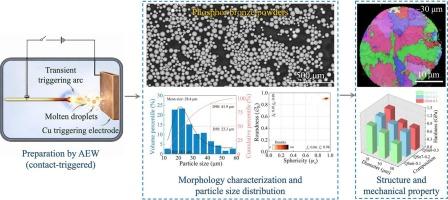
The rapid development of the new-energy industry has placed increasing demands on connectors. Additive manufacturing provides an effective strategy for fabricating complex connector contact components, for which phosphor bronze powder is a promising feedstock owing to its excellent mechanical strength and electrical conductivity. To meet these requirements, high-quality phosphor bronze powders were prepared in this study using the arc erosion of wires (AEW) method. Spherical QSn6–0.1, QSn7–0.2, and QSn8–0.3 powders with smooth surface and low satellite content were successfully produced. Their solidification structure and mechanical properties were systematically examined using X-ray diffraction, scanning electron microscopy, and single-powder compression testing. All powders consist primarily of α-Cu and δ-Cu41Sn11 phases despite the difference in composition. The ultrahigh cooling rate during AEW promotes uniform solidification structure without apparent defects and effectively suppresses Sn inverse segregation. Powder diameter, rather than composition, dominates the solidification behavior: smaller powders experience faster cooling, resulting in finer solidification structures and smaller secondary dendrite arm spacing. Single-powder compression tests reveal that powder hardness increases with decreasing diameter. Analysis of the strain-hardening rate indicates a size-dependent deformation mechanism: larger powders exhibit a pronounced hardening peak associated with the formation of stacking faults due to the alloy's low stacking-fault energy, whereas this effect is suppressed in smaller powders. This study presents a novel method for producing phosphor bronze powders, and the findings offer valuable insights into tailoring their solidification and mechanical behavior for additive manufacturing applications.
电弧冲蚀法制备磷青铜粉末:显微结构和力学性能
新能源产业的快速发展对连接器提出了越来越高的要求。增材制造为制造复杂的连接器接触元件提供了一种有效的策略,而磷青铜粉因其优异的机械强度和导电性而成为一种很有前途的原料。为了满足这些要求,本研究采用电弧侵蚀法(AEW)制备了高质量的磷青铜粉末。成功制备了表面光滑、卫星含量低的球形QSn6-0.1、QSn7-0.2和QSn8-0.3粉末。采用x射线衍射、扫描电镜和单粉压缩试验对其凝固组织和力学性能进行了系统的研究。粉末主要由α-Cu相和δ-Cu41Sn11相组成。在AEW过程中,超高的冷却速率促进了凝固组织的均匀,没有明显的缺陷,并有效地抑制了Sn的反偏析。粉末直径,而不是成分,决定了凝固行为:较小的粉末经历更快的冷却,导致更细的凝固组织和更小的二次枝晶臂间距。单粉压缩试验表明,粉末硬度随直径的减小而增大。对应变硬化率的分析表明,变形机制与尺寸有关:较大的粉末表现出明显的硬化峰,这与合金的低层错能导致的层错形成有关,而较小的粉末则抑制了这种效应。本研究提出了一种生产磷青铜粉的新方法,研究结果为增材制造应用中定制其凝固和机械行为提供了有价值的见解。
本文章由计算机程序翻译,如有差异,请以英文原文为准。
求助全文
约1分钟内获得全文
求助全文
来源期刊
Powder Technology
工程技术-工程:化工
CiteScore
9.90
自引率
15.40%
发文量
1047
审稿时长
46 days
期刊介绍:
Powder Technology is an International Journal on the Science and Technology of Wet and Dry Particulate Systems. Powder Technology publishes papers on all aspects of the formation of particles and their characterisation and on the study of systems containing particulate solids. No limitation is imposed on the size of the particles, which may range from nanometre scale, as in pigments or aerosols, to that of mined or quarried materials. The following list of topics is not intended to be comprehensive, but rather to indicate typical subjects which fall within the scope of the journal's interests:
Formation and synthesis of particles by precipitation and other methods.
Modification of particles by agglomeration, coating, comminution and attrition.
Characterisation of the size, shape, surface area, pore structure and strength of particles and agglomerates (including the origins and effects of inter particle forces).
Packing, failure, flow and permeability of assemblies of particles.
Particle-particle interactions and suspension rheology.
Handling and processing operations such as slurry flow, fluidization, pneumatic conveying.
Interactions between particles and their environment, including delivery of particulate products to the body.
Applications of particle technology in production of pharmaceuticals, chemicals, foods, pigments, structural, and functional materials and in environmental and energy related matters.
For materials-oriented contributions we are looking for articles revealing the effect of particle/powder characteristics (size, morphology and composition, in that order) on material performance or functionality and, ideally, comparison to any industrial standard.
 求助内容:
求助内容: 应助结果提醒方式:

 京公网安备 11010802042870号


