
Nanocoordinated Zn-Baicalein: Merging triple mechanisms with photothermal action for enhanced bacterial eradication
IF 4.2
3区 工程技术
Q2 CHEMISTRY, APPLIED
引用次数: 0
Abstract
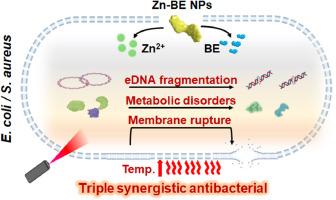
The escalating incidence of antibacterial resistance presents a formidable challenge in managing bacterial infections. Traditional Zn-based antibacterial agents face limitations due to their reliance on ultraviolet activation and potential neurotoxicity. The combination of nanotechnology and traditional Chinese medicine (TCM) not only reduces the side effects of Zn2+ but also enhances therapeutic efficacy. In this study, we synthesized Zn-baicalein nanoparticles (Zn-BE NPs) that self-assemble through chemical coordination, offering broad-spectrum antibacterial capabilities. The Zn component exhibited inherent antibacterial properties by disrupting the synthesis of bacterial metabolic enzymes and destroying genetic factors. Baicalein (BE), derived from Scutellaria, enhanced the NPs’ antibacterial efficacy by disrupting bacterial membranes and facilitating Zn2+ influx, leading to cell wall rupture and metabolic disruption. In addition, Zn-BE NPs exhibited excellent photothermal conversion efficiency, enabling effective bactericidal action under near-infrared irradiation. This triple synergistic mechanism not only overcame the limitations of conventional Zn-based therapies but also sustained long-term antibacterial activity by preventing rapid bacterial metabolism. Our findings demonstrated that Zn-BE NPs could achieve complete bacterial eradication, showcasing expected potential in addressing antibacterial resistance. This research laid a foundation for the development of safer and more effective antibacterial agents, with implications for future applications in combating resistant infections.
纳米配位锌-黄芩苷:融合三重机制与光热作用增强细菌根除
抗菌药物耐药性的不断上升对细菌感染的管理提出了严峻的挑战。传统的锌基抗菌剂由于依赖紫外线激活和潜在的神经毒性而面临局限性。纳米技术与中药的结合不仅可以减少Zn2+的副作用,而且可以提高治疗效果。在这项研究中,我们合成了通过化学配位自组装的锌-黄芩素纳米粒子(Zn-BE NPs),具有广谱抗菌能力。锌组分通过破坏细菌代谢酶的合成和破坏遗传因子表现出固有的抗菌特性。黄芩苷(Baicalein, BE)通过破坏细菌膜,促进Zn2+内流,导致细胞壁破裂和代谢紊乱,从而增强NPs的抗菌作用。此外,Zn-BE NPs表现出优异的光热转换效率,在近红外照射下具有有效的杀菌作用。这种三重协同机制不仅克服了传统锌基治疗的局限性,而且通过防止细菌快速代谢而保持长期的抗菌活性。我们的研究结果表明,Zn-BE NPs可以完全根除细菌,显示出解决抗菌耐药性的预期潜力。该研究为开发更安全、更有效的抗菌剂奠定了基础,对今后在抗耐药感染方面的应用具有重要意义。
本文章由计算机程序翻译,如有差异,请以英文原文为准。
求助全文
约1分钟内获得全文
求助全文
来源期刊
Dyes and Pigments
工程技术-材料科学:纺织
CiteScore
8.20
自引率
13.30%
发文量
933
审稿时长
33 days
期刊介绍:
Dyes and Pigments covers the scientific and technical aspects of the chemistry and physics of dyes, pigments and their intermediates. Emphasis is placed on the properties of the colouring matters themselves rather than on their applications or the system in which they may be applied.
Thus the journal accepts research and review papers on the synthesis of dyes, pigments and intermediates, their physical or chemical properties, e.g. spectroscopic, surface, solution or solid state characteristics, the physical aspects of their preparation, e.g. precipitation, nucleation and growth, crystal formation, liquid crystalline characteristics, their photochemical, ecological or biological properties and the relationship between colour and chemical constitution. However, papers are considered which deal with the more fundamental aspects of colourant application and of the interactions of colourants with substrates or media.
The journal will interest a wide variety of workers in a range of disciplines whose work involves dyes, pigments and their intermediates, and provides a platform for investigators with common interests but diverse fields of activity such as cosmetics, reprographics, dye and pigment synthesis, medical research, polymers, etc.
 求助内容:
求助内容: 应助结果提醒方式:

 京公网安备 11010802042870号


