
Recent progress of Si-rhodamine-based probes in intracellular imaging of metal ions and small molecules
IF 4.2
3区 工程技术
Q2 CHEMISTRY, APPLIED
引用次数: 0
Abstract
Si-rhodamines exhibit exceptional photostability and tunable near-infrared emission wavelengths, rendering them highly versatile tools for bioimaging applications—including cellular imaging, super-resolution imaging, in vivo imaging, and the detection of biological small molecules. Driven by the growing interest in Si-rhodamine-based probes and their significant potential for intracellular imaging of metal ions and small molecules, herein we systematically summarize the remarkable advancements in Si-rhodamine-derived fluorescent probes for this purpose. By elaborating on the design principles, reaction mechanisms, and biological applications of probes targeting a broad spectrum of analytes, encompassing metal ions (e.g., Mg2+, Ca2+, Cu+, Cu2+, Hg2+, Zn2+) and small molecules (e.g., HOCl, NO, formaldehyde, H2S), we delineate how the superior photophysical properties of the Si-rhodamine scaffold underpin their robust performance in intracellular sensing. Furthermore, this review discusses key remaining challenges in the field and highlights promising future opportunities, providing valuable insights to guide subsequent research endeavors in the development of advanced Si-rhodamine-based imaging tools.
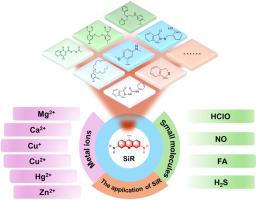
硅罗丹明基探针在金属离子和小分子细胞内成像中的最新进展
si -罗丹明具有优异的光稳定性和可调的近红外发射波长,使其成为生物成像应用的高度通用工具,包括细胞成像、超分辨率成像、体内成像和生物小分子检测。由于人们对基于硅罗丹明的探针越来越感兴趣,以及它们在金属离子和小分子的细胞内成像方面的巨大潜力,我们在这里系统地总结了硅罗丹明衍生的荧光探针在这方面的显著进展。通过详细阐述探针的设计原理、反应机制和生物应用,针对广泛的分析物,包括金属离子(如Mg2+、Ca2+、Cu+、Cu2+、Hg2+、Zn2+)和小分子(如HOCl、NO、甲醛、H2S),我们描述了si -罗丹明支架优越的光物理特性如何支撑其在细胞内传感中的强大性能。此外,本综述讨论了该领域的关键挑战,并强调了有希望的未来机会,为指导后续开发先进的si -罗丹明成像工具的研究工作提供了有价值的见解。
本文章由计算机程序翻译,如有差异,请以英文原文为准。
求助全文
约1分钟内获得全文
求助全文
来源期刊
Dyes and Pigments
工程技术-材料科学:纺织
CiteScore
8.20
自引率
13.30%
发文量
933
审稿时长
33 days
期刊介绍:
Dyes and Pigments covers the scientific and technical aspects of the chemistry and physics of dyes, pigments and their intermediates. Emphasis is placed on the properties of the colouring matters themselves rather than on their applications or the system in which they may be applied.
Thus the journal accepts research and review papers on the synthesis of dyes, pigments and intermediates, their physical or chemical properties, e.g. spectroscopic, surface, solution or solid state characteristics, the physical aspects of their preparation, e.g. precipitation, nucleation and growth, crystal formation, liquid crystalline characteristics, their photochemical, ecological or biological properties and the relationship between colour and chemical constitution. However, papers are considered which deal with the more fundamental aspects of colourant application and of the interactions of colourants with substrates or media.
The journal will interest a wide variety of workers in a range of disciplines whose work involves dyes, pigments and their intermediates, and provides a platform for investigators with common interests but diverse fields of activity such as cosmetics, reprographics, dye and pigment synthesis, medical research, polymers, etc.
 求助内容:
求助内容: 应助结果提醒方式:

 京公网安备 11010802042870号


