
Study on powder physical and compression properties of mannitol: Similarity, variation, and classification
IF 5.5
2区 工程技术
Q2 ENGINEERING, CHEMICAL
引用次数: 0
Abstract
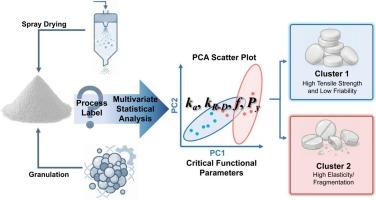
The global supply of mannitol offers diverse grades, typically categorized by manufacturers into “spray-dried” or “granulated” types for direct compression (DC). However, relying solely on these nominal process labels can be misleading for formulation development. This study established a quantitative, functionality-based classification system by systematically evaluating thirteen commercial mannitol grades through multivariate statistical analysis. Principal component analysis (PCA) and hierarchical cluster analysis (HCA) revealed that the manufacturing process label does not strictly dictate functional performance. Notably, three specific granulated grades were found to functionally cluster with spray-dried materials (Cluster 1) due to their shared porous micromorphology and high specific surface area, exhibiting superior tabletability (ka) and compressibility (kG). In contrast, Cluster 2, characterized by dense crystalline structures, demonstrated distinct mechanical behaviors dominated by high elasticity (kFES) and fragmentation tendency (f). Partial least squares (PLS) regression further elucidated the critical mechanisms governing tablet quality, identifying yield pressure (Py) and tabletability (ka) as the primary positive determinants for tensile strength, while excessive fragmentation and elastic recovery negatively impacted mechanical integrity. A trade-off was also observed where enhanced compressibility facilitated rapid disintegration, whereas excessive interparticle bonding could delay it. In summary, this property-driven classification framework provides a more rational strategy for excipient selection than commercial labels, enabling the identification of optimal materials for robust DC formulations based on intrinsic functional attributes.
甘露醇粉末物理和压缩性能的研究:相似性、差异性和分类
甘露醇的全球供应提供多种等级,通常由制造商分为“喷雾干燥”或“颗粒”类型,用于直接压缩(DC)。然而,仅仅依靠这些标称工艺标签可能会误导配方开发。本研究通过多元统计分析,系统评价了13个市售甘露醇等级,建立了一个定量的、基于功能的分类体系。主成分分析(PCA)和层次聚类分析(HCA)表明,制造工艺标签并没有严格规定功能性能。值得注意的是,由于具有相同的多孔微形貌和高比表面积,发现三种特定的颗粒级与喷雾干燥材料(簇1)在功能上聚集在一起,表现出优越的片状性(ka)和可压缩性(kG)。簇2晶体结构致密,表现出明显的力学行为,以高弹性(kFES)和碎裂倾向(f)为主。偏最小二乘(PLS)回归进一步阐明了控制片剂质量的关键机制,确定屈服压力(Py)和片性(ka)是抗拉强度的主要积极决定因素,而过度破碎和弹性恢复则对机械完整性产生负面影响。还观察到一种权衡,即增强的可压缩性促进了快速解体,而过度的粒子间键合可能会延迟解体。总之,这种属性驱动的分类框架为赋形剂的选择提供了比商业标签更合理的策略,能够根据内在功能属性识别出稳健的DC配方的最佳材料。
本文章由计算机程序翻译,如有差异,请以英文原文为准。
求助全文
约1分钟内获得全文
求助全文
来源期刊
Powder Technology
工程技术-工程:化工
CiteScore
9.90
自引率
15.40%
发文量
1047
审稿时长
46 days
期刊介绍:
Powder Technology is an International Journal on the Science and Technology of Wet and Dry Particulate Systems. Powder Technology publishes papers on all aspects of the formation of particles and their characterisation and on the study of systems containing particulate solids. No limitation is imposed on the size of the particles, which may range from nanometre scale, as in pigments or aerosols, to that of mined or quarried materials. The following list of topics is not intended to be comprehensive, but rather to indicate typical subjects which fall within the scope of the journal's interests:
Formation and synthesis of particles by precipitation and other methods.
Modification of particles by agglomeration, coating, comminution and attrition.
Characterisation of the size, shape, surface area, pore structure and strength of particles and agglomerates (including the origins and effects of inter particle forces).
Packing, failure, flow and permeability of assemblies of particles.
Particle-particle interactions and suspension rheology.
Handling and processing operations such as slurry flow, fluidization, pneumatic conveying.
Interactions between particles and their environment, including delivery of particulate products to the body.
Applications of particle technology in production of pharmaceuticals, chemicals, foods, pigments, structural, and functional materials and in environmental and energy related matters.
For materials-oriented contributions we are looking for articles revealing the effect of particle/powder characteristics (size, morphology and composition, in that order) on material performance or functionality and, ideally, comparison to any industrial standard.
 求助内容:
求助内容: 应助结果提醒方式:

 京公网安备 11010802042870号


