
A contact detection algorithm for DEM simulation of mixed cylindrical and polyhedral particles based on the common plane method
IF 5.5
2区 工程技术
Q2 ENGINEERING, CHEMICAL
引用次数: 0
Abstract
Accurate narrow-phase contact detection is a computational bottleneck in discrete element method (DEM) simulations of granular systems containing particles of different shapes. The common-plane (CP) method, originally developed for polyhedron–polyhedron contact, is extended here to particle systems that include cylindrical elements: a cylinder-to-plane distance metric is introduced to enable CP-based treatment of cylinder–cylinder contact, and a unified procedure is established for cylinder–polyhedron contact with explicit formulations for the contact normal, penetration depth, and contact point. To improve robustness and efficiency, an adaptive rotation strategy and step-halving termination scheme are used in the CP iteration to prevent stagnation. The algorithm is implemented in a three-dimensional DEM code and validated by gravity-driven packing experiments on three systems: cylinders only, cubes only (the cube representing a convex polyhedron), and mixed cylinder–cube assemblies. The simulations reproduce the observed deposition process and final packing structure, and the predicted final packing height agrees with experiments within 8%. The results indicate that the proposed approach is feasible for DEM simulation of cylindrical–polyhedral mixtures within the tested parameter range.
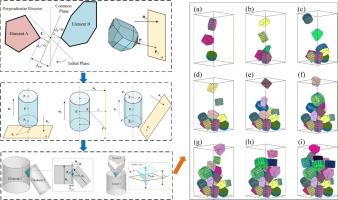
基于公共平面法的圆柱与多面体混合粒子DEM模拟接触检测算法
在含不同形状颗粒的离散元法(DEM)模拟中,精确的窄相接触检测是一个计算瓶颈。最初开发用于多面体-多面体接触的共平面(CP)方法在这里扩展到包括圆柱元素的粒子系统:引入了一个柱面到平面的距离度量来实现基于CP的柱面接触处理,并为柱面接触建立了一个统一的程序,其中包含接触法线、穿透深度和接触点的明确公式。为了提高鲁棒性和效率,在CP迭代中采用自适应旋转策略和步长减半终止方案来防止停滞。该算法在三维DEM代码中实现,并通过重力驱动填充实验在三种系统上进行验证:仅圆柱体、仅立方体(立方体代表凸多面体)和混合圆柱体-立方体组合。模拟重现了观察到的沉积过程和最终填料结构,预测的最终填料高度与实验结果吻合在8%以内。结果表明,该方法在试验参数范围内对圆柱-多面体混合物进行数值模拟是可行的。
本文章由计算机程序翻译,如有差异,请以英文原文为准。
求助全文
约1分钟内获得全文
求助全文
来源期刊
Powder Technology
工程技术-工程:化工
CiteScore
9.90
自引率
15.40%
发文量
1047
审稿时长
46 days
期刊介绍:
Powder Technology is an International Journal on the Science and Technology of Wet and Dry Particulate Systems. Powder Technology publishes papers on all aspects of the formation of particles and their characterisation and on the study of systems containing particulate solids. No limitation is imposed on the size of the particles, which may range from nanometre scale, as in pigments or aerosols, to that of mined or quarried materials. The following list of topics is not intended to be comprehensive, but rather to indicate typical subjects which fall within the scope of the journal's interests:
Formation and synthesis of particles by precipitation and other methods.
Modification of particles by agglomeration, coating, comminution and attrition.
Characterisation of the size, shape, surface area, pore structure and strength of particles and agglomerates (including the origins and effects of inter particle forces).
Packing, failure, flow and permeability of assemblies of particles.
Particle-particle interactions and suspension rheology.
Handling and processing operations such as slurry flow, fluidization, pneumatic conveying.
Interactions between particles and their environment, including delivery of particulate products to the body.
Applications of particle technology in production of pharmaceuticals, chemicals, foods, pigments, structural, and functional materials and in environmental and energy related matters.
For materials-oriented contributions we are looking for articles revealing the effect of particle/powder characteristics (size, morphology and composition, in that order) on material performance or functionality and, ideally, comparison to any industrial standard.
 求助内容:
求助内容: 应助结果提醒方式:

 京公网安备 11010802042870号


