
Formulation and evaluation of semi-solid extrusion (SSE) 3D-printed drug preparations using poloxamers and polyethylene oxide as co-printed carrier polymers
IF 4.7
3区 医学
Q1 PHARMACOLOGY & PHARMACY
European Journal of Pharmaceutical Sciences
Pub Date : 2026-04-01
Epub Date: 2026-02-11
DOI:10.1016/j.ejps.2026.107458
引用次数: 0
Abstract
Semi-solid extrusion (SSE) 3D printing offers a versatile platform for preparing personalised pharmaceutical dosage forms. We investigated the applicability of the three different grades of poloxamers combined with polyethylene oxide (PEO) in pharmaceutical SSE 3D printing. The binary mixtures of poloxamers (F68, F87, and F108) and PEO at a ratio of 55:45 (w/w) were used in preparing the aqueous gels for SSE 3D printing. Acetylsalicylic acid (ASA) was used as a model drug in the concentrations 5%, 7%, and 9% (w/w). The physicochemical properties, printability, geometric accuracy, structural fidelity, and in-vitro drug-release behaviour of SSE 3D-printed 4 × 4 grids and axially perforated tablets were studied. We found that poloxamer F108 as a co-printed carrier polymer (with PEO) formed high-viscosity gels, which were feasible for SSE 3D-printing. The poloxamer F68- and F87-based gel formulations in turn showed reduced print fidelity. FTIR spectroscopy analysis confirmed compatibility between ASA, PEO, and all three poloxamers studied. The SSE 3D-printed grid preparations exhibited immediate-release behaviour with an initial burst release of the drug (ASA), followed by a diffusion- and erosion-controlled drug release in vitro. The release rates decreased in order of poloxamer grade: F87 > F68 > F108. Overall, poloxamer grade F108 was the most feasible carrier polymer to be combined with PEO for the SSE 3D printing of ASA-loaded dosage forms. The present poloxamer and PEO co-printed formulations provide an alternative printing platform for aqueous-based SSE 3D printing of immediate-release oral drug preparations applicable in personalized medicine or compounding settings.
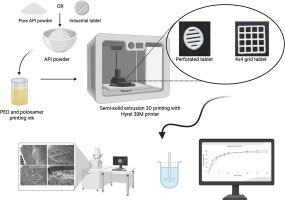
以poloxamers和聚乙烯氧化物为共印载体聚合物的半固体挤出(SSE) 3d打印药物制剂的配方和评价
半固体挤压(SSE) 3D打印为准备个性化药物剂型提供了一个多功能平台。我们研究了三种不同等级的poloxamers与聚乙烯氧化物(PEO)复合在医药SSE 3D打印中的适用性。将poloxamers (F68、F87和F108)与PEO以55:45 (w/w)的比例配制成SSE 3D打印用水凝胶。以5%、7%和9% (w/w)浓度的乙酰水杨酸(ASA)作为模型药物。研究了SSE 3d打印的4 × 4网格和轴向穿孔片剂的理化性质、可打印性、几何精度、结构保真度和体外释药行为。我们发现poloxamer F108作为共打印载体聚合物(与PEO)形成高粘度凝胶,这对于SSE 3d打印是可行的。以波洛沙姆F68和f87为基础的凝胶配方依次显示打印保真度降低。FTIR光谱分析证实了ASA、PEO和所研究的所有三种poloxamers之间的相容性。SSE 3d打印网格制剂具有立即释放的行为,具有初始的药物爆发释放(ASA),随后是体外扩散和侵蚀控制的药物释放。释放率由高到低依次为F87 >; F68 > F108。总体而言,波洛沙姆级F108是最可行的载体聚合物,可以与PEO结合用于SSE 3D打印asa负载剂型。目前的波洛沙姆和PEO共打印配方为适用于个性化医疗或复合环境的速释口服药物制剂的水性SSE 3D打印提供了另一种打印平台。
本文章由计算机程序翻译,如有差异,请以英文原文为准。
求助全文
约1分钟内获得全文
求助全文
来源期刊
CiteScore
9.60
自引率
2.20%
发文量
248
审稿时长
50 days
期刊介绍:
The journal publishes research articles, review articles and scientific commentaries on all aspects of the pharmaceutical sciences with emphasis on conceptual novelty and scientific quality. The Editors welcome articles in this multidisciplinary field, with a focus on topics relevant for drug discovery and development.
More specifically, the Journal publishes reports on medicinal chemistry, pharmacology, drug absorption and metabolism, pharmacokinetics and pharmacodynamics, pharmaceutical and biomedical analysis, drug delivery (including gene delivery), drug targeting, pharmaceutical technology, pharmaceutical biotechnology and clinical drug evaluation. The journal will typically not give priority to manuscripts focusing primarily on organic synthesis, natural products, adaptation of analytical approaches, or discussions pertaining to drug policy making.
Scientific commentaries and review articles are generally by invitation only or by consent of the Editors. Proceedings of scientific meetings may be published as special issues or supplements to the Journal.
 求助内容:
求助内容: 应助结果提醒方式:

 京公网安备 11010802042870号


