
Structural composite battery: Reinforced carbon fibre electrodes within a porous polyethersulfone matrix

IF 9.8 1区 材料科学 Q1 MATERIALS SCIENCE, COMPOSITES
Composites Science and Technology Pub Date : 2026-05-03 Epub Date: 2026-02-07 DOI:10.1016/j.compscitech.2026.111555
Qixiang Jiang , Cedric Normand , Francois Beauchamp , Alexander Beutl , Olivier Hubert , Alexander Bismarck
{"title":"Structural composite battery: Reinforced carbon fibre electrodes within a porous polyethersulfone matrix","authors":"Qixiang Jiang ,&nbsp;Cedric Normand ,&nbsp;Francois Beauchamp ,&nbsp;Alexander Beutl ,&nbsp;Olivier Hubert ,&nbsp;Alexander Bismarck","doi":"10.1016/j.compscitech.2026.111555","DOIUrl":null,"url":null,"abstract":"<div><div>A method to produce multifunctional structural battery composites comprising carbon fibre reinforced anodes and cathodes, and electrolyte filled bicontinuous polymer matrix is disclosed. Lithium iron phosphate (LFP) and lithium titanate (LTO) were deposited onto carbon fibres by electrophoretic deposition (EPD) to produce multifunctional cathodes and anodes, respectively. EPD allowed for an even coating of individual carbon fibres depositing 30 wt% of active materials with respect to carbon fibre current collectors. Carbon fibre reinforced cathode (LFP@CF), separator and anode (LTO@CF) were stacked and impregnated using polyethersulfone (PES) in N-methyl-2-pyrrolidone (NMP) solution; the PES was subsequently precipitated by non-solvent induced phase separation forming a porous high-performance polymer matrix within the stack. The porous matrix binds the carbon fibres and separator while providing sufficient openness for the electrochemical interface. The LFP@CF | separator | LTO@CF/PES assembly had an average Young's modulus of 27 ± 10 GPa and tensile strength of 282 ± 65 MPa. Structural battery composites possessed an energy density of 63 Wh/kg<sub>LFP</sub> or 2 Wh/kg<sub>battery</sub> at charge rate of 0.1C and were able to be cyclically dis/charged for more than 400 h.</div></div>","PeriodicalId":283,"journal":{"name":"Composites Science and Technology","volume":"278 ","pages":"Article 111555"},"PeriodicalIF":9.8000,"publicationDate":"2026-05-03","publicationTypes":"Journal Article","fieldsOfStudy":null,"isOpenAccess":false,"openAccessPdf":"","citationCount":"0","resultStr":null,"platform":"Semanticscholar","paperid":null,"PeriodicalName":"Composites Science and Technology","FirstCategoryId":"88","ListUrlMain":"https://www.sciencedirect.com/science/article/pii/S0266353826000400","RegionNum":1,"RegionCategory":"材料科学","ArticlePicture":[],"TitleCN":null,"AbstractTextCN":null,"PMCID":null,"EPubDate":"2026/2/7 0:00:00","PubModel":"Epub","JCR":"Q1","JCRName":"MATERIALS SCIENCE, COMPOSITES","Score":null,"Total":0}
引用次数: 0

Abstract

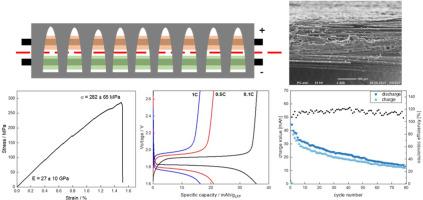
A method to produce multifunctional structural battery composites comprising carbon fibre reinforced anodes and cathodes, and electrolyte filled bicontinuous polymer matrix is disclosed. Lithium iron phosphate (LFP) and lithium titanate (LTO) were deposited onto carbon fibres by electrophoretic deposition (EPD) to produce multifunctional cathodes and anodes, respectively. EPD allowed for an even coating of individual carbon fibres depositing 30 wt% of active materials with respect to carbon fibre current collectors. Carbon fibre reinforced cathode (LFP@CF), separator and anode (LTO@CF) were stacked and impregnated using polyethersulfone (PES) in N-methyl-2-pyrrolidone (NMP) solution; the PES was subsequently precipitated by non-solvent induced phase separation forming a porous high-performance polymer matrix within the stack. The porous matrix binds the carbon fibres and separator while providing sufficient openness for the electrochemical interface. The LFP@CF | separator | LTO@CF/PES assembly had an average Young's modulus of 27 ± 10 GPa and tensile strength of 282 ± 65 MPa. Structural battery composites possessed an energy density of 63 Wh/kgLFP or 2 Wh/kgbattery at charge rate of 0.1C and were able to be cyclically dis/charged for more than 400 h.
Abstract Image

结构复合电池:多孔聚醚砜基质内的增强碳纤维电极
公开了一种生产多功能结构电池复合材料的方法,该复合材料包括碳纤维增强阳极和阴极以及充满电解质的双连续聚合物基体。采用电泳沉积法(EPD)将磷酸铁锂(LFP)和钛酸锂(LTO)分别沉积在碳纤维表面,制备了多功能阴极和多功能阳极。EPD允许单个碳纤维的均匀涂层沉积30%的活性材料,相对于碳纤维集流器。采用聚醚砜(PES)在n -甲基-2-吡罗烷酮(NMP)溶液中对碳纤维增强阴极(LFP@CF)、分离器和阳极(LTO@CF)进行堆积和浸渍;PES随后通过非溶剂诱导相分离析出,在堆内形成多孔的高性能聚合物基体。多孔基质结合了碳纤维和分离器,同时为电化学界面提供了足够的开放性。LFP@CF |分离器| LTO@CF/PES组件的平均杨氏模量为27±10 GPa,抗拉强度为282±65 MPa。在0.1C充电速率下,结构电池复合材料的能量密度为63 Wh/kgLFP或2 Wh/kgbattery,并且能够循环放电/充电超过400 h。
本文章由计算机程序翻译,如有差异,请以英文原文为准。
求助全文
约1分钟内获得全文 求助全文
来源期刊

Composites Science and Technology
Composites Science and Technology 工程技术-材料科学:复合
CiteScore
16.20
自引率
9.90%
发文量
611
审稿时长
33 days
期刊介绍: Composites Science and Technology publishes refereed original articles on the fundamental and applied science of engineering composites. The focus of this journal is on polymeric matrix composites with reinforcements/fillers ranging from nano- to macro-scale. CSTE encourages manuscripts reporting unique, innovative contributions to the physics, chemistry, materials science and applied mechanics aspects of advanced composites. Besides traditional fiber reinforced composites, novel composites with significant potential for engineering applications are encouraged.

×
引用
GB/T 7714-2015
复制
MLA
复制
APA
复制
导出至
BibTeX EndNote RefMan NoteFirst NoteExpress
×
提示
您的信息不完整,为了账户安全,请先补充。
现在去补充
×
提示
您因"违规操作"
具体请查看互助需知
我知道了
×
提示
确定
请完成安全验证×
copy
已复制链接
快去分享给好友吧!
我知道了
右上角分享
点击右上角分享
0
联系我们:info@booksci.cn Book学术提供免费学术资源搜索服务,方便国内外学者检索中英文文献。致力于提供最便捷和优质的服务体验。 Copyright © 2023 布克学术 All rights reserved.
京ICP备2023020795号-1
ghs 京公网安备 11010802042870号
Book学术文献互助
Book学术文献互助群
群 号:604180095
Book学术官方微信
小红书


