
Flexible PEDOT:PSS/PVA/Co3O4 nanocomposite films with absorption-dominated EMI shielding performance
IF 9.9
1区 材料科学
Q1 MATERIALS SCIENCE, COMPOSITES
Composites Science and Technology
Pub Date : 2026-05-03
Epub Date: 2026-02-02
DOI:10.1016/j.compscitech.2026.111554
引用次数: 0
Abstract
The increasing reliance on high-frequency electronics has intensified the need for lightweight and efficient electromagnetic interference (EMI) shielding materials. In this work, PEDOT:PSS/PVA/Co3O4 nanocomposite films were developed using a conductive polymer–metal oxide composite design strategy to overcome the limited conductivity and weak attenuation mechanisms of conventional polymer shields. By varying the Co3O4 content from 0 to 40 wt%, a clear correlation was established between the structure and properties, linking the nanoparticle dispersion with the high-frequency electromagnetic response. Structural, morphological, elemental, mechanical, and electrical analyses collectively demonstrate the effective dispersion of Co3O4 nanoparticles within the conductive PEDOT:PSS/PVA matrix. EMI analyses reveal that absorption-related attenuation dominates over reflection due to the combined effects of conductive loss, interfacial polarization, and multiple scattering. The EMI shielding effectiveness across the X, Ku, and K bands confirms that the high shielding performance of the optimal sample is attributed to its proximity to the optimal dispersion state and uniform filler distribution. These findings highlight a rationally engineered, flexible, and lightweight nanocomposite with strong potential for next-generation communication, aerospace, and wearable electronic systems.
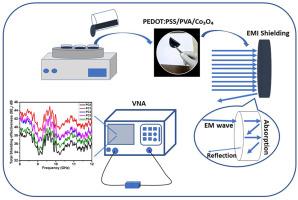
具有吸收主导电磁干扰屏蔽性能的柔性PEDOT:PSS/PVA/Co3O4纳米复合薄膜
随着对高频电子技术的日益依赖,对轻质高效电磁干扰(EMI)屏蔽材料的需求日益增加。本文采用导电聚合物-金属氧化物复合材料设计策略,开发了PEDOT:PSS/PVA/Co3O4纳米复合薄膜,克服了传统聚合物屏蔽层导电性有限和衰减机制弱的缺点。通过将Co3O4含量从0 wt%变化到40 wt%,在结构和性能之间建立了明确的相关性,将纳米颗粒的分散与高频电磁响应联系起来。结构、形态、元素、力学和电学分析共同证明了Co3O4纳米颗粒在导电PEDOT:PSS/PVA基体中的有效分散。电磁干扰分析表明,由于导电损耗、界面极化和多次散射的综合影响,吸收相关的衰减占主导地位。X、Ku和K波段的电磁干扰屏蔽效果证实,最佳样品的高屏蔽性能归因于其接近最佳色散状态和均匀填料分布。这些发现突出了一种合理设计、灵活、轻质的纳米复合材料,在下一代通信、航空航天和可穿戴电子系统中具有强大的潜力。
本文章由计算机程序翻译,如有差异,请以英文原文为准。
求助全文
约1分钟内获得全文
求助全文
来源期刊
Composites Science and Technology
工程技术-材料科学:复合
CiteScore
16.20
自引率
9.90%
发文量
611
审稿时长
33 days
期刊介绍:
Composites Science and Technology publishes refereed original articles on the fundamental and applied science of engineering composites. The focus of this journal is on polymeric matrix composites with reinforcements/fillers ranging from nano- to macro-scale. CSTE encourages manuscripts reporting unique, innovative contributions to the physics, chemistry, materials science and applied mechanics aspects of advanced composites.
Besides traditional fiber reinforced composites, novel composites with significant potential for engineering applications are encouraged.
 求助内容:
求助内容: 应助结果提醒方式:

 京公网安备 11010802042870号


