
Enhancing transverse mechanical properties of continuous carbon fibre reinforced composites via staggered-layer printing method
IF 9.9
1区 材料科学
Q1 MATERIALS SCIENCE, COMPOSITES
Composites Science and Technology
Pub Date : 2026-05-03
Epub Date: 2026-02-13
DOI:10.1016/j.compscitech.2026.111575
引用次数: 0
Abstract
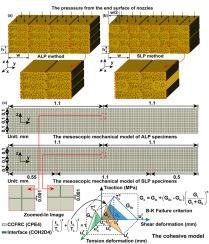
The transverse mechanical performance is known to be usually weak in Continuous Carbon Fibre Reinforced Composites (CCFRCs) fabricated through Fused Filament Fabrication (FFF), impeding their engineering applications. To address this issue, a Staggered-Layer Printing (SLP) method is proposed based on FFF to produce the CCFRCs with enhanced transverse mechanical properties. First, the optimal melt deposition width was determined based on microscopic characterizations. And then, multi-scale models were constructed based on the mesoscopic features of CCFRCs manufactured using both the conventional fabrication method, i.e., Aligned-Layer Printing (ALP) and the proposed SLP method. Finally, the tensile tests and short beam shear tests were performed to obtain the mechanical properties of printed specimens. Experimental validations on 90° specimens were performed, showing that the transverse Young's modulus and tensile strength of the ALP specimens are 3.6 GPa and 22.4 MPa respectively, while those of the SLP specimens are 4.8 GPa and 44.1 MPa respectively. Furthermore, the change of the meso-structure due to the SLP method has enhanced the printed specimens' critical fracture toughness, resulting in a substantial improvement of 97% in the transverse strength of additively manufactured CCFRCs. The main reason is attributed to the stress redistribution that impedes the crack propagation along the weak intra-layer interfaces in SLP specimens. Accordingly, the numerical model was developed to evaluate the critical fracture strength and fracture toughness inside printed filaments in the transverse direction as 73 MPa and 0.6 mJ/mm2, respectively. Hence, the specific meso-structure generated from SLP is effective to significantly improve the transverse load-bearing capacity of FFF-printed CCFRCs without compromising their longitudinal properties.
交错层列印法提高连续碳纤维增强复合材料横向力学性能
通过熔丝法(FFF)制备的连续碳纤维增强复合材料(CCFRCs)的横向力学性能通常较弱,阻碍了其工程应用。为了解决这一问题,提出了一种基于FFF的交错层印刷(SLP)方法来生产具有增强横向力学性能的CCFRCs。首先,根据微观表征确定了最佳熔体沉积宽度。在此基础上,基于传统的排列层打印(ALP)和SLP方法制备的CCFRCs的介观特征构建了多尺度模型。最后进行了拉伸试验和短梁剪切试验,获得了打印试件的力学性能。对90°试样进行了实验验证,结果表明,ALP试样的横向杨氏模量和抗拉强度分别为3.6 GPa和22.4 MPa, SLP试样的横向杨氏模量和抗拉强度分别为4.8 GPa和44.1 MPa。此外,由于SLP方法导致的细观结构的改变提高了打印样品的临界断裂韧性,导致增材制造的CCFRCs的横向强度大幅提高了97%。其主要原因是应力重分布阻碍了裂纹沿弱层内界面的扩展。据此,建立了打印细丝横向的临界断裂强度和断裂韧性数值模型,分别为73 MPa和0.6 mJ/mm2。因此,SLP产生的特定细观结构可以有效地显著提高fff打印的CCFRCs的横向承载能力,而不会影响其纵向性能。
本文章由计算机程序翻译,如有差异,请以英文原文为准。
求助全文
约1分钟内获得全文
求助全文
来源期刊
Composites Science and Technology
工程技术-材料科学:复合
CiteScore
16.20
自引率
9.90%
发文量
611
审稿时长
33 days
期刊介绍:
Composites Science and Technology publishes refereed original articles on the fundamental and applied science of engineering composites. The focus of this journal is on polymeric matrix composites with reinforcements/fillers ranging from nano- to macro-scale. CSTE encourages manuscripts reporting unique, innovative contributions to the physics, chemistry, materials science and applied mechanics aspects of advanced composites.
Besides traditional fiber reinforced composites, novel composites with significant potential for engineering applications are encouraged.
 求助内容:
求助内容: 应助结果提醒方式:

 京公网安备 11010802042870号


