
Screening of glial fibrillary acidic protein specific aptamer and application in the development of fluorescent biosensor based on isothermal amplification strategy
IF 8.9
1区 化学
Q1 CHEMISTRY, MULTIDISCIPLINARY
Chinese Chemical Letters
Pub Date : 2026-05-01
Epub Date: 2025-07-19
DOI:10.1016/j.cclet.2025.111616
引用次数: 0
Abstract
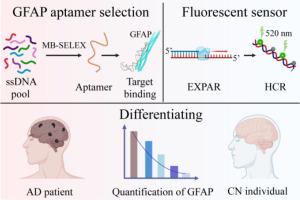
Glial fibrillary acidic protein (GFAP) can serve as a promising early blood biomarker for Alzheimer's disease (AD). Existing assays mostly rely on antibody-based detection technologies, the preparation of antibodies is relatively complex, costly, and requires high storage conditions. In this study, we screened an aptamer specifically targeting GFAP (KD = 0.621 µmol/L) through systematic evolution of ligands by exponential enrichment (SELEX) technique for the first time and then applied which to develop a simple but sensitive fluorescent sensor by combining isothermal exponential amplification reaction (EXPAR) with hybridization chain reaction (HCR). The platform achieved a broad linear detection range (10 pg/mL to 10 µg/mL) and a low detection limit (0.24 pg/mL). The results detected by the proposed sensor were highly correlated with that detected by ELISA method (R = 0.9989, P < 0.0001). The work overcomes the limitations of antibody-based technologies and provides a promising solution for early diagnosis of AD.
胶质原纤维酸性蛋白特异性适配体的筛选及其在等温扩增荧光生物传感器开发中的应用
胶质原纤维酸性蛋白(GFAP)可作为阿尔茨海默病(AD)早期血液生物标志物。现有的检测方法大多依赖于基于抗体的检测技术,抗体的制备相对复杂,成本高,并且需要较高的储存条件。本研究首次利用指数富集(SELEX)技术,通过配体系统进化筛选出特异性靶向GFAP的适体(KD = 0.621 µmol/L),并将其应用于等温指数扩增反应(EXPAR)和杂交链反应(HCR)相结合的荧光传感器。该平台具有较宽的线性检测范围(10 pg/mL ~ 10 µg/mL)和较低的检出限(0.24 pg/mL)。该传感器检测结果与ELISA法检测结果高度相关(R = 0.9989,P <; 0.0001)。这项工作克服了基于抗体技术的局限性,为阿尔茨海默病的早期诊断提供了一个有希望的解决方案。
本文章由计算机程序翻译,如有差异,请以英文原文为准。
求助全文
约1分钟内获得全文
求助全文
来源期刊
Chinese Chemical Letters
化学-化学综合
CiteScore
14.10
自引率
15.40%
发文量
8969
审稿时长
1.6 months
期刊介绍:
Chinese Chemical Letters (CCL) (ISSN 1001-8417) was founded in July 1990. The journal publishes preliminary accounts in the whole field of chemistry, including inorganic chemistry, organic chemistry, analytical chemistry, physical chemistry, polymer chemistry, applied chemistry, etc.Chinese Chemical Letters does not accept articles previously published or scheduled to be published. To verify originality, your article may be checked by the originality detection service CrossCheck.
 求助内容:
求助内容: 应助结果提醒方式:

 京公网安备 11010802042870号


