
Fabrication of RuCo bimetallic catalyst enabling efficient hydrogen generation via ammonia borane hydrolysis
IF 7.5
1区 工程技术
Q2 ENERGY & FUELS
引用次数: 0
Abstract
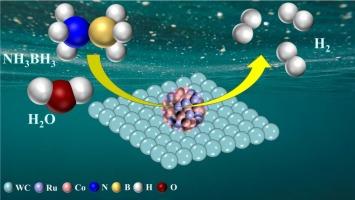
Ammonia borane (NH3BH3) is an ideal solid hydrogen storage material, and its dehydrogenation through hydrolysis reaction has attracted growing interest. However, the key challenge in ammonia borane hydrolysis is the development of an efficient and low-cost catalyst. In this work, RuCo nanoparticles supported on tungsten carbide (RuCo/WC) were synthesized via the impregnation method. Among catalysts with varying Ru/Co mass ratios, Ru1Co1/WC exhibited the highest catalytic activity for NH3BH3 hydrolysis in alkaline solution at 298 K, achieving a rH2 of 1729 molH2⋅molRu-1⋅min−1 and an activation energy (Ea) value of 34.7 kJ⋅mol−1, competitive with state-of-the-art Ru-based catalysts. The enhanced activity originates from (i) electron transfer between Ru and Co due to their electronegativity difference and (ii) strong metal–support interactions between RuCo nanoparticles and WC. Specifically, the Ru–Co synergy facilitates NH3BH3 activation, while WC promotes H2O dissociation.
能通过氨硼烷水解高效产氢的RuCo双金属催化剂的制备
氨硼烷(NH3BH3)是一种理想的固体储氢材料,其水解脱氢引起了人们越来越多的关注。然而,氨硼烷水解的关键挑战是开发一种高效、低成本的催化剂。本文采用浸渍法制备了负载在碳化钨上的RuCo纳米颗粒(RuCo/WC)。在不同Ru/Co质量比的催化剂中,Ru1Co1/WC在298 K碱性溶液中水解NH3BH3的催化活性最高,rH2为1729 molH2⋅molRu-1⋅min -1,活化能(Ea)值为34.7 kJ⋅mol -1,与现有的Ru基催化剂相媲美。活性的增强源于(i) Ru和Co之间的电子转移(由于它们的电负性差异)和(ii) RuCo纳米颗粒与WC之间的强金属支撑相互作用。具体来说,Ru-Co协同作用促进NH3BH3活化,而WC促进H2O解离。
本文章由计算机程序翻译,如有差异,请以英文原文为准。
求助全文
约1分钟内获得全文
求助全文
来源期刊
Fuel
工程技术-工程:化工
CiteScore
12.80
自引率
20.30%
发文量
3506
审稿时长
64 days
期刊介绍:
The exploration of energy sources remains a critical matter of study. For the past nine decades, fuel has consistently held the forefront in primary research efforts within the field of energy science. This area of investigation encompasses a wide range of subjects, with a particular emphasis on emerging concerns like environmental factors and pollution.
 求助内容:
求助内容: 应助结果提醒方式:

 京公网安备 11010802042870号


