
Efficient base-free oxidation of 5-hydroxymethylfurfural to 2,5-furandicarboxylic acid over a Ru/CaY molecular sieve catalyst
IF 4.9
2区 化学
Q2 CHEMISTRY, PHYSICAL
引用次数: 0
Abstract
As a vital platform compound for renewable plastics, coatings, and pharmaceuticals, 2,5-furandicarboxylic acid (FDCA) has increasingly drawn interest for its green and efficient production. In this study, a cost-effective NaY molecular sieve with a high Si/Al ratio was used as the support to prepare CaY molecular sieve via ion exchange, followed by the loading of ruthenium nanoparticles using an impregnation–reduction method to obtain the Ru/CaY catalyst. Structure-activity relationship studies revealed that the high dispersion of Ru nanoparticles enhanced the accessibility of active sites on the catalyst surface. The introduction of Ca2+ increased the basicity of the support, synergistically promoting the oxidation of HMF, while the structural stability and high specific surface area of the molecular sieve framework provided a favorable environment for Ru dispersion. Under base-free conditions, optimized oxygen pressure (0.5 MPa), reaction temperature (120 °C), and reaction time (11 h), the 4 wt% Ru/CaY (1:1) catalyst achieved efficient catalytic oxidation of 5-hydroxymethylfurfural (HMF), achieving a 100% conversion rate and 91.4% FDCA yield. Furthermore, after five consecutive reaction cycles, maintaining an FDCA yield of 85.2%, and after regeneration treatment, the FDCA yield was restored to 90.2%, demonstrating excellent reusability. This study offers an efficient strategy for the base-free oxidation of HMF and establishes a solid foundation for the green, scalable synthesis of FDCA.
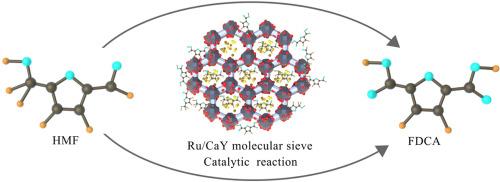
Ru/CaY分子筛催化5-羟甲基糠醛高效无碱氧化制2,5-呋喃二羧酸
2,5-呋喃二甲酸(2,5-呋喃二甲酸,FDCA)作为可再生塑料、涂料和药品的重要平台化合物,其绿色高效的生产方式越来越受到人们的关注。本研究以高Si/Al比的高性价比NaY分子筛为载体,通过离子交换法制备CaY分子筛,再通过浸渍还原法制备钌纳米颗粒,得到Ru/CaY催化剂。构效关系研究表明,Ru纳米颗粒的高分散性增强了催化剂表面活性位点的可及性。Ca2+的引入增加了载体的碱性,协同促进了HMF的氧化,同时分子筛骨架的结构稳定性和高比表面积为Ru的分散提供了有利的环境。在无碱条件下,优化氧压(0.5 MPa)、反应温度(120℃)、反应时间(11 h), 4 wt% Ru/CaY(1:1)催化剂实现了5-羟甲基糠醛(HMF)的高效催化氧化,转化率为100%,FDCA收率为91.4%。在连续5个反应周期后,FDCA的产率保持在85.2%,经过再生处理后,FDCA的产率恢复到90.2%,具有良好的可重复使用性。本研究为HMF的无碱氧化提供了一种有效的策略,为绿色、可扩展的FDCA合成奠定了坚实的基础。
本文章由计算机程序翻译,如有差异,请以英文原文为准。
求助全文
约1分钟内获得全文
求助全文
来源期刊
Molecular Catalysis
Chemical Engineering-Process Chemistry and Technology
CiteScore
6.90
自引率
10.90%
发文量
700
审稿时长
40 days
期刊介绍:
Molecular Catalysis publishes full papers that are original, rigorous, and scholarly contributions examining the molecular and atomic aspects of catalytic activation and reaction mechanisms. The fields covered are:
Heterogeneous catalysis including immobilized molecular catalysts
Homogeneous catalysis including organocatalysis, organometallic catalysis and biocatalysis
Photo- and electrochemistry
Theoretical aspects of catalysis analyzed by computational methods
 求助内容:
求助内容: 应助结果提醒方式:

 京公网安备 11010802042870号


