
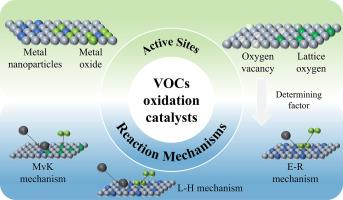
Active sites and reaction mechanisms over the catalysts for VOCs oxidation
IF 4.9
2区 化学
Q2 CHEMISTRY, PHYSICAL
引用次数: 0
Abstract
Volatile organic compounds (VOCs) have attracted widespread attention due to their great threat to the environment and human health. Catalytic oxidation was regarded as the most promising technology for reducing VOCs emissions because of high efficiency and low energy consumption, highlighting the demand for the exploitation of highly active catalysts. However, there still lacked a comprehensive review of active sites and reaction mechanisms for VOCs oxidation. In this work, the previously mentioned issues for varying catalysts were studied. It was summarized that highly dispersed metal sites facilitated the activation of C-H bonds and the opening of aromatic rings. Oxygen vacancies enhanced the activation and migration of oxygen species. Furthermore, the catalytic performances were primarily influenced by the textures and properties of the superficially active sites. Rationally controlling the density and coordination environment of active sites represented a viable approach for enhancing both the oxidation activity and stability of catalysts. The reaction mechanisms of VOCs typically involved multiple pathways, prevailingly influenced by the noumenal active sites and enthetic oxygens. Both of the abovementioned species were found to critically govern the VOCs oxidation reaction process, including lattice oxygen participation, adsorbed oxygen activation, and intermediate transformation, which determined the reaction efficiency and pathway, then provided a deeper understanding of the VOCs oxidation process from a microscopic aspect. This investigation was of great significance for elucidating the intrinsic relationship between active sites and reaction mechanisms and guiding the directional synthesis and design of catalysts.
VOCs氧化催化剂的活性位点及反应机理
挥发性有机化合物(VOCs)因其对环境和人体健康的巨大威胁而受到广泛关注。催化氧化因其高效、低能耗被认为是减少挥发性有机化合物排放最有前途的技术,因此对高活性催化剂的开发需求突出。然而,目前对VOCs氧化的活性位点和反应机制还缺乏全面的研究。本文研究了不同催化剂对上述问题的影响。综上所述,高度分散的金属位点有利于C-H键的激活和芳环的打开。氧空位促进了氧的活化和迁移。此外,催化性能主要受表面活性位点的结构和性质的影响。合理控制活性位点的密度和配位环境是提高催化剂氧化活性和稳定性的可行途径。挥发性有机化合物的反应机制涉及多种途径,主要受本体活性位点和活性氧的影响。发现上述两种物质对VOCs氧化反应过程,包括晶格氧参与、吸附氧活化和中间转化起着关键的控制作用,这决定了反应的效率和途径,从而从微观角度对VOCs氧化过程有了更深入的了解。该研究对于阐明活性位点与反应机理之间的内在联系,指导催化剂的定向合成和设计具有重要意义。
本文章由计算机程序翻译,如有差异,请以英文原文为准。
求助全文
约1分钟内获得全文
求助全文
来源期刊
Molecular Catalysis
Chemical Engineering-Process Chemistry and Technology
CiteScore
6.90
自引率
10.90%
发文量
700
审稿时长
40 days
期刊介绍:
Molecular Catalysis publishes full papers that are original, rigorous, and scholarly contributions examining the molecular and atomic aspects of catalytic activation and reaction mechanisms. The fields covered are:
Heterogeneous catalysis including immobilized molecular catalysts
Homogeneous catalysis including organocatalysis, organometallic catalysis and biocatalysis
Photo- and electrochemistry
Theoretical aspects of catalysis analyzed by computational methods
 求助内容:
求助内容: 应助结果提醒方式:

 京公网安备 11010802042870号


