
Selective hydrogenation of citral: A catalytic challenge

IF 4.9 2区 化学 Q2 CHEMISTRY, PHYSICAL
Molecular Catalysis Pub Date : 2026-03-15 Epub Date: 2026-02-05 DOI:10.1016/j.mcat.2026.115765
Stefano Paganelli , Chiara D’Acunzi , Serena Riela , Marina Massaro , Alessandro Di Michele , Beatrice Muzzi , Oreste Piccolo
{"title":"Selective hydrogenation of citral: A catalytic challenge","authors":"Stefano Paganelli ,&nbsp;Chiara D’Acunzi ,&nbsp;Serena Riela ,&nbsp;Marina Massaro ,&nbsp;Alessandro Di Michele ,&nbsp;Beatrice Muzzi ,&nbsp;Oreste Piccolo","doi":"10.1016/j.mcat.2026.115765","DOIUrl":null,"url":null,"abstract":"<div><div>The hydrogenation of citral was investigated using various palladium- and rhodium-based catalytic systems. We explored both Pd and Rh nanoparticles stabilized by K-carrageenan in a biphasic water/THF system, as well as several heterogeneous catalysts with low precious metal content. In particular, the heterogenous catalysts employed were Pd/Al<sub>2</sub>O<sub>3</sub> (0.3% Pd w/w), Rh/Al<sub>2</sub>O<sub>3</sub> (0.18% Rh w/w), and HNTs@PDA/PdNPs (0.8% Pd w/w), obtained using a site-specific polydopamine coating on the external surface of halloysite as support. Across all experiments, palladium-based catalysts consistently demonstrated superior activity and selectivity compared to their rhodium counterparts. Notably, the catalytic systems exhibit a very different selectivity. Indeed, both Pd- and Rh-based water-soluble catalysts, as well as the heterogeneous Rh/Al<sub>2</sub>O<sub>3</sub> catalytic system, favor the formation of citronellal, due to the hydrogenation of the carbon-carbon double bond conjugated to the carbonyl group. In contrast, the two heterogeneous palladium-based catalysts strongly promote the formation of menthol through the cyclization of citronellal, in some cases achieving nearly complete selectivity.</div></div>","PeriodicalId":393,"journal":{"name":"Molecular Catalysis","volume":"593 ","pages":"Article 115765"},"PeriodicalIF":4.9000,"publicationDate":"2026-03-15","publicationTypes":"Journal Article","fieldsOfStudy":null,"isOpenAccess":false,"openAccessPdf":"","citationCount":"0","resultStr":null,"platform":"Semanticscholar","paperid":null,"PeriodicalName":"Molecular Catalysis","FirstCategoryId":"92","ListUrlMain":"https://www.sciencedirect.com/science/article/pii/S2468823126000659","RegionNum":2,"RegionCategory":"化学","ArticlePicture":[],"TitleCN":null,"AbstractTextCN":null,"PMCID":null,"EPubDate":"2026/2/5 0:00:00","PubModel":"Epub","JCR":"Q2","JCRName":"CHEMISTRY, PHYSICAL","Score":null,"Total":0}
引用次数: 0

Abstract

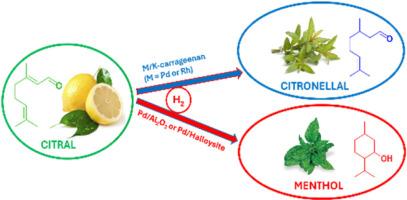
The hydrogenation of citral was investigated using various palladium- and rhodium-based catalytic systems. We explored both Pd and Rh nanoparticles stabilized by K-carrageenan in a biphasic water/THF system, as well as several heterogeneous catalysts with low precious metal content. In particular, the heterogenous catalysts employed were Pd/Al2O3 (0.3% Pd w/w), Rh/Al2O3 (0.18% Rh w/w), and HNTs@PDA/PdNPs (0.8% Pd w/w), obtained using a site-specific polydopamine coating on the external surface of halloysite as support. Across all experiments, palladium-based catalysts consistently demonstrated superior activity and selectivity compared to their rhodium counterparts. Notably, the catalytic systems exhibit a very different selectivity. Indeed, both Pd- and Rh-based water-soluble catalysts, as well as the heterogeneous Rh/Al2O3 catalytic system, favor the formation of citronellal, due to the hydrogenation of the carbon-carbon double bond conjugated to the carbonyl group. In contrast, the two heterogeneous palladium-based catalysts strongly promote the formation of menthol through the cyclization of citronellal, in some cases achieving nearly complete selectivity.
Abstract Image

柠檬醛选择性加氢:一个催化挑战
研究了不同钯基和铑基催化体系对柠檬醛加氢反应的影响。我们探索了k -卡拉胶在双相水/四氢呋喃体系中稳定的Pd和Rh纳米颗粒,以及几种低贵金属含量的非均相催化剂。其中,采用的多相催化剂分别是Pd/Al2O3 (0.3% Pd w/w)、Rh/Al2O3 (0.18% Rh w/w)和HNTs@PDA/PdNPs (0.8% Pd w/w),这些催化剂是通过在高岭土表面涂覆特定位点的聚多巴胺作为载体得到的。在所有的实验中,钯基催化剂始终表现出优于铑基催化剂的活性和选择性。值得注意的是,催化体系表现出非常不同的选择性。事实上,钯基和铑基水溶性催化剂以及非均相的Rh/Al2O3催化体系都有利于香茅醛的形成,这是由于碳-碳双键与羰基共轭的氢化作用。相比之下,两种非均相钯基催化剂通过香茅醛的环化强烈促进薄荷醇的形成,在某些情况下实现了几乎完全的选择性。
本文章由计算机程序翻译,如有差异,请以英文原文为准。
求助全文
约1分钟内获得全文 求助全文
来源期刊
Molecular Catalysis
Molecular Catalysis Chemical Engineering-Process Chemistry and Technology
CiteScore
6.90
自引率
10.90%
发文量
700
审稿时长
40 days
期刊介绍: Molecular Catalysis publishes full papers that are original, rigorous, and scholarly contributions examining the molecular and atomic aspects of catalytic activation and reaction mechanisms. The fields covered are: Heterogeneous catalysis including immobilized molecular catalysts Homogeneous catalysis including organocatalysis, organometallic catalysis and biocatalysis Photo- and electrochemistry Theoretical aspects of catalysis analyzed by computational methods

×
引用
GB/T 7714-2015
复制
MLA
复制
APA
复制
导出至
BibTeX EndNote RefMan NoteFirst NoteExpress
×
提示
您的信息不完整,为了账户安全,请先补充。
现在去补充
×
提示
您因"违规操作"
具体请查看互助需知
我知道了
×
提示
确定
请完成安全验证×
copy
已复制链接
快去分享给好友吧!
我知道了
右上角分享
点击右上角分享
0
联系我们:info@booksci.cn Book学术提供免费学术资源搜索服务,方便国内外学者检索中英文文献。致力于提供最便捷和优质的服务体验。 Copyright © 2023 布克学术 All rights reserved.
京ICP备2023020795号-1
ghs 京公网安备 11010802042870号
Book学术文献互助
Book学术文献互助群
群 号:604180095
Book学术官方微信
小红书


