
The enhanced electrocatalytic activity of Cr-doped NiC2O4 for water splitting via surface reconstruction
IF 4.3
2区 化学
Q2 CHEMISTRY, PHYSICAL
引用次数: 0
Abstract
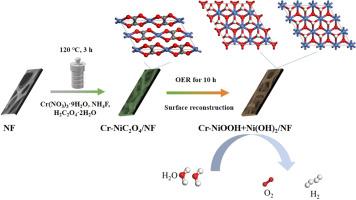
Electrolysis of water to produce hydrogen can alleviate the problem of global energy shortage, and seeking efficient water splitting electrocatalysts is the promising direction. In this work, Cr-doped nickel oxalate (Cr-NiC2O4/NF) was synthesized on nickel foam (NF) by a one-step hydrothermal method and used as an alkaline electrolytic water catalyst. The electrocatalytic activity of NiC2O4 is significantly improved by Cr doping. For the oxygen evolution reaction (OER), the overpotential is 324 mV at 100 mA cm-2, and for the hydrogen evolution reaction (HER), the overpotential is 191 mV at 10 mA cm-2. When Cr-NiC2O4/NF is used as anode and cathode in water splitting, only voltage of 1.58 V is required at current density of 10 mA cm-2. Furthermore, the mechanism of enhanced catalytic activity via surface reconstruction during the OER and HER was systematically studied. The pre-catalyst Cr-NiC2O4 was restructured into hydroxides and hydroxyl oxides for OER, and some Cr-NiC2O4 was converted into hydroxides for HER. Consequently, this investigation provides a new method to improve the electrocatalytic performance of metal oxalates and a theoretical guidance for surface reconstruction.
通过表面重构增强cr掺杂NiC2O4对水裂解的电催化活性
电解水制氢可以缓解全球能源短缺的问题,寻求高效的水分解电催化剂是有希望的方向。本文采用一步水热法在泡沫镍(NF)上合成了掺杂cr的草酸镍(Cr-NiC2O4/NF),并将其用作碱性电解水催化剂。Cr的掺杂显著提高了NiC2O4的电催化活性。析氧反应(OER)在100 mA cm-2时的过电位为324 mV,析氢反应(HER)在10 mA cm-2时的过电位为191 mV。当Cr-NiC2O4/NF作为水分解的阳极和阴极时,在电流密度为10 mA cm-2时,只需要1.58 V的电压。此外,系统地研究了OER和HER过程中通过表面重构提高催化活性的机理。预催化剂Cr-NiC2O4被重组为氢氧化物和羟基氧化物用于OER,部分Cr-NiC2O4被转化为氢氧化物用于HER。因此,本研究为提高金属草酸盐的电催化性能提供了一种新的方法,并为表面重建提供了理论指导。
本文章由计算机程序翻译,如有差异,请以英文原文为准。
求助全文
约1分钟内获得全文
求助全文
来源期刊
Molecular Catalysis
Chemical Engineering-Process Chemistry and Technology
CiteScore
6.90
自引率
10.90%
发文量
700
审稿时长
40 days
期刊介绍:
Molecular Catalysis publishes full papers that are original, rigorous, and scholarly contributions examining the molecular and atomic aspects of catalytic activation and reaction mechanisms. The fields covered are:
Heterogeneous catalysis including immobilized molecular catalysts
Homogeneous catalysis including organocatalysis, organometallic catalysis and biocatalysis
Photo- and electrochemistry
Theoretical aspects of catalysis analyzed by computational methods
 求助内容:
求助内容: 应助结果提醒方式:

 京公网安备 11010802042870号


