
Unexpected ultra-fine nickel phyllosilicate nanofibers formed on the surface of Ni-encapsulated zeolite catalyst: Phase identification and independent synthesis
IF 4.5
3区 材料科学
Q1 CHEMISTRY, APPLIED
Microporous and Mesoporous Materials
Pub Date : 2026-04-01
Epub Date: 2026-02-03
DOI:10.1016/j.micromeso.2026.114065
引用次数: 0
Abstract
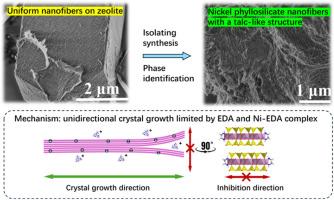
During the study of hydrothermal synthesis of nickel-encapsulated zeolite catalyst using the ligand-protection method, uniform nanofibers (∼10 nm diameter, hundreds of nanometers long) were unexpectedly observed on the surface of zeolite crystals. These nanofibers were subsequently synthesized independently outside the zeolite synthesis system and were identified as nickel-kerolite, a kind of talc-like nickel phyllosilicate. An optimal synthesis approach of the nickel phyllosilicate fibers was realized via a hydrothermal method using a synthetic gel comprising a silicon source, sodium hydroxide, nickel nitrate, and ethylenediamine (EDA). It is found that the formation of the unique fibrous morphology of nickel phyllosilicate requires a sufficiently strong alkaline medium and the presence of EDA. Ethylenediamine was proven to be essential for achieving the nano-fibrous morphology, probably due to the anisotropic growth inhibition from both EDA and its nickel complex (Ni-EDA), which restrict crystal development predominantly along one direction.
镍包封沸石催化剂表面形成超细的层状硅酸镍纳米纤维:相鉴定和独立合成
在采用配体保护法水热合成镍包封沸石催化剂的研究过程中,意外地在沸石晶体表面观察到均匀的纳米纤维(直径~ 10 nm,长数百纳米)。这些纳米纤维随后在沸石合成系统外独立合成,并被鉴定为镍-kerolite,一种类似滑石的镍层状硅酸盐。利用硅源、氢氧化钠、硝酸镍和乙二胺(EDA)组成的合成凝胶,通过水热法实现了叶状硅酸镍纤维的最佳合成方法。研究发现,层状硅酸镍独特的纤维形态的形成需要足够强的碱性介质和EDA的存在。乙二胺被证明是实现纳米纤维形态所必需的,可能是由于EDA及其镍配合物(Ni-EDA)的各向异性生长抑制作用,这主要限制了晶体沿一个方向发育。
本文章由计算机程序翻译,如有差异,请以英文原文为准。
求助全文
约1分钟内获得全文
求助全文
来源期刊
Microporous and Mesoporous Materials
化学-材料科学:综合
CiteScore
10.70
自引率
5.80%
发文量
649
审稿时长
26 days
期刊介绍:
Microporous and Mesoporous Materials covers novel and significant aspects of porous solids classified as either microporous (pore size up to 2 nm) or mesoporous (pore size 2 to 50 nm). The porosity should have a specific impact on the material properties or application. Typical examples are zeolites and zeolite-like materials, pillared materials, clathrasils and clathrates, carbon molecular sieves, ordered mesoporous materials, organic/inorganic porous hybrid materials, or porous metal oxides. Both natural and synthetic porous materials are within the scope of the journal.
Topics which are particularly of interest include:
All aspects of natural microporous and mesoporous solids
The synthesis of crystalline or amorphous porous materials
The physico-chemical characterization of microporous and mesoporous solids, especially spectroscopic and microscopic
The modification of microporous and mesoporous solids, for example by ion exchange or solid-state reactions
All topics related to diffusion of mobile species in the pores of microporous and mesoporous materials
Adsorption (and other separation techniques) using microporous or mesoporous adsorbents
Catalysis by microporous and mesoporous materials
Host/guest interactions
Theoretical chemistry and modelling of host/guest interactions
All topics related to the application of microporous and mesoporous materials in industrial catalysis, separation technology, environmental protection, electrochemistry, membranes, sensors, optical devices, etc.
 求助内容:
求助内容: 应助结果提醒方式:

 京公网安备 11010802042870号


