
Engineering hierarchical beta zeolites with isolated metal centers for adjustable catalytic functionality
IF 4.7
3区 材料科学
Q1 CHEMISTRY, APPLIED
Microporous and Mesoporous Materials
Pub Date : 2026-04-01
Epub Date: 2026-02-09
DOI:10.1016/j.micromeso.2026.114077
引用次数: 0
Abstract
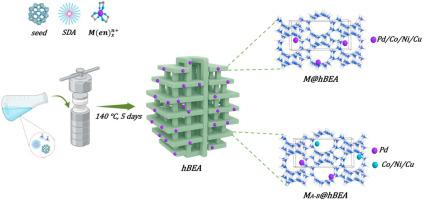
Hierarchical zeolites confine nanoscale metal species that hold great appeal for multifunctional catalysis, although controlled synthesis still remains a challenge. In this paper, hierarchical Beta (hBEA) zeolite confining subnanometric metal species was synthesized with the strategy of cooperative ethylenediamine (en) ligand protection and seed-assisted crystallization in the presence of the unique tetraquaternary ammonium structure-directing agent (SDA). Such a cooperative synthesis environment allowed SDA to direct mesostructure formation while bulk BEA seed maintained framework topology, leading to an interconnected micro-mesoporous architecture with improved textural properties. The en-ligand protection effectively suppressed metal hydroxide precipitation under strongly basic hydrothermal conditions, allowing for the confinement of Pd, Co, Ni, and Cu metal centers within the framework. Characterization by XRD, XPS, and HAADF-STEM confirmed the uniform dispersion of isolated and ultra-small metal nanosites without metallic nanoparticle formation. Building on this design, dimetallic Pd-Co, Pd-Ni, and Pd-Cu@hBEA catalysts were prepared using preformed metal-containing seeds as both structural templates and secondary metal sources, achieving homogeneous co-distribution of both metals. This study demonstrates a versatile and generalizable route for constructing multimetallic hierarchical zeolites capable of stabilizing multiple active centers, offering a robust platform for designing selective and sustainable catalysts for tandem reactions.
工程分级β沸石与分离的金属中心可调节的催化功能
虽然控制合成仍然是一个挑战,但分级沸石限制了纳米级金属物种,对多功能催化具有很大的吸引力。本文在独特的四季铵定向结构剂(SDA)存在下,采用乙二胺(en)配体协同保护和种子辅助结晶的策略合成了亚纳米金属物种的分级β (hBEA)沸石。这种协同合成环境允许SDA指导介孔结构的形成,而散装BEA种子保持框架拓扑结构,从而导致具有改善纹理性能的互联微介孔结构。在强碱性水热条件下,配体保护有效地抑制了金属氢氧化物的析出,使得Pd、Co、Ni和Cu金属中心被限制在骨架内。通过XRD, XPS和HAADF-STEM表征证实了分离的和超小的金属纳米位点的均匀分散,没有形成金属纳米颗粒。在此基础上,以预成型含金属种子作为结构模板和二次金属源制备了双金属钯钴、钯镍和Pd-Cu@hBEA催化剂,实现了两种金属的均匀共分布。该研究为构建具有稳定多个活性中心的多金属级联沸石提供了一种通用的、可推广的途径,为设计具有选择性和可持续性的串联反应催化剂提供了坚实的平台。
本文章由计算机程序翻译,如有差异,请以英文原文为准。
求助全文
约1分钟内获得全文
求助全文
来源期刊
Microporous and Mesoporous Materials
化学-材料科学:综合
CiteScore
10.70
自引率
5.80%
发文量
649
审稿时长
26 days
期刊介绍:
Microporous and Mesoporous Materials covers novel and significant aspects of porous solids classified as either microporous (pore size up to 2 nm) or mesoporous (pore size 2 to 50 nm). The porosity should have a specific impact on the material properties or application. Typical examples are zeolites and zeolite-like materials, pillared materials, clathrasils and clathrates, carbon molecular sieves, ordered mesoporous materials, organic/inorganic porous hybrid materials, or porous metal oxides. Both natural and synthetic porous materials are within the scope of the journal.
Topics which are particularly of interest include:
All aspects of natural microporous and mesoporous solids
The synthesis of crystalline or amorphous porous materials
The physico-chemical characterization of microporous and mesoporous solids, especially spectroscopic and microscopic
The modification of microporous and mesoporous solids, for example by ion exchange or solid-state reactions
All topics related to diffusion of mobile species in the pores of microporous and mesoporous materials
Adsorption (and other separation techniques) using microporous or mesoporous adsorbents
Catalysis by microporous and mesoporous materials
Host/guest interactions
Theoretical chemistry and modelling of host/guest interactions
All topics related to the application of microporous and mesoporous materials in industrial catalysis, separation technology, environmental protection, electrochemistry, membranes, sensors, optical devices, etc.
 求助内容:
求助内容: 应助结果提醒方式:

 京公网安备 11010802042870号


