
Dual-emission [email protected]: A platform for ultra-low LOD ammonia detection and on-site visual recognition
IF 4.7
3区 材料科学
Q1 CHEMISTRY, APPLIED
Microporous and Mesoporous Materials
Pub Date : 2026-04-01
Epub Date: 2026-01-30
DOI:10.1016/j.micromeso.2026.114057
引用次数: 0
Abstract
Luminescent metal-organic frameworks (LMOFs) have emerged as promising materials for optical sensing, owing to their tunable luminescent properties. However, most existing LMOF-based sensors rely on single-wavelength fluorescence intensity changes, which suffer from poor resistance to environmental fluctuations due to the absence of auxiliary reference signals, limiting their accuracy, especially for trace ammonia(NH3) below the human olfactory threshold, which evades sensory perception yet poses long-term risks. To address this limitation, UIO-67-x where x denotes the molar ratio of terephthalic acid (H2BDC) to biphenyl-4,4′-dicarboxylic acid (H2BPDC) was designed. By optimizing the ligand ratio, UIO-67-0.2 was synthesized with well-defined crystallinity, large specific surface area and high fluorescence emission peak intensity. Its regular structure enables efficient encapsulation of rhodamine B (RhB) forming the dual-emission [email protected] platform. This platform has two adjustable emission peaks, both of which respond sensitively and synchronously to ammonia, thereby strengthening signal reliability and anti-interference capability through dual-channel synergistic verification. Notably [email protected] achieves an ultra-low NH3 limit of detection (LOD) of 0.2 ppm, far below the olfactory threshold, and maintains remarkable stability after 5 cycles with stable reusability. Combining experiments and Density functional theory (DFT) calculations the quenching mechanism is clarified as the synergistic effect of static quenching and charge transfer. A [email protected] drop-cast film exhibits naked-eye distinguishable color change at 2.5 ppm NH3 under 365 nm Ultraviolet(UV) light. It remains unchanged with other volatile organic compounds (VOCs) and shows concentration-dependent color gradation for semi-quantitative assessment. Furthermore, Digital conversion of fluorescence color signals via ΔE analysis enabled truly quantitative ammonia detection with a linear calibration curve (R2 = 0.968), eliminating the subjectivity of naked-eye judgment. This work develops a dual-mode LMOF for sub-olfactory-threshold NH3 detection and informs anti-interference dual-emission platform design enabling on-site low-cost monitoring.
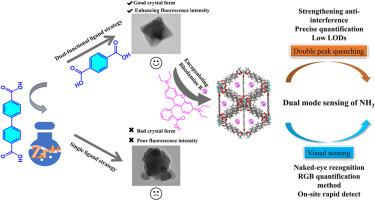
双发射[email protected]:超低LOD氨检测及现场视觉识别平台
发光金属有机框架(LMOFs)由于其可调谐的发光特性而成为一种很有前途的光学传感材料。然而,现有的基于lmof的传感器大多依赖于单波长的荧光强度变化,由于缺乏辅助参考信号,对环境波动的抵抗能力较差,限制了其准确性,特别是对于低于人类嗅觉阈值的微量氨(NH3),逃避了感官感知,但存在长期风险。为了解决这一限制,设计了uuo -67-x,其中x表示对苯二甲酸(H2BDC)与联苯-4,4 ' -二羧酸(H2BPDC)的摩尔比。通过优化配体配比,合成了结晶度清晰、比表面积大、荧光发射峰强度高的UIO-67-0.2。它的规则结构使罗丹明B (RhB)的有效封装形成双发射[电子邮件保护]平台。该平台具有两个可调的发射峰,对氨的响应灵敏且同步,通过双通道协同验证,增强了信号的可靠性和抗干扰能力。值得注意的是[email protected]实现了0.2 ppm的超低NH3检测限(LOD),远低于嗅觉阈值,并且在5次循环后保持了显著的稳定性,具有稳定的可重复使用性。结合实验和密度泛函理论(DFT)计算,阐明了其猝灭机理为静态猝灭和电荷转移的协同作用。在365nm紫外线(UV)下,在2.5 ppm NH3下,滴投膜呈现肉眼可分辨的颜色变化。它与其他挥发性有机化合物(VOCs)保持不变,并显示出浓度依赖的颜色渐变,用于半定量评估。通过ΔE分析对荧光颜色信号进行数字化转换,实现了真正意义上的氨定量检测,校准曲线线性(R2 = 0.968),消除了肉眼判断的主观性。本研究开发了一种用于亚嗅觉阈值NH3检测的双模LMOF,并为抗干扰双发射平台设计提供了信息,使现场低成本监测成为可能。
本文章由计算机程序翻译,如有差异,请以英文原文为准。
求助全文
约1分钟内获得全文
求助全文
来源期刊
Microporous and Mesoporous Materials
化学-材料科学:综合
CiteScore
10.70
自引率
5.80%
发文量
649
审稿时长
26 days
期刊介绍:
Microporous and Mesoporous Materials covers novel and significant aspects of porous solids classified as either microporous (pore size up to 2 nm) or mesoporous (pore size 2 to 50 nm). The porosity should have a specific impact on the material properties or application. Typical examples are zeolites and zeolite-like materials, pillared materials, clathrasils and clathrates, carbon molecular sieves, ordered mesoporous materials, organic/inorganic porous hybrid materials, or porous metal oxides. Both natural and synthetic porous materials are within the scope of the journal.
Topics which are particularly of interest include:
All aspects of natural microporous and mesoporous solids
The synthesis of crystalline or amorphous porous materials
The physico-chemical characterization of microporous and mesoporous solids, especially spectroscopic and microscopic
The modification of microporous and mesoporous solids, for example by ion exchange or solid-state reactions
All topics related to diffusion of mobile species in the pores of microporous and mesoporous materials
Adsorption (and other separation techniques) using microporous or mesoporous adsorbents
Catalysis by microporous and mesoporous materials
Host/guest interactions
Theoretical chemistry and modelling of host/guest interactions
All topics related to the application of microporous and mesoporous materials in industrial catalysis, separation technology, environmental protection, electrochemistry, membranes, sensors, optical devices, etc.
 求助内容:
求助内容: 应助结果提醒方式:

 京公网安备 11010802042870号


