
Legume presence modulates soil bacterial diversity, composition, network complexity, and functions under drought in timothy-red clover mixed stands
IF 5
2区 农林科学
Q1 SOIL SCIENCE
引用次数: 0
Abstract
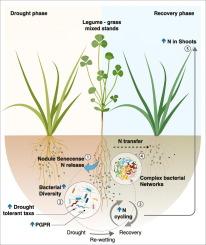
Drought disrupts soil microbial communities by altering their diversity, composition, and network stability, impacting biogeochemical cycles that are critical for plant growth. While legume-based forage systems may enhance microbial resilience through nitrogen inputs, the response of soil bacterial communities to drought across different forage systems remains largely unexplored. This greenhouse study investigated soil bacterial community dynamics in timothy grass (Phleum pratense L.) monocultures versus timothy-red clover (Trifolium pratense L.) mixed stands under moderate (40% field capacity, FC), severe (20% FC), and no-drought (80% FC) conditions, followed by a post-drought recovery. Four weeks of drought significantly increased bacterial alpha and beta diversity in clover-timothy mixed stand soils, while grass monoculture soils showed no notable changes. Compositional shifts in mixed stand favors drought-tolerant Actinomycetota while reducing the desiccation-sensitive taxa. Co-occurrence network analysis revealed that mixed stands form larger, more complex, and more stable bacterial networks under moderate drought (during drought phase), and severe drought (during recovery phase) compared to grass monocultures. Notably, mixed stands exhibited enriched predicted nitrogen-cycling functions, potentially driven by nitrogen release from nodule senescence, with denitrification rates significantly exceeding those in monocultures, under both drought and recovery phases. Correspondingly, mixed stands outperformed the grass monocultures, exhibiting higher biomass, lower shoot C:N ratios, and increased total shoot nitrogen content, likely driven by legume rhizodeposition. These findings underscore the critical role of grass-legume mixtures in maintaining microbial network stability, nitrogen cycling, and forage productivity under drought and post-drought recovery, providing valuable insights for sustainable agriculture in climate-challenged environments.
豆科植物的存在调节干旱条件下红三叶草混交林土壤细菌多样性、组成、网络复杂性和功能
干旱通过改变土壤微生物群落的多样性、组成和网络稳定性来破坏土壤微生物群落,影响对植物生长至关重要的生物地球化学循环。虽然豆科牧草系统可以通过氮输入增强微生物的恢复力,但不同牧草系统对土壤细菌群落对干旱的反应在很大程度上仍未被探索。本温室研究调查了在中度(40%田间容量,FC)、重度(20% FC)和无干旱(80% FC)条件下,蒂莫西草(Phleum pratense L.)单一栽培与蒂莫西-红三叶草(Trifolium pratense L.)混交林的土壤细菌群落动态,以及干旱后恢复。4周干旱显著增加了三叶草-蒂莫西混交林土壤细菌α和β多样性,而单作草地土壤细菌α和β多样性变化不显著。混交林的组成变化有利于抗旱放线菌,而减少了对干燥敏感的类群。共生网络分析表明,与单株草相比,混合林分在中度干旱(干旱期)和重度干旱(恢复期)下形成的细菌网络更大、更复杂、更稳定。值得注意的是,在干旱和恢复阶段,混合林分表现出丰富的预测氮循环功能,这可能是由根瘤衰老释放的氮驱动的,其反硝化速率显著高于单一林分。相应地,混合林分表现出更高的生物量、更低的地上部C:N比和更高的地上部总氮含量,这可能是由豆科植物的根沉积驱动的。这些发现强调了在干旱和干旱后恢复条件下,草-豆科植物混合物在维持微生物网络稳定性、氮循环和牧草生产力方面的关键作用,为气候挑战环境下的可持续农业提供了有价值的见解。
本文章由计算机程序翻译,如有差异,请以英文原文为准。
求助全文
约1分钟内获得全文
求助全文
来源期刊
Applied Soil Ecology
农林科学-土壤科学
CiteScore
9.70
自引率
4.20%
发文量
363
审稿时长
5.3 months
期刊介绍:
Applied Soil Ecology addresses the role of soil organisms and their interactions in relation to: sustainability and productivity, nutrient cycling and other soil processes, the maintenance of soil functions, the impact of human activities on soil ecosystems and bio(techno)logical control of soil-inhabiting pests, diseases and weeds.
 求助内容:
求助内容: 应助结果提醒方式:

 京公网安备 11010802042870号


