
Effects of hummock–hollow microtopography on soil microbial communities and their links to soil carbon cycling in a sedge peatland of the Changbai mountains
IF 5
2区 农林科学
Q1 SOIL SCIENCE
引用次数: 0
Abstract
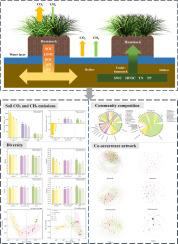
In peatlands, hummock–hollow microtopography generates distinct environmental gradients, leading to significant variations in carbon emissions and stocks between hummocks and hollows. However, the influence of such microtopographic differences on soil microbial communities remains poorly understood, hindering a clear understanding of the mechanisms underlying microtopography-driven carbon cycling. Here, we used high-throughput sequencing to investigate how hummock-hollow microtopography affects bacterial and fungal communities, as well as their relationships with soil carbon emissions, in the sedge peatlands of the Changbai Mountains in Northeast China. Our results revealed that soil CO₂ and CH₄ emissions varied significantly across three microtopographic positions, with hummocks exhibiting the highest CO₂ emissions, whereas under-hummock and hollow soils presented higher CH₄ emissions than hummocks did. Bacterial community metrics displayed significant variations across microtopographic positions, with hummocks exhibiting higher bacterial Shannon indices, a greater abundance of the bacterial phylum Proteobacteria, and more complex co-occurrence networks, whereas Chloroflexi were more abundant in hollows and Bacteroidetes were more abundant in under-hummocks. In contrast, microtopography had no significant effect on fungal diversity, community composition, and co-occurrence networks. Partial least squares path models showed that microtopographic variations between hummocks and under-hummocks created divergent hydrothermal conditions, which in turn altered the availability of organic substrates and nutrients. These environmental differences further shape bacterial communities and thereby modulate the significant variations in carbon emissions across microtopographic positions. Our study highlights that microtopography-driven environmental heterogeneity primarily regulates bacterial but not fungal community dynamics and that this bacterial-mediated pathway constitutes a core mechanism shaping peatland carbon cycling.
长白山莎草泥炭地丘空心微地形对土壤微生物群落的影响及其与土壤碳循环的联系
在泥炭地,凹丘-凹丘微地形产生了明显的环境梯度,导致凹丘和凹丘之间碳排放和储量的显著差异。然而,这种微地形差异对土壤微生物群落的影响仍然知之甚少,阻碍了对微地形驱动碳循环机制的清晰理解。本研究利用高通量测序技术,研究了长白山莎草泥炭地的凹丘微地形对细菌和真菌群落的影响,以及它们与土壤碳排放的关系。研究结果表明,土壤CO₂和CH₄的排放量在三个微地形位置上存在显著差异,丘状土壤的CO₂排放量最高,而丘下土壤和空心土壤的CH₄排放量高于丘状土壤。细菌群落指标在不同的微地形位置上表现出显著的差异,小丘表现出更高的细菌香农指数,更丰富的变形菌门细菌,更复杂的共生网络,而氯霉素在洼地中更丰富,拟杆菌门在小丘下更丰富。微地形对真菌多样性、群落组成和共生网络无显著影响。偏最小二乘路径模型显示,丘与下丘之间的微地形差异创造了不同的热液条件,从而改变了有机基质和营养物质的有效性。这些环境差异进一步塑造了细菌群落,从而调节了微地形位置上碳排放的显著变化。我们的研究强调,微地形驱动的环境异质性主要调节细菌而不是真菌群落动态,这种细菌介导的途径构成了形成泥炭地碳循环的核心机制。
本文章由计算机程序翻译,如有差异,请以英文原文为准。
求助全文
约1分钟内获得全文
求助全文
来源期刊
Applied Soil Ecology
农林科学-土壤科学
CiteScore
9.70
自引率
4.20%
发文量
363
审稿时长
5.3 months
期刊介绍:
Applied Soil Ecology addresses the role of soil organisms and their interactions in relation to: sustainability and productivity, nutrient cycling and other soil processes, the maintenance of soil functions, the impact of human activities on soil ecosystems and bio(techno)logical control of soil-inhabiting pests, diseases and weeds.
 求助内容:
求助内容: 应助结果提醒方式:

 京公网安备 11010802042870号


