
Dynamic mechanical behavior of K417G superalloy: development of Johnson-Cook constitutive model and its application in single-grit grinding
IF 7.9
2区 材料科学
Q1 MATERIALS SCIENCE, MULTIDISCIPLINARY
引用次数: 0
Abstract
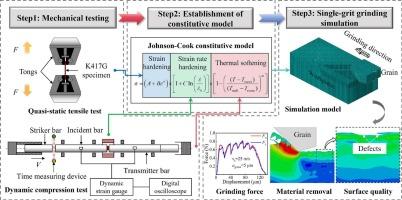
Precision grinding of K417G superalloy, a key material for hot-end components of aero-engines, is plagued by large grinding forces and excessive heat generation. Clarifying the material removal mechanism is a prerequisite for optimizing the grinding process. Although single-grit grinding is a critical method for revealing this mechanism, it suffers from bottlenecks, such as the difficult acquisition of force or stress fields and poor process visualization. Finite element simulation, an alternative approach, cannot be practically applied because of the lack of dynamic mechanical properties data and a suitable constitutive model for K417G. This study systematically investigates the dynamic mechanical behavior of K417G and develops a Johnson-Cook constitutive model with high fitting accuracy. After embedding this model into single-grit grinding simulations, the study further quantifies the effects of undeformed chip thickness and grinding speed on material removal behavior. The results show that the undeformed chip thickness significantly affects the grinding force, chip morphology, and residual stress. This study not only provides a reliable constitutive basis for the simulation modeling of the precision grinding of K417G but also offers key theoretical support for the accurate optimization of grinding processes for aero-engine hot-end components, which has important engineering application value.
K417G高温合金动态力学行为:Johnson-Cook本构模型的建立及其在单粒磨削中的应用
K417G高温合金是航空发动机热端部件的关键材料,其精密磨削存在磨削力大、发热量过大的问题。明确材料去除机理是优化磨削工艺的前提。虽然单粒磨削是揭示该机制的关键方法,但它存在瓶颈,例如难以获取力或应力场以及较差的过程可视化。由于缺乏K417G的动态力学性能数据和合适的本构模型,有限元模拟作为一种替代方法无法实际应用。本研究系统研究了K417G的动态力学行为,建立了具有较高拟合精度的Johnson-Cook本构模型。将该模型嵌入到单粒磨削模拟中,进一步量化了未变形切屑厚度和磨削速度对材料去除行为的影响。结果表明,未变形切屑厚度对磨削力、切屑形貌和残余应力有显著影响。该研究不仅为K417G精密磨削仿真建模提供了可靠的本构基础,而且为航空发动机热端部件磨削工艺的精确优化提供了关键的理论支持,具有重要的工程应用价值。
本文章由计算机程序翻译,如有差异,请以英文原文为准。
求助全文
约1分钟内获得全文
求助全文
来源期刊
Materials & Design
Engineering-Mechanical Engineering
CiteScore
14.30
自引率
7.10%
发文量
1028
审稿时长
85 days
期刊介绍:
Materials and Design is a multi-disciplinary journal that publishes original research reports, review articles, and express communications. The journal focuses on studying the structure and properties of inorganic and organic materials, advancements in synthesis, processing, characterization, and testing, the design of materials and engineering systems, and their applications in technology. It aims to bring together various aspects of materials science, engineering, physics, and chemistry.
The journal explores themes ranging from materials to design and aims to reveal the connections between natural and artificial materials, as well as experiment and modeling. Manuscripts submitted to Materials and Design should contain elements of discovery and surprise, as they often contribute new insights into the architecture and function of matter.
 求助内容:
求助内容: 应助结果提醒方式:

 京公网安备 11010802042870号


