
Spectral light regulation enhances sprouting, physiological efficiency, and ionomic homeostasis in Western Himalayan buckwheat
IF 6.8
1区 农林科学
Q1 FOOD SCIENCE & TECHNOLOGY
Innovative Food Science & Emerging Technologies
Pub Date : 2026-05-01
Epub Date: 2026-02-05
DOI:10.1016/j.ifset.2026.104479
引用次数: 0
Abstract
This study examined the effects of different spectral LED (light-emitting diode) light treatments on growth performance, physiological responses, and underlying ionomic variations in 6-day-old sprouts of two underutilized western Himalayan buckwheat species, namely Fagopyrum esculentum Moench (common buckwheat) and F. tataricum Gaertn. (Tartary buckwheat). Both species responded differentially to spectral modulation, exhibiting variation in overall growth and elemental distribution. The highest biomass accumulation was predominantly reported in common buckwheat, whereas Tartary buckwheat showed a more pronounced ionomic shift across different spectral treatments. Blue light significantly enhanced elemental concentrations in both species. Specifically, it improved Na, Mn, Mg, Co, and Cu concentrations in Tartary buckwheat, whereas B, Fe, and Cu concentrations in common buckwheat. Multivariate analysis, including hierarchical clustering and principal component analysis, confirmed distinct ionomic separation patterns between treated and control groups. A linear association was also revealed among several elemental pairs, indicating coordinated nutrient regulation in response to spectral light modulation. Blue light further improved APX, CAT, Vitamin C, and total protein levels in both species, whereas red light stimulated SOD activity, demonstrating wavelength-specific regulation of enzymatic antioxidative potential. In contrast, the 70Blue: 30Red spectral combination increased the total sugar content while simultaneously promoting the accumulation of photosynthetic and photoprotective pigments. The study explicitly highlights the importance of species-specific lighting strategies tailored to the targeted enhancement of biomass, pigments, antioxidants, and ionomic profile in a controlled environment. Additionally, the findings offer a promising approach for advancing the functional and nutraceutical quality of Himalayan buckwheat sprouts, ultimately improving their consumer acceptance and commercial potential.
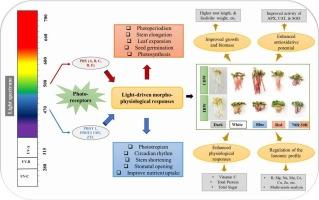
光谱光调节提高了西喜马拉雅荞麦的发芽、生理效率和体内经济平衡
本研究研究了不同光谱LED(发光二极管)光处理对两种未充分利用的喜马拉雅西部荞麦品种荞麦(Fagopyrum esculentum Moench)和荞麦(F. tataricum Gaertn) 6日龄芽的生长性能、生理反应和潜在的基因组变化的影响。(苦荞麦)。两个物种对光谱调制的响应不同,表现出整体生长和元素分布的差异。据报道,最高的生物量积累主要在普通荞麦中,而苦荞在不同的光谱处理中表现出更明显的生态变化。蓝光显著提高了两个物种的元素浓度。具体来说,它提高了苦荞中Na、Mn、Mg、Co和Cu的浓度,而普通荞麦中B、Fe和Cu的浓度。多变量分析,包括层次聚类和主成分分析,证实了治疗组和对照组之间明显的经济分离模式。几种元素对之间也存在线性关联,表明光谱光调制对营养物质的协调调节。蓝光进一步提高了两种植物的APX、CAT、维生素C和总蛋白水平,而红光则刺激了SOD活性,证明了波长特异性调节酶的抗氧化潜力。70Blue: 30Red光谱组合增加了总糖含量,同时促进了光合色素和光保护色素的积累。该研究明确强调了在受控环境中定制特定物种的照明策略的重要性,这些策略可以有针对性地增强生物量、色素、抗氧化剂和生物特征。此外,研究结果为提高喜马拉雅荞麦芽的功能和营养质量提供了一个有希望的方法,最终提高其消费者接受度和商业潜力。
本文章由计算机程序翻译,如有差异,请以英文原文为准。
求助全文
约1分钟内获得全文
求助全文
来源期刊
CiteScore
12.00
自引率
6.10%
发文量
259
审稿时长
25 days
期刊介绍:
Innovative Food Science and Emerging Technologies (IFSET) aims to provide the highest quality original contributions and few, mainly upon invitation, reviews on and highly innovative developments in food science and emerging food process technologies. The significance of the results either for the science community or for industrial R&D groups must be specified. Papers submitted must be of highest scientific quality and only those advancing current scientific knowledge and understanding or with technical relevance will be considered.
 求助内容:
求助内容: 应助结果提醒方式:

 京公网安备 11010802042870号


