
Enhancing charge transport and device stability of MAPbI3 perovskite solar cells by hole-transport bilayer

IF 2.6 4区 工程技术 Q3 MATERIALS SCIENCE, MULTIDISCIPLINARY
Organic Electronics Pub Date : 2026-04-01 Epub Date: 2026-02-02 DOI:10.1016/j.orgel.2026.107391
Shanshan Du , Niqian Du , Yaru Du , Xiangda Zeng , Xiaobo Zhang , Kaikai Liu , Zhiyong Liu
{"title":"Enhancing charge transport and device stability of MAPbI3 perovskite solar cells by hole-transport bilayer","authors":"Shanshan Du ,&nbsp;Niqian Du ,&nbsp;Yaru Du ,&nbsp;Xiangda Zeng ,&nbsp;Xiaobo Zhang ,&nbsp;Kaikai Liu ,&nbsp;Zhiyong Liu","doi":"10.1016/j.orgel.2026.107391","DOIUrl":null,"url":null,"abstract":"<div><div>Perovskite solar cells (PSCs) have attracted widespread attention and have gained rapid progress. The poly(3,4-ethylenedioxythiophene):poly(styrene sulfonate) (PEDOT:PSS) is widely used as a hole transport layer (HTL) in inverted architectures. However, the devices based on PEDOT:PSS suffer from low efficiency and poor stability, primarily due to energy-level misalignment and an unfavorable HTL/perovskite interface. Herein, a poly (triarylamine) (PTAA) layer is deposited on top of the PEDOT:PSS film to construct a PEDOT:PSS/PTAA hole-transport bilayer, thereby improving the interface between PEDOT:PSS and the perovskite and boosting the performance of PSCs. The introduction of the PTAA layer mitigates the hydrophilicity of PEDOT:PSS, realizes energy-band alignment, and accelerates carrier extraction. Consequently, the power-conversion efficiency (PCE) of the PSCs increased from 21.95% to 22.81%. Unencapsulated devices retain &gt;70% of initial performance after 30 days at a humidity of ∼20% and room temperature, substantially outperforming the device with a PEDOT:PSS layer (∼40%). This work provides an easily accessible bilayer HTL strategy that boosts both efficiency and stability of PEDOT:PSS-based inverted PSCs.</div></div>","PeriodicalId":399,"journal":{"name":"Organic Electronics","volume":"151 ","pages":"Article 107391"},"PeriodicalIF":2.6000,"publicationDate":"2026-04-01","publicationTypes":"Journal Article","fieldsOfStudy":null,"isOpenAccess":false,"openAccessPdf":"","citationCount":"0","resultStr":null,"platform":"Semanticscholar","paperid":null,"PeriodicalName":"Organic Electronics","FirstCategoryId":"5","ListUrlMain":"https://www.sciencedirect.com/science/article/pii/S1566119926000200","RegionNum":4,"RegionCategory":"工程技术","ArticlePicture":[],"TitleCN":null,"AbstractTextCN":null,"PMCID":null,"EPubDate":"2026/2/2 0:00:00","PubModel":"Epub","JCR":"Q3","JCRName":"MATERIALS SCIENCE, MULTIDISCIPLINARY","Score":null,"Total":0}
引用次数: 0

Abstract

Perovskite solar cells (PSCs) have attracted widespread attention and have gained rapid progress. The poly(3,4-ethylenedioxythiophene):poly(styrene sulfonate) (PEDOT:PSS) is widely used as a hole transport layer (HTL) in inverted architectures. However, the devices based on PEDOT:PSS suffer from low efficiency and poor stability, primarily due to energy-level misalignment and an unfavorable HTL/perovskite interface. Herein, a poly (triarylamine) (PTAA) layer is deposited on top of the PEDOT:PSS film to construct a PEDOT:PSS/PTAA hole-transport bilayer, thereby improving the interface between PEDOT:PSS and the perovskite and boosting the performance of PSCs. The introduction of the PTAA layer mitigates the hydrophilicity of PEDOT:PSS, realizes energy-band alignment, and accelerates carrier extraction. Consequently, the power-conversion efficiency (PCE) of the PSCs increased from 21.95% to 22.81%. Unencapsulated devices retain >70% of initial performance after 30 days at a humidity of ∼20% and room temperature, substantially outperforming the device with a PEDOT:PSS layer (∼40%). This work provides an easily accessible bilayer HTL strategy that boosts both efficiency and stability of PEDOT:PSS-based inverted PSCs.
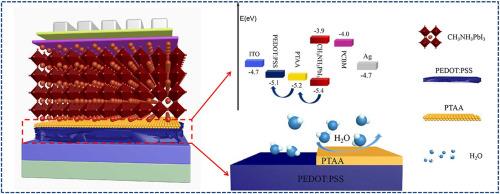
Abstract Image

空穴-输运双分子层增强MAPbI3钙钛矿太阳能电池的电荷输运和器件稳定性
钙钛矿太阳能电池(PSCs)得到了广泛的关注和迅速的发展。聚(3,4-乙烯二氧噻吩):聚(苯乙烯磺酸盐)(PEDOT:PSS)在倒置结构中广泛用作空穴传输层(HTL)。然而,基于PEDOT:PSS的器件效率低,稳定性差,主要是由于能级错位和html /钙钛矿界面不利。在PEDOT:PSS薄膜上沉积聚三烯胺(PTAA)层,构建PEDOT:PSS/PTAA空穴传输双层膜,从而改善PEDOT:PSS与钙钛矿之间的界面,提高PSCs的性能。PTAA层的引入减轻了PEDOT:PSS的亲水性,实现了能带对准,加速了载流子提取。因此,PSCs的功率转换效率(PCE)从21.95%提高到22.81%。未封装的器件在湿度为~ 20%和室温下30天后仍保持70%的初始性能,大大优于具有PEDOT:PSS层的器件(~ 40%)。这项工作提供了一个易于访问的双层html策略,提高了基于PEDOT: pss的倒置PSCs的效率和稳定性。
本文章由计算机程序翻译,如有差异,请以英文原文为准。
求助全文
约1分钟内获得全文 求助全文
来源期刊
Organic Electronics
Organic Electronics 工程技术-材料科学:综合
CiteScore
6.60
自引率
6.20%
发文量
238
审稿时长
44 days
期刊介绍: Organic Electronics is a journal whose primary interdisciplinary focus is on materials and phenomena related to organic devices such as light emitting diodes, thin film transistors, photovoltaic cells, sensors, memories, etc. Papers suitable for publication in this journal cover such topics as photoconductive and electronic properties of organic materials, thin film structures and characterization in the context of organic devices, charge and exciton transport, organic electronic and optoelectronic devices.

×
引用
GB/T 7714-2015
复制
MLA
复制
APA
复制
导出至
BibTeX EndNote RefMan NoteFirst NoteExpress
×
提示
您的信息不完整,为了账户安全,请先补充。
现在去补充
×
提示
您因"违规操作"
具体请查看互助需知
我知道了
×
提示
确定
请完成安全验证×
copy
已复制链接
快去分享给好友吧!
我知道了
右上角分享
点击右上角分享
0
联系我们:info@booksci.cn Book学术提供免费学术资源搜索服务,方便国内外学者检索中英文文献。致力于提供最便捷和优质的服务体验。 Copyright © 2023 布克学术 All rights reserved.
京ICP备2023020795号-1
ghs 京公网安备 11010802042870号
Book学术文献互助
Book学术文献互助群
群 号:604180095
Book学术官方微信
小红书


