
All-solid-state flexible symmetric light-driven supercapacitor based on indium oxide-modified carbon nanotube bifunctional photoelectrodes
IF 5.6
3区 材料科学
Q1 ELECTROCHEMISTRY
引用次数: 0
Abstract
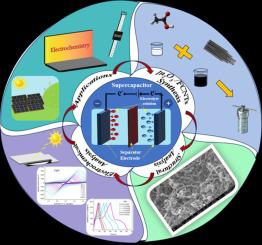
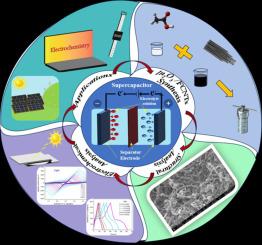
Light-driven supercapacitors (LDSCs) enable sustainable energy storage in flexible forms for portable devices and transportation. Flexible carbon-based electrodes offer promising conductivity, lightness, strength, durability, high surface area, porosity and flexibility. Carbon nanotubes decorated with indium oxide prepared by hydrothermal treatment serve as a flexible photoelectrode that integrates both photoactive and energy storage functionalities in LDSCs. The In2O3@CNT electrode significantly improves the electrochemical performance compared to pure In2O3 and bare CNTs due to the superior electrical conductivity and larger specific surface area. This improvement is due to the synergistic integration of In2O3 with carbon nanotubes, which optimize the charge transport and accessibility of the active sites. Consequently, the optimized In2O3@CNT electrode delivered a high capacitance of 0.9 mAh/cm2 at a current density of 0.08 mA/cm2. Under illumination, the specific capacitance of the electrode reached 1.4 mAh/cm2, which corresponds to a 1.55-fold increase compared to conditions in the dark. The device showed exceptional flexibility when assembled into a flexible symmetrical LDSC with a sandwich structure. It achieved a specific capacitance of 1.2 mAh/cm2, an energy density of 1.77 mWh/cm2 and a power density of 53.15 mW/cm2. Light-assisted operation resulted in a remarkable increase in specific capacitance compared to dark conditions, suggesting that charges generated by light increase conductivity and accelerate charge transfer processes. In addition, the effects of simultaneous double-sided illumination on the characterization of this device were evaluated, with the results indicating that the capacitance under double-sided illumination exceeds that under single-sided illumination. Overall, the study provides a practical and simple approach to increase the light absorption efficiency and overall performance of flexible LDSCs.
基于氧化铟修饰碳纳米管双功能光电极的全固态柔性对称光驱动超级电容器
光驱动超级电容器(LDSCs)能够以灵活的形式为便携式设备和运输实现可持续的能量存储。柔性碳基电极具有良好的导电性、轻便性、强度、耐久性、高表面积、多孔性和灵活性。水热法制备氧化铟修饰的碳纳米管作为柔性光电极,在ldsc中具有光活性和储能功能。与纯In2O3和裸碳纳米管相比,In2O3@CNT电极具有更好的导电性和更大的比表面积,显著提高了电化学性能。这种改善是由于In2O3与碳纳米管的协同集成,优化了电荷传输和活性位点的可达性。因此,优化后的In2O3@CNT电极在0.08 mA/cm2的电流密度下提供了0.9 mAh/cm2的高电容。在照明条件下,电极的比电容达到1.4 mAh/cm2,与黑暗条件相比增加了1.55倍。当组装成具有三明治结构的柔性对称LDSC时,该器件显示出非凡的灵活性。其比电容为1.2 mAh/cm2,能量密度为1.77 mWh/cm2,功率密度为53.15 mW/cm2。与黑暗条件相比,光辅助操作导致比电容显著增加,这表明光产生的电荷增加了电导率并加速了电荷转移过程。此外,还评估了双面同时照明对该器件表征的影响,结果表明双面照明下的电容大于单面照明下的电容。总的来说,该研究为提高柔性LDSCs的光吸收效率和整体性能提供了一种实用而简单的方法。
本文章由计算机程序翻译,如有差异,请以英文原文为准。
求助全文
约1分钟内获得全文
求助全文
来源期刊
Electrochimica Acta
工程技术-电化学
CiteScore
11.30
自引率
6.10%
发文量
1634
审稿时长
41 days
期刊介绍:
Electrochimica Acta is an international journal. It is intended for the publication of both original work and reviews in the field of electrochemistry. Electrochemistry should be interpreted to mean any of the research fields covered by the Divisions of the International Society of Electrochemistry listed below, as well as emerging scientific domains covered by ISE New Topics Committee.
 求助内容:
求助内容: 应助结果提醒方式:

 京公网安备 11010802042870号


