{"title":"Impact of Season, Semen Collection Frequency and Between-Male Variation on Ostrich Seminal Plasma Composition.","authors":"Pfunzo Muvhali, Maud Bonato, Irek Malecki, Kevin Douglas, Pieter Swart, Schalk Cloete","doi":"10.1111/rda.70186","DOIUrl":null,"url":null,"abstract":"<p><p>This study evaluated the effect of season, semen collection frequency, and male variation on seminal plasma composition of farmed ostriches. Five South African Black ostrich males (4.47 ± 0.95 years of age) were used in spring 2011 and winter 2012. Semen was collected once daily, three times with an interval of 4 days between collections, followed by three collections at two-day intervals, and daily for three consecutive days using the dummy female method. Seminal plasma volume was measured with an automatic pipette after semen centrifugation, while seminal plasma protein concentration was determined using the Bradford Coomasie assay. Total seminal plasma proteins were obtained as a product of seminal plasma volume and protein concentration. Semen samples collected in spring had lower total seminal plasma proteins and protein concentration compared to samples collected in winter. Semen collection frequency had no effect on total seminal plasma proteins and protein concentration. Seminal plasma volume was independent of season and semen collection frequency. Lastly, between-male variation was recorded for all seminal plasma traits, with repeatability estimates for seminal plasma volume, seminal plasma protein concentration and total seminal plasma proteins amounting to 0.51 ± 0.19, 0.33 ± 0.18 and 0.44 ± 0.19, respectively. This study established that higher seminal plasma protein levels are characteristic of winter collections, while frequent semen collection exerts no influence on seminal plasma composition. Between-male variation and repeatability estimates suggest identification and selection for males with favourable seminal plasma concentration could be achievable in the ostrich.</p>","PeriodicalId":21035,"journal":{"name":"Reproduction in Domestic Animals","volume":"61 2","pages":"e70186"},"PeriodicalIF":1.7000,"publicationDate":"2026-02-01","publicationTypes":"Journal Article","fieldsOfStudy":null,"isOpenAccess":false,"openAccessPdf":"https://www.ncbi.nlm.nih.gov/pmc/articles/PMC12903072/pdf/","citationCount":"0","resultStr":null,"platform":"Semanticscholar","paperid":null,"PeriodicalName":"Reproduction in Domestic Animals","FirstCategoryId":"97","ListUrlMain":"https://doi.org/10.1111/rda.70186","RegionNum":3,"RegionCategory":"农林科学","ArticlePicture":[],"TitleCN":null,"AbstractTextCN":null,"PMCID":null,"EPubDate":"","PubModel":"","JCR":"Q2","JCRName":"AGRICULTURE, DAIRY & ANIMAL SCIENCE","Score":null,"Total":0}
引用次数: 0
Abstract
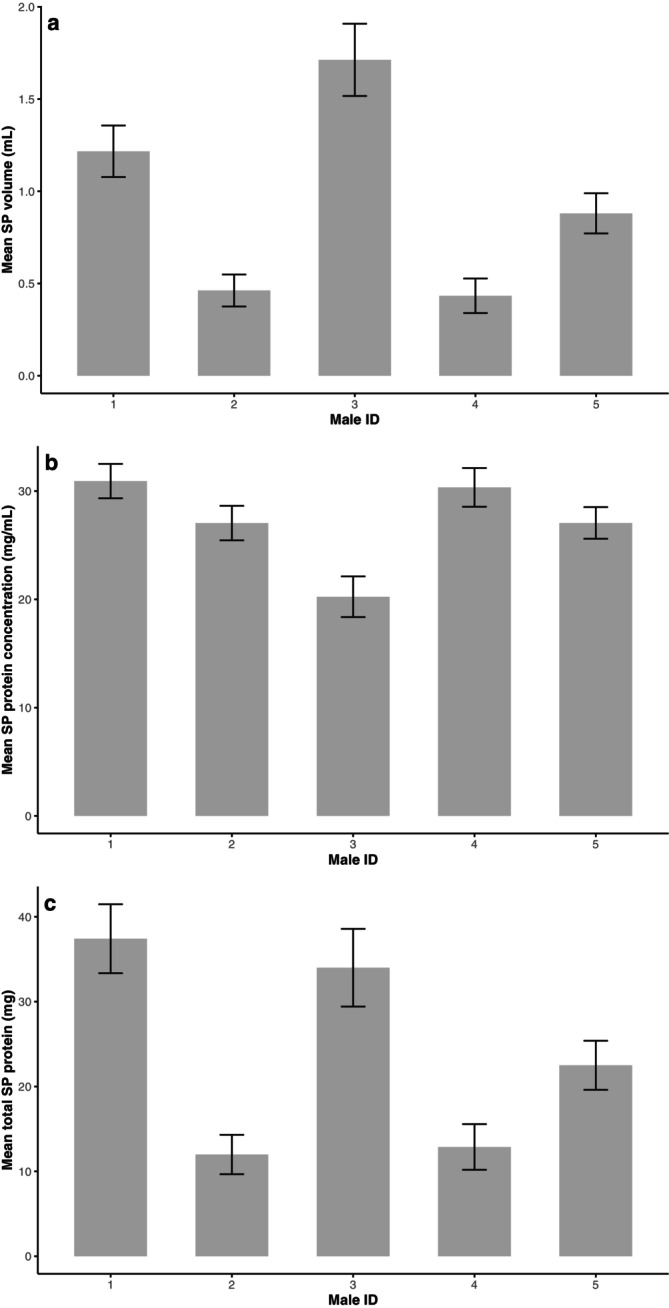
This study evaluated the effect of season, semen collection frequency, and male variation on seminal plasma composition of farmed ostriches. Five South African Black ostrich males (4.47 ± 0.95 years of age) were used in spring 2011 and winter 2012. Semen was collected once daily, three times with an interval of 4 days between collections, followed by three collections at two-day intervals, and daily for three consecutive days using the dummy female method. Seminal plasma volume was measured with an automatic pipette after semen centrifugation, while seminal plasma protein concentration was determined using the Bradford Coomasie assay. Total seminal plasma proteins were obtained as a product of seminal plasma volume and protein concentration. Semen samples collected in spring had lower total seminal plasma proteins and protein concentration compared to samples collected in winter. Semen collection frequency had no effect on total seminal plasma proteins and protein concentration. Seminal plasma volume was independent of season and semen collection frequency. Lastly, between-male variation was recorded for all seminal plasma traits, with repeatability estimates for seminal plasma volume, seminal plasma protein concentration and total seminal plasma proteins amounting to 0.51 ± 0.19, 0.33 ± 0.18 and 0.44 ± 0.19, respectively. This study established that higher seminal plasma protein levels are characteristic of winter collections, while frequent semen collection exerts no influence on seminal plasma composition. Between-male variation and repeatability estimates suggest identification and selection for males with favourable seminal plasma concentration could be achievable in the ostrich.
期刊介绍:
The journal offers comprehensive information concerning physiology, pathology, and biotechnology of reproduction. Topical results are currently published in original papers, reviews, and short communications with particular attention to investigations on practicable techniques.
Carefully selected reports, e. g. on embryo transfer and associated biotechnologies, gene transfer, and spermatology provide a link between basic research and clinical application. The journal applies to breeders, veterinarians, and biologists, and is also of interest in human medicine. Interdisciplinary cooperation is documented in the proceedings of the joint annual meetings.
Fields of interest: Animal reproduction and biotechnology with special regard to investigations on applied and clinical research.


 求助内容:
求助内容: 应助结果提醒方式:

 京公网安备 11010802042870号


