
Magmatic evolution of the Karakoram Batholith, Trans-Himalaya, NW India: Geochemical insights for arc dynamics and crustal growth
IF 2.4
3区 地球科学
Q2 GEOSCIENCES, MULTIDISCIPLINARY
Journal of Asian Earth Sciences
Pub Date : 2026-04-01
Epub Date: 2026-01-30
DOI:10.1016/j.jseaes.2026.106989
引用次数: 0
Abstract
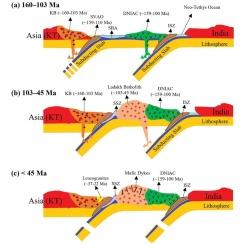
The Karakoram Terrane (KT), a continental block along the southern margin of the Asian Plate, originated within the peri-Gondwanan Cimmerian assemblage. It rifted from the Gondwana during the Permian, opened the Neo-Tethys Ocean, and accreted to southern Asia by the Early Jurassic. To constrain its tectono-magmatic evolution, we present whole-rock geochemical data from the Karakoram Batholith (KB), a major granitoid complex of the Trans-Himalaya, NW India. The KB is dominated by porphyritic granites containing abundant diorite enclaves, reflecting magma mingling between coeval mafic and felsic melts. Geochemically, KB granites and diorites exhibit calc-alkaline metaluminous characteristics typical of I-type granitoids, analogous to subduction-zone settings. KB granites have whole-rock εNd(t = 110 Ma) values from -6.9 to -8.8 with Nd depleted mantle model ages (TDM) from 1650 to 1857 Ma. Similarly, KB diorites have whole-rock εNd(t = 110 Ma) values from -4.5 to -6.3 with TDM from 1800 to 1953 Ma. These results are analogous to those of the Middle Cretaceous KB diorites (-8.2 to -7.3, and 1380 to 1650 Ma; respectively). These features indicate that during the Jurassic-Cretaceous, northward subduction of the Neo-Tethys oceanic plate beneath the southern margin of the KT established an Andean-type tectonic setting. This emplaced extensive KB magmatism derived from mixed sources, including the mantle wedge and upper crustal rocks of the KT.
印度西北部跨喜马拉雅喀喇昆仑岩基的岩浆演化:弧动力学和地壳生长的地球化学见解
喀喇昆仑地体(KT)是亚洲板块南缘的一个大陆块体,起源于近冈瓦南西米叠世组合。它在二叠纪时期从冈瓦纳裂化,打开了新特提斯洋,并在早侏罗世增生到南亚。为了限制其构造-岩浆演化,我们提供了喀喇昆仑岩基(KB)的全岩石地球化学数据,KB是印度西北部跨喜马拉雅山脉的一个主要花岗岩杂岩。KB以含丰富闪长岩包体的斑状花岗岩为主,反映了同世镁质和长英质熔体的岩浆混合作用。地球化学上,KB花岗岩和闪长岩表现出典型的i型花岗岩的钙碱性成矿特征,类似于俯冲带环境。KB花岗岩全岩εNd(t = 110 Ma)值为-6.9 ~ -8.8,Nd贫化地幔模式年龄(TDM)为1650 ~ 1857 Ma。KB闪长岩的全岩εNd(t = 110 Ma)值为-4.5 ~ -6.3,TDM值为1800 ~ 1953 Ma。这些结果与中白垩世KB闪长岩(分别为-8.2 ~ -7.3 Ma和1380 ~ 1650 Ma)相似。这些特征表明,在侏罗纪-白垩纪,新特提斯洋板块在第三纪南缘下向北俯冲,形成了安第斯型的构造环境。这种侵位的广泛的KB岩浆活动来源于混合的来源,包括地幔楔和KT的上地壳岩石。
本文章由计算机程序翻译,如有差异,请以英文原文为准。
求助全文
约1分钟内获得全文
求助全文
来源期刊
Journal of Asian Earth Sciences
地学-地球科学综合
CiteScore
5.90
自引率
10.00%
发文量
324
审稿时长
71 days
期刊介绍:
Journal of Asian Earth Sciences has an open access mirror journal Journal of Asian Earth Sciences: X, sharing the same aims and scope, editorial team, submission system and rigorous peer review.
The Journal of Asian Earth Sciences is an international interdisciplinary journal devoted to all aspects of research related to the solid Earth Sciences of Asia. The Journal publishes high quality, peer-reviewed scientific papers on the regional geology, tectonics, geochemistry and geophysics of Asia. It will be devoted primarily to research papers but short communications relating to new developments of broad interest, reviews and book reviews will also be included. Papers must have international appeal and should present work of more than local significance.
The scope includes deep processes of the Asian continent and its adjacent oceans; seismology and earthquakes; orogeny, magmatism, metamorphism and volcanism; growth, deformation and destruction of the Asian crust; crust-mantle interaction; evolution of life (early life, biostratigraphy, biogeography and mass-extinction); fluids, fluxes and reservoirs of mineral and energy resources; surface processes (weathering, erosion, transport and deposition of sediments) and resulting geomorphology; and the response of the Earth to global climate change as viewed within the Asian continent and surrounding oceans.
 求助内容:
求助内容: 应助结果提醒方式:

 京公网安备 11010802042870号


