
Spatial distribution and ecological risk evaluation of microplastics in surface water, sediment, and Oreochromis niloticus from the Eravur sector, Batticaloa Lagoon, Sri Lanka
IF 4.1
3区 地球科学
Q2 GEOSCIENCES, MULTIDISCIPLINARY
Physics and Chemistry of the Earth
Pub Date : 2026-06-01
Epub Date: 2026-01-17
DOI:10.1016/j.pce.2025.104260
引用次数: 0
Abstract
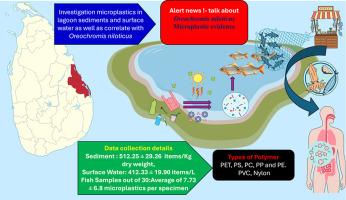
Batticaloa Lagoon is a major and prominent coastal ecosystem in Sri Lanka. However, increasing anthropogenic activities around the Eravur sector have raised the plastic accumulation thus lead to concern of microplastic contamination and ecological risk. Therefore, this study intends to examine the abundance, spatial distribution and compositional characterization of microplastics in three separate aquatic environmental components such as surface water, sediment, and Oreochromis niloticus at the Eravur lagoon. Total microplastic abundance in surface water and sediment was 512.25, 412.33 ± 19.90 items L−1 and ±29.26 items Kg−1dry weight respectively with significantly higher concentrations at those sites located at lagoon shore (267.6 ± 15.4 items L−1; 329.9 ± 22.3 items Kg-1) than lagoon sample sites (ANOVA, p < 0.001). Sediments had a greater proportion of microplastics (∼55 %) than surface waters, made of fragments and films, mostly white and transparent particles, and the smaller size fractions occupy the largest contributions to total counts (<1-2 mm-1-2mm: 30–34 %) in sediments; While in surface waters (2–4 mm: 41 %). Microplastics were found in 26 of 30 individuals of the O. niloticus (232 particles; 7.73 ± 6.8 ind−1), dominated by filaments (∼69 %), mostly <1 mm (∼62 %), and ingestion was positively correlated with fish weight and length (r = 0.799 and r = 0.793, respectively; p < 0.001). FTIR confirms seven major polymer types where PET was most abundant in sediment (26 %), PS in surface water (30 %) and PE and PP in fish samples (25 % each). The evidence of active microplastic transfer shows significant impacts on lagoon ecology.
斯里兰卡Batticaloa泻湖Eravur区地表水、沉积物和尼罗褐藻中微塑料的空间分布和生态风险评价
Batticaloa泻湖是斯里兰卡重要的沿海生态系统。然而,在Eravur地区,越来越多的人为活动增加了塑料的积累,从而引起了对微塑料污染和生态风险的关注。因此,本研究旨在研究Eravur泻湖地表水、沉积物和尼罗河Oreochromis niloticus三种不同的水环境组分中微塑料的丰度、空间分布和组成特征。地表水和沉积物中总微塑料丰度分别为512.25、412.33±19.90项L−1和±29.26项Kg−1干重,其中泻湖岸边的微塑料丰度(267.6±15.4项L−1;329.9±22.3项Kg-1)显著高于泻湖样地(方差分析,p < 0.001)。沉积物中微塑料的比例(~ 55%)高于地表水,它们由碎片和薄膜组成,主要是白色和透明的颗粒,较小的颗粒占沉积物总数的最大贡献(<1-2 mm-1-2mm: 30 - 34%);而在地表水(2-4毫米:41%)。30条O. niloticus中有26条(232粒;7.73±6.8 ind - 1)中发现了微塑料,以细丝为主(~ 69%),大部分为1 mm(~ 62%),摄取量与鱼的体重和长度呈正相关(r = 0.799和r = 0.793; p < 0.001)。FTIR确认了7种主要的聚合物类型,其中PET在沉积物中含量最多(26%),PS在地表水中含量最多(30%),PE和PP在鱼类样本中含量最多(各占25%)。活性微塑料转移的证据显示对泻湖生态有显著影响。
本文章由计算机程序翻译,如有差异,请以英文原文为准。
求助全文
约1分钟内获得全文
求助全文
来源期刊
Physics and Chemistry of the Earth
地学-地球科学综合
CiteScore
5.40
自引率
2.70%
发文量
176
审稿时长
31.6 weeks
期刊介绍:
Physics and Chemistry of the Earth is an international interdisciplinary journal for the rapid publication of collections of refereed communications in separate thematic issues, either stemming from scientific meetings, or, especially compiled for the occasion. There is no restriction on the length of articles published in the journal. Physics and Chemistry of the Earth incorporates the separate Parts A, B and C which existed until the end of 2001.
Please note: the Editors are unable to consider submissions that are not invited or linked to a thematic issue. Please do not submit unsolicited papers.
The journal covers the following subject areas:
-Solid Earth and Geodesy:
(geology, geochemistry, tectonophysics, seismology, volcanology, palaeomagnetism and rock magnetism, electromagnetism and potential fields, marine and environmental geosciences as well as geodesy).
-Hydrology, Oceans and Atmosphere:
(hydrology and water resources research, engineering and management, oceanography and oceanic chemistry, shelf, sea, lake and river sciences, meteorology and atmospheric sciences incl. chemistry as well as climatology and glaciology).
-Solar-Terrestrial and Planetary Science:
(solar, heliospheric and solar-planetary sciences, geology, geophysics and atmospheric sciences of planets, satellites and small bodies as well as cosmochemistry and exobiology).
 求助内容:
求助内容: 应助结果提醒方式:

 京公网安备 11010802042870号


