
Slippery dopamine–fluoropolymer hybrid surface for improving biliary stent longevity
IF 18
1区 医学
Q1 ENGINEERING, BIOMEDICAL
引用次数: 0
Abstract
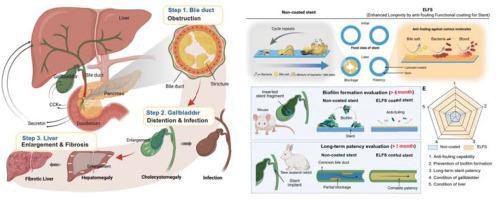
Biliary obstruction leads to bile retention and triggers a cascade of pathological events. Bile accumulation induces cholestasis and inflammation, progressing to hepatocellular injury, fibrosis, and ultimately liver failure. To restore bile flow, biliary stents are a necessary option due to their immediate patency. However, their high susceptibility to foreign body reaction (FBR) associated fibrosis, biofilm formation, and biliary sludge accumulation leads to frequent occlusion. To address this limitation, we developed the Enhanced Longevity by anti-fouling Functional coating for Stent (ELFS), a lubricant-infused coating that prevents stent occlusion. ELFS can be readily fabricated via a simple dip-coating solution process and employ a polydopamine (PDA) adhesion layer. Intravital imaging in mice confirmed that ELFS suppressed the FBR by blocking early neutrophil adhesion, which in turn prevented downstream immune-fibrotic cascades. At 3 h, neutrophil recruitment in the non-coated group was >20-fold higher than in ELFS-coated groups. Additionally, ELFS-coated stents remained free of biofilm for over six months in mice and maintained full open for two months in a rabbit common bile duct model. In contrast, non-coated stents resulted in complete occlusion, bile duct dilation (over 4 times), hepatomegaly (over 2 times), and fibrosis.
光滑的多巴胺-氟聚合物复合表面改善胆道支架使用寿命
胆道梗阻导致胆汁潴留并引发一系列病理事件。胆汁积聚引起胆汁淤积和炎症,进展为肝细胞损伤、纤维化,最终导致肝功能衰竭。为了恢复胆汁流动,胆道支架是必要的选择,因为它们立即开放。然而,它们对异物反应(FBR)相关的纤维化、生物膜形成和胆道污泥积聚的高易感性导致了频繁的闭塞。为了解决这一限制,我们开发了抗污染支架功能涂层(ELFS),这是一种注入润滑油的涂层,可防止支架闭塞。ELFS可以通过简单的浸涂溶液工艺制备,并使用聚多巴胺(PDA)粘附层。小鼠活体成像证实,ELFS通过阻断早期中性粒细胞粘附抑制FBR,从而阻止下游免疫纤维化级联反应。在3 h时,未包被组的中性粒细胞募集比包被组高20倍。此外,elfs涂层支架在小鼠中保持无生物膜超过6个月,在兔胆总管模型中保持完全开放2个月。相比之下,无涂层支架导致完全闭塞,胆管扩张(超过4倍),肝肿大(超过2倍)和纤维化。
本文章由计算机程序翻译,如有差异,请以英文原文为准。
求助全文
约1分钟内获得全文
求助全文
来源期刊
Bioactive Materials
Biochemistry, Genetics and Molecular Biology-Biotechnology
CiteScore
28.00
自引率
6.30%
发文量
436
审稿时长
20 days
期刊介绍:
Bioactive Materials is a peer-reviewed research publication that focuses on advancements in bioactive materials. The journal accepts research papers, reviews, and rapid communications in the field of next-generation biomaterials that interact with cells, tissues, and organs in various living organisms.
The primary goal of Bioactive Materials is to promote the science and engineering of biomaterials that exhibit adaptiveness to the biological environment. These materials are specifically designed to stimulate or direct appropriate cell and tissue responses or regulate interactions with microorganisms.
The journal covers a wide range of bioactive materials, including those that are engineered or designed in terms of their physical form (e.g. particulate, fiber), topology (e.g. porosity, surface roughness), or dimensions (ranging from macro to nano-scales). Contributions are sought from the following categories of bioactive materials:
Bioactive metals and alloys
Bioactive inorganics: ceramics, glasses, and carbon-based materials
Bioactive polymers and gels
Bioactive materials derived from natural sources
Bioactive composites
These materials find applications in human and veterinary medicine, such as implants, tissue engineering scaffolds, cell/drug/gene carriers, as well as imaging and sensing devices.
 求助内容:
求助内容: 应助结果提醒方式:

 京公网安备 11010802042870号


