
Preparation of hollow fibre braided polyvinylidene fluoride membranes by dip coating for membrane aerated bioreactor
IF 9
1区 工程技术
Q1 ENGINEERING, CHEMICAL
Journal of Membrane Science
Pub Date : 2026-04-01
Epub Date: 2026-02-02
DOI:10.1016/j.memsci.2026.125227
引用次数: 0
Abstract
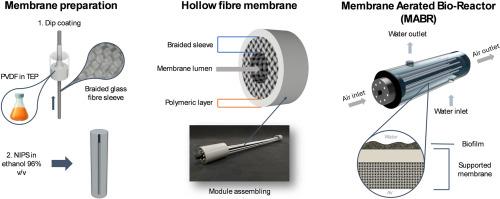
In this work, hollow fibre polyvinylidene fluoride (PVDF) supported membranes were prepared by dip coating a fibre glass sleeve in a PVDF solution, followed by precipitation via nonsolvent induced phase separation (NIPS) in 96% ethanol. The combination of these was optimized for obtaining membranes with a low-resistance thin polymeric layer and enhanced mechanical stability. The influence of both the withdrawal rate and the viscosity of the dope solution were investigated. The thickness of the PVDF coating layer was evaluated in the frame of the Landau-Levich model, which predicts that the film thickness results from the balance between viscous drag and surface tension forces. Among all the prepared membranes, the membranes prepared from a dope solution at 60 °C and with a withdrawal rate of 0.5 cm/s were selected to be used as support to grow biofilm for an application as Membrane Aerated Biological Reactor (MABR). The performance of the MABR, with the biofilm grown on the outer surface of the PVDF membranes and airflow supplied through the lumen of the fibre glass sleeve, was evaluated in terms of removal of Chemical Oxygen Demand (COD), ammoniacal nitrogen and total nitrogen. The MABR set up enabled the simultaneous abatement of the aforementioned parameters, with 78% of removal for COD, 21% for ammonia and 5% for total nitrogen, an interesting starting point for lab-made membranes exploited for this application.
浸涂法制备膜曝气生物反应器用中空纤维编织聚偏氟乙烯膜
在PVDF溶液中浸渍涂覆玻璃纤维套筒,然后在96%乙醇中通过非溶剂诱导相分离(NIPS)沉淀,制备了中空聚偏氟乙烯纤维(PVDF)支撑膜。优化了这两种方法的组合,以获得具有低电阻薄聚合物层的膜,并增强了机械稳定性。考察了萃取速率和溶液粘度对萃取效果的影响。在Landau-Levich模型框架下对PVDF涂层的厚度进行了评估,该模型预测薄膜厚度是粘性阻力和表面张力之间平衡的结果。在所有制备的膜中,选择在60°C下,提取速率为0.5 cm/s的溶液中制备的膜作为生物膜生长的载体,作为膜曝气生物反应器(MABR)的应用。生物膜生长在PVDF膜的外表面,气流通过玻璃纤维套管的管腔输送,对MABR的化学需氧量(COD)、氨态氮和总氮的去除率进行了评价。MABR装置可以同时去除上述参数,COD去除率为78%,氨去除率为21%,总氮去除率为5%,这对于用于该应用的实验室自制膜来说是一个有趣的起点。
本文章由计算机程序翻译,如有差异,请以英文原文为准。
求助全文
约1分钟内获得全文
求助全文
来源期刊
Journal of Membrane Science
工程技术-高分子科学
CiteScore
17.10
自引率
17.90%
发文量
1031
审稿时长
2.5 months
期刊介绍:
The Journal of Membrane Science is a publication that focuses on membrane systems and is aimed at academic and industrial chemists, chemical engineers, materials scientists, and membranologists. It publishes original research and reviews on various aspects of membrane transport, membrane formation/structure, fouling, module/process design, and processes/applications. The journal primarily focuses on the structure, function, and performance of non-biological membranes but also includes papers that relate to biological membranes. The Journal of Membrane Science publishes Full Text Papers, State-of-the-Art Reviews, Letters to the Editor, and Perspectives.
 求助内容:
求助内容: 应助结果提醒方式:

 京公网安备 11010802042870号


