
Surface electrostatic assembly for enhancing the fire safety, compatibility and mechanical performance of triazin-based intumescent flame retardant systems in styrene thermoplastic elastomers
IF 8.1
2区 化学
Q1 POLYMER SCIENCE
Polymer Degradation and Stability
Pub Date : 2026-05-01
Epub Date: 2026-02-10
DOI:10.1016/j.polymdegradstab.2026.112000
引用次数: 0
Abstract
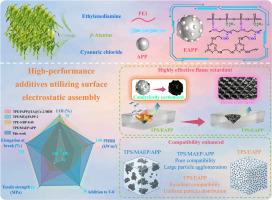
Intumescent flame retardant styrene thermoplastic elastomers (TPS) are widely used in new energy and electronic appliance sectors. However, the poor flame retardant efficiency, compatibility and bio-modification of the intumescent flame retardants (IFRs) used for TPS restrict their application in high-end fields. In this study, acid source ammonium polyphosphate (APP) is used as the carrier, and a positively charged bio-based char-foaming agent (MAEP) is constructed on the APP surface by electrostatic assembly technology, thereby preparing monomolecular IFRs (EAPP). EAPP not only decreases the dependence of IFRs on petroleum-based raw materials, but also enhances the flame retardant efficiency of triazine-based IFRs and their compatibility with TPS composites. Compared to conventional IFR blends, 30 wt.% electrostatically assembled EAPP enabled the TPS to achieve UL-94 V-0 rating. The flame retardancy mechanism of TPS/EAPP composites primarily relies on the synergy of catalytic charring and physical barrier effects. Consequently, the total heat and smoke release from TPS/EAPP composites are 27.7% and 74.7% lower than that of pure TPS. Besides, electrostatically assembled EAPP reduces its surface polarity, and demonstrates better compatibility with the TPS matrix. Compared to the TPS/MAEP/APP composites, the mechanical properties of TPS/EAPP composites improved by 31.5%. Electrostatically assembled bio-based IFRs offer a promising strategy for the preparation of high-performance TPS with excellent fire safety, mechanical and sustainable properties.
用于提高苯乙烯热塑性弹性体中三嗪基膨胀阻燃系统的防火安全性、相容性和机械性能的表面静电组件
膨胀阻燃型苯乙烯热塑性弹性体(TPS)广泛应用于新能源和电子电器领域。然而,用于TPS的膨胀型阻燃剂(IFRs)的阻燃效率、相容性和生物改性较差,限制了其在高端领域的应用。本研究以酸源聚磷酸铵(APP)为载体,通过静电组装技术在APP表面构建带正电的生物基发炭剂(MAEP),从而制备单分子IFRs (EAPP)。EAPP不仅降低了ifr对石油基原料的依赖,而且提高了三嗪基ifr的阻燃效率及其与TPS复合材料的相容性。与传统的IFR共混物相比,30 wt.%的静电组装EAPP使TPS达到UL-94 V-0等级。TPS/EAPP复合材料的阻燃机理主要依赖于催化炭化和物理屏障效应的协同作用。因此,TPS/EAPP复合材料的总放热量和总排烟量分别比纯TPS低27.7%和74.7%。此外,静电组装的EAPP降低了其表面极性,并与TPS矩阵表现出更好的相容性。与TPS/MAEP/APP复合材料相比,TPS/EAPP复合材料力学性能提高了31.5%。静电组装生物基ifr为制备具有优异消防安全、机械和可持续性能的高性能TPS提供了一种很有前途的策略。
本文章由计算机程序翻译,如有差异,请以英文原文为准。
求助全文
约1分钟内获得全文
求助全文
来源期刊
Polymer Degradation and Stability
化学-高分子科学
CiteScore
10.10
自引率
10.20%
发文量
325
审稿时长
23 days
期刊介绍:
Polymer Degradation and Stability deals with the degradation reactions and their control which are a major preoccupation of practitioners of the many and diverse aspects of modern polymer technology.
Deteriorative reactions occur during processing, when polymers are subjected to heat, oxygen and mechanical stress, and during the useful life of the materials when oxygen and sunlight are the most important degradative agencies. In more specialised applications, degradation may be induced by high energy radiation, ozone, atmospheric pollutants, mechanical stress, biological action, hydrolysis and many other influences. The mechanisms of these reactions and stabilisation processes must be understood if the technology and application of polymers are to continue to advance. The reporting of investigations of this kind is therefore a major function of this journal.
However there are also new developments in polymer technology in which degradation processes find positive applications. For example, photodegradable plastics are now available, the recycling of polymeric products will become increasingly important, degradation and combustion studies are involved in the definition of the fire hazards which are associated with polymeric materials and the microelectronics industry is vitally dependent upon polymer degradation in the manufacture of its circuitry. Polymer properties may also be improved by processes like curing and grafting, the chemistry of which can be closely related to that which causes physical deterioration in other circumstances.
 求助内容:
求助内容: 应助结果提醒方式:

 京公网安备 11010802042870号


