
Plant–microbe interactions underpin contrasting enzymatic responses to flooding intensity variation in the cascade reservoir riparian areas
IF 5.7
1区 农林科学
Q1 GEOSCIENCES, MULTIDISCIPLINARY
引用次数: 0
Abstract
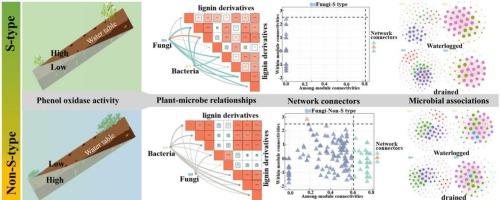
Periodic anoxia, induced by flooding and erosion, has been regarded as a protective mechanism for soil organic carbon (SOC) by limiting microbial decomposition. However, this effect was not observed uniformly across riparian zones. This study distinguishes S-type from Non-S-type riparian areas, where the former retains SOC through microbial limitation, while the latter experiences accelerated SOC loss due to high reducible metals and organic carbon. To explore these dynamics, field experiments were conducted across 19 plots in the riparian areas of cascade reservoirs along the Jinsha River, China. In older reservoirs with prolonged flooding, phenol oxidase activity was suppressed (12 years: 4.033 ± 0.240 μmol g−1 h−1; 13 years: 5.442 ± 0.199 μmol g−1 h−1) compared to a 5-year-old reservoir (8.430 ± 0.340 μmol g−1 h−1). Non-S-type riparian areas exposed to high flooding intensity (FI) showed significantly higher phenol oxidase activity (high FI: 6.336 ± 0.236 μmol g−1 h−1 vs. low FI: 3.801 ± 0.181 μmol g−1 h−1), along with reduced lignin-derived compounds. These Non-S-type riparian areas exhibited higher microbial diversity, dominated by r-strategist taxa (e.g., Proteobacteria), enhanced bacterial connectivity, and hosted three fungal guilds acting as network connectors—traits absent in S-type areas. Furthermore, microbial communities in Non-S-type riparian zones showed structural stability through iron-reducing and phenol oxidation-related carbon metabolism. Mantel's test analysis showed that the weak correlation between lignin-derived compounds and phenol oxidase-producing microbes dynamics in these areas suggested that lignin-degrading taxa, resilient to hydrological perturbations (S-type: P < 0.05, Non-S-type: P > 0.05), mitigate the impact of lignin on carbon metabolism. These findings disclosed the presence of distinct microbial resilience mechanisms in response to hydrological extremes, highlighting the capacity of Non-S-type zones to maintain ecological functions under fluctuating environmental conditions.
植物与微生物的相互作用支撑了梯级水库河岸区对洪水强度变化的对比酶反应
洪水和侵蚀引起的周期性缺氧被认为是通过限制微生物分解来保护土壤有机碳(SOC)的机制。然而,这种效应并不是在整个河岸带中均匀观察到的。该研究区分了s型和非s型河岸区,前者通过微生物限制保留了有机碳,而后者由于高可还原金属和有机碳而加速了有机碳的损失。为了探索这些动态,在金沙江梯级水库河岸区进行了19个样地的现场试验。在长期驱替的老旧储层中,苯酚氧化酶活性(12年:4.033±0.240 μmol g−1 h−1;13年:5.442±0.199 μmol g−1 h−1)比5年储层(8.430±0.340 μmol g−1 h−1)受到抑制。暴露于高洪水强度(FI)的非s型河岸区显示出显著更高的酚氧化酶活性(高FI: 6.336±0.236 μmol g−1 h−1,低FI: 3.801±0.181 μmol g−1 h−1),以及木质素衍生化合物的减少。这些非s型河岸区表现出更高的微生物多样性,以r-战略类群(如变形菌门)为主,细菌连通性增强,并有3个真菌行会作为网络连接者,这些特征在s型河岸区是不存在的。此外,非s型河岸带微生物群落通过铁还原和酚氧化相关的碳代谢表现出结构稳定性。Mantel的试验分析表明,这些地区木质素衍生化合物与产生酚氧化酶的微生物动力学之间存在弱相关性,这表明木质素降解分类群对水文扰动具有弹性(s型:P <; 0.05,非s型:P >; 0.05),减轻了木质素对碳代谢的影响。这些发现揭示了在极端水文条件下存在不同的微生物恢复机制,突出了非s型带在波动环境条件下维持生态功能的能力。
本文章由计算机程序翻译,如有差异,请以英文原文为准。
求助全文
约1分钟内获得全文
求助全文
来源期刊
Catena
环境科学-地球科学综合
CiteScore
10.50
自引率
9.70%
发文量
816
审稿时长
54 days
期刊介绍:
Catena publishes papers describing original field and laboratory investigations and reviews on geoecology and landscape evolution with emphasis on interdisciplinary aspects of soil science, hydrology and geomorphology. It aims to disseminate new knowledge and foster better understanding of the physical environment, of evolutionary sequences that have resulted in past and current landscapes, and of the natural processes that are likely to determine the fate of our terrestrial environment.
Papers within any one of the above topics are welcome provided they are of sufficiently wide interest and relevance.
 求助内容:
求助内容: 应助结果提醒方式:

 京公网安备 11010802042870号


