
Adaptively reconstructed spectral eddy-viscosity in large eddy simulations of particle-laden isotropic turbulence, Part II: Number density spectra and inertial range clustering
IF 3.9
2区 工程技术
Q1 MECHANICS
International Journal of Multiphase Flow
Pub Date : 2026-03-01
Epub Date: 2026-01-21
DOI:10.1016/j.ijmultiphaseflow.2026.105626
引用次数: 0
Abstract
Large eddy simulations (LES) of isotropic turbulence coupled with the Lagrangian particle tracking have been consistently disregarded as a means of exploring the physics underlying turbulent dispersed two-phase flows with a fully developed inertial subrange. In the present work, we determine the impact of our recently developed adaptively reconstructed spectral eddy-viscosity on the dynamics of small, heavy inertial particles at high Reynolds numbers. We use the particle number density spectrum to assess the ability of LES to predict particle clustering at distances exceeding the Kolmogorov length scale. We demonstrate that the functional form of the spectral eddy-viscosity has in general a moderate impact on the quantitative prediction of this phenomenon, while preserving qualitative agreement between LES and reference direct numerical simulations (DNS). By comparing the results against a state-of-the-art point-particle DNS, we demonstrate that the adaptively reconstructed closure enhances the predictive capabilities of LES for a wide range of Stokes and Reynolds numbers, providing the opportunity to explore the inertial-range clustering of dispersed particles over a broad spectrum of length scales. We point out that, assuming sufficient spatial resolution, the LES enriched with the proposed spectral eddy-viscosity becomes a reliable method for exploring the influence of large, energy-containing flow scales on the dynamics of inertial particles suspended in isotropic turbulence, particularly at Reynolds numbers that are currently unachievable in DNS. We further argue that this approach can support ongoing efforts to develop theories concerning the turbulent transport of dispersed particles.
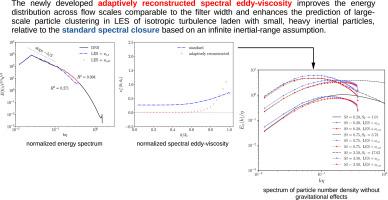
大涡模拟中自适应重构的谱涡黏度,第二部分:数密度谱和惯性范围聚类
各向同性湍流的大涡模拟(LES)与拉格朗日粒子跟踪相结合,一直被忽视为探索具有完全发展的惯性子范围的湍流分散两相流的物理基础的手段。在目前的工作中,我们确定了我们最近开发的自适应重建光谱涡流粘度对高雷诺数下小、重惯性粒子动力学的影响。我们使用粒子数密度谱来评估LES在超过Kolmogorov长度尺度的距离上预测粒子聚类的能力。我们证明了谱涡黏度的函数形式通常对这一现象的定量预测有适度的影响,同时在LES和参考直接数值模拟(DNS)之间保持定性一致。通过将结果与最先进的点粒子DNS进行比较,我们证明了自适应重建闭包增强了LES对大范围斯托克斯数和雷诺数的预测能力,为在广泛的长度尺度上探索分散粒子的惯性范围聚类提供了机会。我们指出,假设有足够的空间分辨率,富含所提出的光谱涡流粘度的LES将成为一种可靠的方法,用于探索大的、含能量的流动尺度对悬浮在各向同性湍流中的惯性粒子动力学的影响,特别是在目前在DNS中无法实现的雷诺数下。我们进一步认为,这种方法可以支持正在进行的关于分散粒子湍流输运的理论的发展。
本文章由计算机程序翻译,如有差异,请以英文原文为准。
求助全文
约1分钟内获得全文
求助全文
来源期刊
CiteScore
7.30
自引率
10.50%
发文量
244
审稿时长
4 months
期刊介绍:
The International Journal of Multiphase Flow publishes analytical, numerical and experimental articles of lasting interest. The scope of the journal includes all aspects of mass, momentum and energy exchange phenomena among different phases such as occur in disperse flows, gas–liquid and liquid–liquid flows, flows in porous media, boiling, granular flows and others.
The journal publishes full papers, brief communications and conference announcements.
 求助内容:
求助内容: 应助结果提醒方式:

 京公网安备 11010802042870号


