
A computational study of electric field-controlled CO2 Capture using earth-abundant metals
IF 10.2
Carbon Capture Science & Technology
Pub Date : 2026-03-01
Epub Date: 2026-02-07
DOI:10.1016/j.ccst.2026.100585
引用次数: 0
Abstract
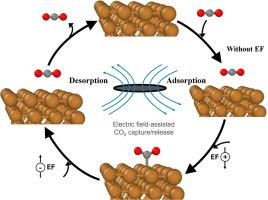
With the growing urgency to combat climate change, developing energy-efficient and tunable direct air capture (DAC) technologies for CO2 removal has become an urgent scientific and engineering challenge. This study explores a novel strategy that leverages external electric fields (EFs) and surface charges to modulate CO2 adsorption and desorption on low-cost, earth-abundant metal surfaces with varying d-orbital occupancies. Using Density Functional Theory (DFT), we systematically investigated Cu (111), Fe (110), and Zn (0001) surfaces, representing moderate, high, and inert reactivity, respectively.
Without external stimuli, Fe (110) intrinsically chemisorbs CO2, while Cu (111) and Zn (0001) surfaces exhibit only weak physisorption. Upon application of an EF and excess surface charge, all three surfaces show enhanced CO2 activation, with the effect being most pronounced on Cu (111) surface. The application of an EF leads to a transition from physisorption to chemisorption, accompanied by significant molecular activation. Reversing the field with a modest potential (∼ -2 V) enables efficient CO2 desorption, completing a low-energy capture-release cycle. In contrast, Fe binds CO2 too strongly, rendering desorption ineffective even under a strong reverse field (-40 V), while Zn remains largely unresponsive due to filled d-orbitals, showing minimal activation for CO2 adsorption even at high field strengths (30 V).
Among the three, Cu (111) emerges as the most promising candidate for electrically tunable CO2 capture, offering a balance between reactivity and reversibility due to its nearly filled d-band configuration. By elucidating the crucial roles of d-orbital occupancy and electric field sensitivity, this work presents electrically modulated adsorption and desorption as an effective carbon capture mechanism that eliminates the need for chemical functionalization, surface modification, or energy-intensive thermal or pressure processes. This approach opens new pathways for designing tunable CO2 capture systems through targeted material selection and electric field engineering.
利用地球上丰富的金属进行电场控制CO2捕获的计算研究
随着应对气候变化的紧迫性日益增加,开发节能、可调的直接空气捕获(DAC)技术来去除二氧化碳已成为一项紧迫的科学和工程挑战。本研究探索了一种利用外部电场(EFs)和表面电荷来调节二氧化碳在低成本、富含地球的金属表面上吸附和解吸的新策略,这些金属表面具有不同的d轨道占有率。利用密度泛函理论(DFT),我们系统地研究了Cu (111), Fe(110)和Zn(0001)表面,分别代表中等,高和惰性反应性。在没有外界刺激的情况下,Fe(110)本质上化学吸收CO2,而Cu(111)和Zn(0001)表面只表现出弱的物理吸附。在施加EF和过量表面电荷后,所有三个表面都表现出增强的CO2活化,其中Cu(111)表面的效果最为明显。EF的应用导致从物理吸附到化学吸附的转变,伴随着显著的分子活化。以适度的电位(~ -2 V)逆转磁场,实现有效的CO2解吸,完成低能量的捕获-释放循环。相比之下,Fe与CO2的结合过于强烈,即使在强大的反向电场(-40 V)下也无法解吸,而Zn由于填充d轨道而基本上没有反应,即使在高电场强度(30 V)下也表现出最小的CO2吸附活性。在这三种化合物中,Cu(111)是电可调CO2捕获最有希望的候选者,由于其几乎充满d波段的结构,在反应性和可逆性之间提供了平衡。通过阐明d轨道占用和电场敏感性的关键作用,本研究提出了电调制吸附和解吸作为一种有效的碳捕获机制,消除了对化学功能化、表面改性或能源密集型热或压力过程的需要。这种方法通过有针对性的材料选择和电场工程,为设计可调二氧化碳捕获系统开辟了新的途径。
本文章由计算机程序翻译,如有差异,请以英文原文为准。
求助全文
约1分钟内获得全文
求助全文

 求助内容:
求助内容: 应助结果提醒方式:

 京公网安备 11010802042870号


