
Enhanced solar-to-chemical conversion of seawater to H2O2 via defect-rich sulphur-doped poly (heptazine imide) photocatalysts
IF 7.9
3区 材料科学
Q1 GREEN & SUSTAINABLE SCIENCE & TECHNOLOGY
Materials Today Sustainability
Pub Date : 2026-03-01
Epub Date: 2026-02-02
DOI:10.1016/j.mtsust.2026.101318
引用次数: 0
Abstract
Sustainable on-site hydrogen peroxide (H2O2) production from oxygen and water using visible light is an appealing method for decentralized water treatment and green oxidation chemistry. However, it often faces challenges due to weak O2 activation and rapid charge recombination in carbon nitride photocatalysts. In this study, we report a sulphur-functionalized poly (heptazine imide) (S-PHI) made through KCl-assisted polymerization. The controlled addition of different atoms and changes to the framework improve crystallinity, stacking order, and defect chemistry. XRD and vibrational spectroscopy confirm the creation of a heptazine-imide network with strain-induced structural changes. XPS shows C–S bonding without oxidized sulphur species present. S-PHI shows improved visible-light absorption (Eg ∼ 2.64 eV; LHE ∼91% up to 440 nm), strong photoluminescence quenching, a slightly longer carrier lifetime (∼10.48 ns), a larger electrochemically active surface area (Cdl: 61.5 mF cm−2), lower interfacial charge-transfer resistance, and a more negative flat-band potential (−1.62 V), which supports oxygen reduction. With low-power 405 nm LED light and ethanol, S-PHI produces 16,400 μmol g−1 h−1 H2O2, increasing to 38,142 μmol g−1 h−1 in untreated seawater with O2 bubbling. The apparent quantum yields reach up to 45.1%, and the SCC efficiency is 0.31%. Rotating-disk analysis (n ∼ 2.29) and scavenger tests indicate a mainly two-electron O2 reduction pathway, with an extra 1O2-mediated contribution from defect states and photosensitized pathways. This work showcases defect-engineered PHI as a strong and scalable option for solar-driven H2O2 production in real saline environments.
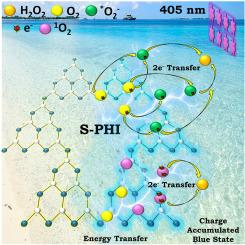
通过富硫掺杂聚七嗪亚胺光催化剂增强海水光化学转化为H2O2
利用可见光从氧气和水中可持续地生产过氧化氢(H2O2)是分散水处理和绿色氧化化学的一种有吸引力的方法。然而,由于氮化碳光催化剂中O2活化弱、电荷重组快,因此常常面临挑战。在这项研究中,我们报道了一个硫功能化聚(七嗪亚胺)(S-PHI)通过氯化钾辅助聚合。不同原子的可控添加和框架的改变改善了结晶度、堆叠顺序和缺陷化学。XRD和振动光谱证实了七嗪-亚胺网络的形成,并伴有应变引起的结构变化。XPS显示C-S键,不存在氧化硫。S-PHI表现出更好的可见光吸收(例如 ~ 2.64 eV; LHE ~ 91%,高达440 nm),强光致发光猝灭,稍长的载流子寿命(~ 10.48 ns),更大的电化学活性表面积(Cdl: 61.5 mF cm−2),更低的界面电荷转移电阻,以及更负的平带电位(- 1.62 V),支持氧还原。在低功率405 nm LED灯和乙醇的作用下,S-PHI产生16400 μmol g−1 h−1 H2O2,在未处理的海水中产生38,142 μmol g−1 h−1。表观量子产率高达45.1%,SCC效率为0.31%。旋转圆盘分析(n ~ 2.29)和清道夫测试表明,主要是双电子O2还原途径,缺陷态和光敏化途径对O2介导的额外贡献。这项工作表明,缺陷工程PHI是在实际盐水环境中太阳能驱动H2O2生产的强大且可扩展的选择。
本文章由计算机程序翻译,如有差异,请以英文原文为准。
求助全文
约1分钟内获得全文
求助全文
来源期刊
Materials Today Sustainability
Multiple-
CiteScore
5.80
自引率
6.40%
发文量
174
审稿时长
32 days
期刊介绍:
Materials Today Sustainability is a multi-disciplinary journal covering all aspects of sustainability through materials science.
With a rapidly increasing population with growing demands, materials science has emerged as a critical discipline toward protecting of the environment and ensuring the long term survival of future generations.
 求助内容:
求助内容: 应助结果提醒方式:

 京公网安备 11010802042870号


