
Rapid and recyclable removal of Congo Red dye using mesoporous Zinc-based metal organic framework

IF 8.1 2区 环境科学与生态学 Q1 ENVIRONMENTAL SCIENCES
Chemosphere Pub Date : 2026-03-01 Epub Date: 2026-02-10 DOI:10.1016/j.chemosphere.2026.144854
Roopa Kumari , Tripuresh Shanker Dwivedi , Roopal Pal , Ranu Gadi
{"title":"Rapid and recyclable removal of Congo Red dye using mesoporous Zinc-based metal organic framework","authors":"Roopa Kumari ,&nbsp;Tripuresh Shanker Dwivedi ,&nbsp;Roopal Pal ,&nbsp;Ranu Gadi","doi":"10.1016/j.chemosphere.2026.144854","DOIUrl":null,"url":null,"abstract":"<div><div>Metal-organic frameworks (MOFs) have emerged as advanced adsorbent materials in wastewater purification because of their high porosity, tunable structure, and exceptional surface area. In the present work, a zinc-based MOF (ZMOF) was prepared via a solvothermal method using zinc nitrate and terephthalic acid. The structural and surface properties of ZMOF were characterized using XRD, FTIR, SEM, BET surface area analysis, XPS, and zeta potential measurements. These results proved that the crystalline mesoporous framework exhibited a surface area of 1188.43 m<sup>2</sup>g<sup>-1</sup>, pore radius of 1.68 nm, homogeneous morphology, and a moderately negative surface charge of −11.54 mV, which could enhance electrostatic interaction with anionic dyes. ZMOF exhibited outstanding adsorption performance. About 92% CR could be removed within 3 min at a concentration of 3.48 mg/L. After being reused four times, 64% efficiency could still be maintained. The kinetic modeling showed that the adsorption fits well to the PSO model with R<sup>2</sup> = 0.989, indicating a chemisorption-dominant process driven by coordination and electrostatic interaction between Zn<sup>2+</sup> centers and functional groups of CR. The post-adsorption analyses of XRD, FTIR, SEM, XPS, and zeta potential indicated structural stability with a dual contribution of physisorption and chemisorption. These results demonstrate rapid, recyclable and stable performance of ZMOF toward dye removal from wastewater, showcasing its great potential as a sustainable adsorbent for large-scale treatments.</div></div>","PeriodicalId":276,"journal":{"name":"Chemosphere","volume":"396 ","pages":"Article 144854"},"PeriodicalIF":8.1000,"publicationDate":"2026-03-01","publicationTypes":"Journal Article","fieldsOfStudy":null,"isOpenAccess":false,"openAccessPdf":"","citationCount":"0","resultStr":null,"platform":"Semanticscholar","paperid":null,"PeriodicalName":"Chemosphere","FirstCategoryId":"93","ListUrlMain":"https://www.sciencedirect.com/science/article/pii/S0045653526000317","RegionNum":2,"RegionCategory":"环境科学与生态学","ArticlePicture":[],"TitleCN":null,"AbstractTextCN":null,"PMCID":null,"EPubDate":"2026/2/10 0:00:00","PubModel":"Epub","JCR":"Q1","JCRName":"ENVIRONMENTAL SCIENCES","Score":null,"Total":0}
引用次数: 0

Abstract

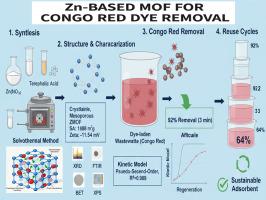
Metal-organic frameworks (MOFs) have emerged as advanced adsorbent materials in wastewater purification because of their high porosity, tunable structure, and exceptional surface area. In the present work, a zinc-based MOF (ZMOF) was prepared via a solvothermal method using zinc nitrate and terephthalic acid. The structural and surface properties of ZMOF were characterized using XRD, FTIR, SEM, BET surface area analysis, XPS, and zeta potential measurements. These results proved that the crystalline mesoporous framework exhibited a surface area of 1188.43 m2g-1, pore radius of 1.68 nm, homogeneous morphology, and a moderately negative surface charge of −11.54 mV, which could enhance electrostatic interaction with anionic dyes. ZMOF exhibited outstanding adsorption performance. About 92% CR could be removed within 3 min at a concentration of 3.48 mg/L. After being reused four times, 64% efficiency could still be maintained. The kinetic modeling showed that the adsorption fits well to the PSO model with R2 = 0.989, indicating a chemisorption-dominant process driven by coordination and electrostatic interaction between Zn2+ centers and functional groups of CR. The post-adsorption analyses of XRD, FTIR, SEM, XPS, and zeta potential indicated structural stability with a dual contribution of physisorption and chemisorption. These results demonstrate rapid, recyclable and stable performance of ZMOF toward dye removal from wastewater, showcasing its great potential as a sustainable adsorbent for large-scale treatments.
Abstract Image

介孔锌基金属有机骨架快速可回收去除刚果红染料。
金属有机骨架(mof)因其高孔隙率、可调结构和特殊的表面积而成为污水净化中先进的吸附材料。本文以硝酸锌和对苯二甲酸为原料,采用溶剂热法制备了锌基MOF。采用XRD、FTIR、SEM、BET表面积分析、XPS和zeta电位等手段对ZMOF的结构和表面性能进行了表征。结果表明,晶体介孔骨架的表面积为1188.43 m2g-1,孔径半径为1.68 nm,形貌均匀,表面电荷为-11.54 mV,可增强与阴离子染料的静电相互作用。ZMOF表现出优异的吸附性能。当浓度为3.48 mg/L时,3 min内CR去除率约为92%。重复使用4次后,仍可保持64%的效率。动力学建模结果表明,吸附过程符合PSO模型,R2 = 0.989,表明吸附过程以化学吸附为主,由CR的Zn2+中心和官能团之间的配位和静电相互作用驱动。吸附后的XRD、FTIR、SEM、XPS和zeta电位分析表明,吸附过程具有物理吸附和化学吸附双重作用。这些结果证明了ZMOF对废水中染料的快速、可回收和稳定的去除性能,显示了它作为大规模处理的可持续吸附剂的巨大潜力。
本文章由计算机程序翻译,如有差异,请以英文原文为准。
求助全文
约1分钟内获得全文 求助全文
来源期刊
Chemosphere
Chemosphere 环境科学-环境科学
CiteScore
15.80
自引率
8.00%
发文量
4975
审稿时长
3.4 months
期刊介绍: Chemosphere, being an international multidisciplinary journal, is dedicated to publishing original communications and review articles on chemicals in the environment. The scope covers a wide range of topics, including the identification, quantification, behavior, fate, toxicology, treatment, and remediation of chemicals in the bio-, hydro-, litho-, and atmosphere, ensuring the broad dissemination of research in this field.

×
引用
GB/T 7714-2015
复制
MLA
复制
APA
复制
导出至
BibTeX EndNote RefMan NoteFirst NoteExpress
×
提示
您的信息不完整,为了账户安全,请先补充。
现在去补充
×
提示
您因"违规操作"
具体请查看互助需知
我知道了
×
提示
确定
请完成安全验证×
copy
已复制链接
快去分享给好友吧!
我知道了
右上角分享
点击右上角分享
0
联系我们:info@booksci.cn Book学术提供免费学术资源搜索服务,方便国内外学者检索中英文文献。致力于提供最便捷和优质的服务体验。 Copyright © 2023 布克学术 All rights reserved.
京ICP备2023020795号-1
ghs 京公网安备 11010802042870号
Book学术文献互助
Book学术文献互助群
群 号:604180095
Book学术官方微信
小红书


