Navigating diversions in the obstetric operating room: focusing amidst distractions

AJOG global reports Pub Date : 2026-02-01 Epub Date: 2025-12-19 DOI:10.1016/j.xagr.2025.100587
Kaitlyn Voity , Christina O’Leary , Nicole P. Jenkins DO , Claire Wolford , Jonathan D. Baum MD , Antonia F. Oladipo MD, MSCI
{"title":"Navigating diversions in the obstetric operating room: focusing amidst distractions","authors":"Kaitlyn Voity ,&nbsp;Christina O’Leary ,&nbsp;Nicole P. Jenkins DO ,&nbsp;Claire Wolford ,&nbsp;Jonathan D. Baum MD ,&nbsp;Antonia F. Oladipo MD, MSCI","doi":"10.1016/j.xagr.2025.100587","DOIUrl":null,"url":null,"abstract":"<div><h3>Background</h3><div>Distractions in the operating room (OR) are known to disrupt surgical workflow and compromise patient safety. However, little is known about the nature and impact of intraoperative distractions during cesarean deliveries, which involve dual-patient care and complex team dynamics. This study aims to characterize the frequency, type, and severity of distractions in the obstetric OR and examine associations with surgical duration and complications.</div></div><div><h3>Objective</h3><div>To systematically characterize the frequency, types, and severity of intraoperative distractions during scheduled cesarean deliveries, and to evaluate their association with surgical duration and maternal or neonatal complications. The study hypothesizes that higher distraction scores are associated with longer procedure times and increased clinical complications.</div></div><div><h3>Study Design</h3><div>We conducted a prospective observational study of 97 scheduled cesarean deliveries at ≥37 weeks’ gestation from March 2023 to December 2024. Distractions were recorded in real time using a published distraction categorization tool and grading system by severity (mild, moderate, severe). A weighted distraction score was calculated per case. Clinical data included procedure duration, staff count, and presence of maternal or neonatal complications.</div></div><div><h3>Results</h3><div>Across 97 cases, 8113 distractions were documented (mean: 81 per case). Door movement and teaching conversations were the most common types of distraction type. While mild distractions were most frequent, moderate distractions contributed the largest portion of the total distraction burden (44.5%). Severe distractions occurred in all cases. No significant correlation was found between surgery length and distraction score. Cases with NICU admissions (n=11) had higher average total distraction scores (98.8) and more severe distractions (mean: 3.56).</div></div><div><h3>Conclusions</h3><div>Distractions in the obstetric OR are frequent and varied, with moderate distractions representing a key contributor to cognitive load. Higher distraction scores may be associated with neonatal complications, underscoring the need for distraction-reduction strategies to optimize safety in cesarean deliveries. Although distractions were not associated with prolonging surgical length, healthcare providers should be cognizant of the amount and type of distractions that can occur that may impact patient outcomes.</div></div>","PeriodicalId":72141,"journal":{"name":"AJOG global reports","volume":"6 1","pages":"Article 100587"},"PeriodicalIF":0.0000,"publicationDate":"2026-02-01","publicationTypes":"Journal Article","fieldsOfStudy":null,"isOpenAccess":false,"openAccessPdf":"","citationCount":"0","resultStr":null,"platform":"Semanticscholar","paperid":null,"PeriodicalName":"AJOG global reports","FirstCategoryId":"1085","ListUrlMain":"https://www.sciencedirect.com/science/article/pii/S2666577825001480","RegionNum":0,"RegionCategory":null,"ArticlePicture":[],"TitleCN":null,"AbstractTextCN":null,"PMCID":null,"EPubDate":"2025/12/19 0:00:00","PubModel":"Epub","JCR":"","JCRName":"","Score":null,"Total":0}
引用次数: 0

Abstract

Background

Distractions in the operating room (OR) are known to disrupt surgical workflow and compromise patient safety. However, little is known about the nature and impact of intraoperative distractions during cesarean deliveries, which involve dual-patient care and complex team dynamics. This study aims to characterize the frequency, type, and severity of distractions in the obstetric OR and examine associations with surgical duration and complications.

Objective

To systematically characterize the frequency, types, and severity of intraoperative distractions during scheduled cesarean deliveries, and to evaluate their association with surgical duration and maternal or neonatal complications. The study hypothesizes that higher distraction scores are associated with longer procedure times and increased clinical complications.

Study Design

We conducted a prospective observational study of 97 scheduled cesarean deliveries at ≥37 weeks’ gestation from March 2023 to December 2024. Distractions were recorded in real time using a published distraction categorization tool and grading system by severity (mild, moderate, severe). A weighted distraction score was calculated per case. Clinical data included procedure duration, staff count, and presence of maternal or neonatal complications.

Results

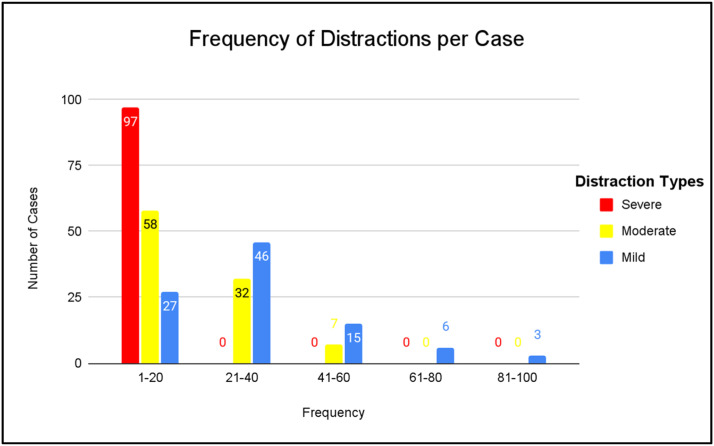
Across 97 cases, 8113 distractions were documented (mean: 81 per case). Door movement and teaching conversations were the most common types of distraction type. While mild distractions were most frequent, moderate distractions contributed the largest portion of the total distraction burden (44.5%). Severe distractions occurred in all cases. No significant correlation was found between surgery length and distraction score. Cases with NICU admissions (n=11) had higher average total distraction scores (98.8) and more severe distractions (mean: 3.56).

Conclusions

Distractions in the obstetric OR are frequent and varied, with moderate distractions representing a key contributor to cognitive load. Higher distraction scores may be associated with neonatal complications, underscoring the need for distraction-reduction strategies to optimize safety in cesarean deliveries. Although distractions were not associated with prolonging surgical length, healthcare providers should be cognizant of the amount and type of distractions that can occur that may impact patient outcomes.

Abstract Image

Abstract Image

Abstract Image

在产科手术室中导航转移:在分心中集中注意力。
背景:众所周知,手术室(OR)中的干扰会破坏手术流程并危及患者安全。然而,关于剖宫产术中分心的性质和影响知之甚少,这涉及到双患者护理和复杂的团队动态。本研究旨在描述产科手术室中分心的频率、类型和严重程度,并研究其与手术时间和并发症的关系。目的:系统地描述剖宫产术中分心的频率、类型和严重程度,并评估其与手术时间和产妇或新生儿并发症的关系。该研究假设,较高的分心得分与较长的手术时间和增加的临床并发症有关。研究设计:我们对2023年3月至2024年12月97例妊娠≥37周的剖宫产患者进行了前瞻性观察研究。使用已发布的分心分类工具和严重程度(轻度、中度、严重)分级系统实时记录分心。计算每个病例的加权分心评分。临床资料包括手术时间、工作人员数量、产妇或新生儿并发症的存在。结果:在97例病例中,记录了8113例分心(平均每例81例)。门的移动和教学谈话是最常见的分心类型。虽然轻度分心是最常见的,但中度分心在总分心负担中所占比例最大(44.5%)。所有案例中都发生了严重的分心。手术时间与牵张评分无显著相关性。NICU入院病例(n=11)的平均总分心得分更高(98.8),分心程度更严重(平均值:3.56)。结论:产科手术室的分心是频繁和多样的,适度的分心是认知负荷的关键因素。较高的分心评分可能与新生儿并发症有关,强调需要减少分心策略以优化剖宫产的安全性。虽然分心与延长手术时间无关,但医疗保健提供者应该认识到可能影响患者预后的分心的数量和类型。
本文章由计算机程序翻译,如有差异,请以英文原文为准。
求助全文
约1分钟内获得全文 求助全文
来源期刊
AJOG global reports
AJOG global reports Endocrinology, Diabetes and Metabolism, Obstetrics, Gynecology and Women's Health, Perinatology, Pediatrics and Child Health, Urology
CiteScore
1.20
自引率
0.00%
发文量
0

×
引用
GB/T 7714-2015
复制
MLA
复制
APA
复制
导出至
BibTeX EndNote RefMan NoteFirst NoteExpress
×
提示
您的信息不完整,为了账户安全,请先补充。
现在去补充
×
提示
您因"违规操作"
具体请查看互助需知
我知道了
×
提示
确定
请完成安全验证×
copy
已复制链接
快去分享给好友吧!
我知道了
右上角分享
点击右上角分享
0
联系我们:info@booksci.cn Book学术提供免费学术资源搜索服务,方便国内外学者检索中英文文献。致力于提供最便捷和优质的服务体验。 Copyright © 2023 布克学术 All rights reserved.
京ICP备2023020795号-1
ghs 京公网安备 11010802042870号
Book学术文献互助
Book学术文献互助群
群 号:604180095
Book学术官方微信
小红书