Mario Alberto Alarcón-Sánchez, Valeria Henao-Díaz, Lilibeth-Stephania Escoto-Vasquez, Melissa Martínez-Nieto, Gustavo Eder González-Alvarez, Armen A Muradyan, Artak Heboyan, Sarah Monserrat Lomelí-Martínez
{"title":"Impact of hepatitis C virus on oral health: Clinical lesions, immunopathology, and dental management: A narrative review.","authors":"Mario Alberto Alarcón-Sánchez, Valeria Henao-Díaz, Lilibeth-Stephania Escoto-Vasquez, Melissa Martínez-Nieto, Gustavo Eder González-Alvarez, Armen A Muradyan, Artak Heboyan, Sarah Monserrat Lomelí-Martínez","doi":"10.1177/03946320261419189","DOIUrl":null,"url":null,"abstract":"<p><p>Hepatitis C virus (HCV) infection is a major global public health problem. Although it has traditionally been linked to liver damage, several studies have demonstrated its extrahepatic impact, specifically in the oral cavity. Oral manifestations can be considered early signs of infection or contribute to clinical progression. This narrative review aims to describe the oral alterations associated with HCV, integrating the pathophysiological mechanisms and clinical implications for dental management. The most prevalent manifestations include periodontal disease, oral lichen planus, Sjögren's syndrome-like sialadenitis, and squamous cell carcinoma of the oral cavity. Recent findings suggest that HCV triggers dysbiosis of the oral microbiome, promotes exacerbated immune responses with overproduction of pro-inflammatory cytokines, and disrupts the homeostatic environment, thereby promoting the progression of inflammatory and neoplastic diseases. In addition, viral RNA has been identified in saliva and gingival crevicular fluid, which could be considered a non-parenteral route of transmission, particularly important in dental interventions. In parallel, direct-acting antiviral therapy, in addition to achieving virus elimination, could also partially correct immunological and microbial disruptions in the cavity, with favorable clinical responses. Understanding these oral alterations can guide dentists in early detection and improve systemic outcomes.</p>","PeriodicalId":48647,"journal":{"name":"International Journal of Immunopathology and Pharmacology","volume":"40 ","pages":"3946320261419189"},"PeriodicalIF":2.6000,"publicationDate":"2026-01-01","publicationTypes":"Journal Article","fieldsOfStudy":null,"isOpenAccess":false,"openAccessPdf":"https://www.ncbi.nlm.nih.gov/pmc/articles/PMC12901906/pdf/","citationCount":"0","resultStr":null,"platform":"Semanticscholar","paperid":null,"PeriodicalName":"International Journal of Immunopathology and Pharmacology","FirstCategoryId":"3","ListUrlMain":"https://doi.org/10.1177/03946320261419189","RegionNum":3,"RegionCategory":"医学","ArticlePicture":[],"TitleCN":null,"AbstractTextCN":null,"PMCID":null,"EPubDate":"2026/2/12 0:00:00","PubModel":"Epub","JCR":"","JCRName":"","Score":null,"Total":0}
引用次数: 0
Abstract
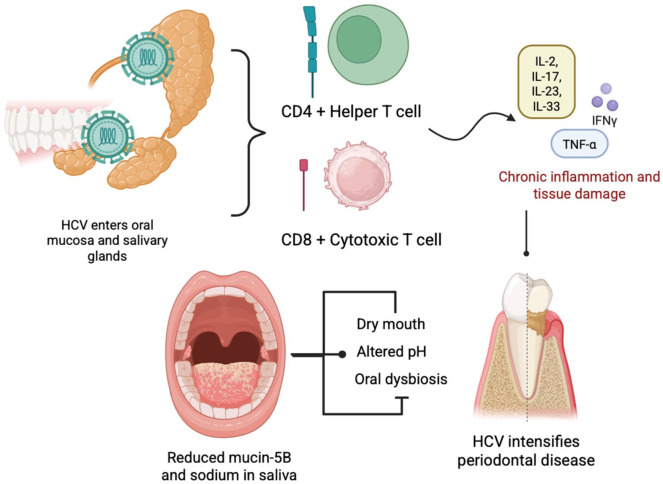
Hepatitis C virus (HCV) infection is a major global public health problem. Although it has traditionally been linked to liver damage, several studies have demonstrated its extrahepatic impact, specifically in the oral cavity. Oral manifestations can be considered early signs of infection or contribute to clinical progression. This narrative review aims to describe the oral alterations associated with HCV, integrating the pathophysiological mechanisms and clinical implications for dental management. The most prevalent manifestations include periodontal disease, oral lichen planus, Sjögren's syndrome-like sialadenitis, and squamous cell carcinoma of the oral cavity. Recent findings suggest that HCV triggers dysbiosis of the oral microbiome, promotes exacerbated immune responses with overproduction of pro-inflammatory cytokines, and disrupts the homeostatic environment, thereby promoting the progression of inflammatory and neoplastic diseases. In addition, viral RNA has been identified in saliva and gingival crevicular fluid, which could be considered a non-parenteral route of transmission, particularly important in dental interventions. In parallel, direct-acting antiviral therapy, in addition to achieving virus elimination, could also partially correct immunological and microbial disruptions in the cavity, with favorable clinical responses. Understanding these oral alterations can guide dentists in early detection and improve systemic outcomes.
期刊介绍:
International Journal of Immunopathology and Pharmacology is an Open Access peer-reviewed journal publishing original papers describing research in the fields of immunology, pathology and pharmacology. The intention is that the journal should reflect both the experimental and clinical aspects of immunology as well as advances in the understanding of the pathology and pharmacology of the immune system.



 求助内容:
求助内容: 应助结果提醒方式:

 京公网安备 11010802042870号


