Structure and Function of the Achilles Tendon and Plantarflexors 1 Year Following Achilles Tendon Rupture in the United Kingdom: A Cross-Sectional Study.
Samuel Briggs-Price, Jitendra Mangwani, Alexander Kilcran, Anchal Prasad, Reihaneh Salimian, Seth O'Neill
{"title":"Structure and Function of the Achilles Tendon and Plantarflexors 1 Year Following Achilles Tendon Rupture in the United Kingdom: A Cross-Sectional Study.","authors":"Samuel Briggs-Price, Jitendra Mangwani, Alexander Kilcran, Anchal Prasad, Reihaneh Salimian, Seth O'Neill","doi":"10.1002/jfa2.70134","DOIUrl":null,"url":null,"abstract":"<p><strong>Background: </strong>Achilles tendon rupture (ATR) is the most common tendon rupture affecting the lower limb. This study investigates Achilles tendon structure, strength and function 1 year or more after ATR.</p><p><strong>Methods: </strong>This cross-sectional study recruited individuals ≥ 12 months post ATR. Structure was assessed using ultrasound tissue characterisation (UTC) including cross-sectional area (CSA), aligned fibrillar structure (AFS), disorganised fibrillar structure (DFS) and echo type percentage. Strength was measured using maximal voluntary isometric contraction (MVIC) plantarflexor testing and the calf raise test. Patient-reported outcomes included the Achilles tendon rupture score (ATRS), EQ-5D-5L and general practice physical activity questionnaire (GPPAQ). Achilles tendon resting angle (ATRA) was used as an indirect measure of tendon elongation. The relationship between outcomes and time since ATR was analysed using linear regression adjusting for age, sex, ethnicity and body mass index (BMI). Between limb comparisons were made using paired t-tests.</p><p><strong>Findings: </strong>Sixty participants (mean age 55.2 years and 78.5% male) were assessed at a mean of 6.8 years post ATR. The affected tendon showed a 62% larger cross-sectional area, with 28.7 mm<sup>2</sup> (16%) DFS compared to 7.3 mm<sup>2</sup> (7%) on the nonaffected side (p < 0.001). Linear regression showed decreasing AFS with time postinjury (p = 0.04); no significant associations were found for CSA or DFS. Significant deficits were observed in plantarflexor strength and function, with MVIC and calf raise work 18% and 40% lower in the affected limb (p < 0.001). ATRA indicated tendon elongation in the affected limb of 6.7° (p < 0.001). Median ATRS was 83, EQ-5D index was 0.95 and VAS was 85; 93% were physically active based on the GPPAQ.</p><p><strong>Conclusion: </strong>Significant structural and functional deficits persist years after ATR, including increased tendon size, fibre disorganisation, reduced strength and tendon elongation. ATRS scores were consistent with previous nonsurgical immobilisation protocol outcomes in the United Kingdom. Longitudinal studies are needed to understand the trajectory of recovery following ATR.</p>","PeriodicalId":49164,"journal":{"name":"Journal of Foot and Ankle Research","volume":"19 1","pages":"e70134"},"PeriodicalIF":2.2000,"publicationDate":"2026-03-01","publicationTypes":"Journal Article","fieldsOfStudy":null,"isOpenAccess":false,"openAccessPdf":"https://www.ncbi.nlm.nih.gov/pmc/articles/PMC12893871/pdf/","citationCount":"0","resultStr":null,"platform":"Semanticscholar","paperid":null,"PeriodicalName":"Journal of Foot and Ankle Research","FirstCategoryId":"3","ListUrlMain":"https://doi.org/10.1002/jfa2.70134","RegionNum":3,"RegionCategory":"医学","ArticlePicture":[],"TitleCN":null,"AbstractTextCN":null,"PMCID":null,"EPubDate":"","PubModel":"","JCR":"Q1","JCRName":"ORTHOPEDICS","Score":null,"Total":0}
引用次数: 0
Abstract
Background: Achilles tendon rupture (ATR) is the most common tendon rupture affecting the lower limb. This study investigates Achilles tendon structure, strength and function 1 year or more after ATR.
Methods: This cross-sectional study recruited individuals ≥ 12 months post ATR. Structure was assessed using ultrasound tissue characterisation (UTC) including cross-sectional area (CSA), aligned fibrillar structure (AFS), disorganised fibrillar structure (DFS) and echo type percentage. Strength was measured using maximal voluntary isometric contraction (MVIC) plantarflexor testing and the calf raise test. Patient-reported outcomes included the Achilles tendon rupture score (ATRS), EQ-5D-5L and general practice physical activity questionnaire (GPPAQ). Achilles tendon resting angle (ATRA) was used as an indirect measure of tendon elongation. The relationship between outcomes and time since ATR was analysed using linear regression adjusting for age, sex, ethnicity and body mass index (BMI). Between limb comparisons were made using paired t-tests.
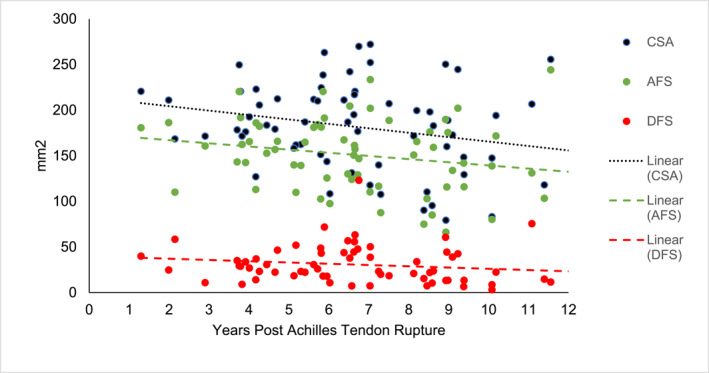
Findings: Sixty participants (mean age 55.2 years and 78.5% male) were assessed at a mean of 6.8 years post ATR. The affected tendon showed a 62% larger cross-sectional area, with 28.7 mm2 (16%) DFS compared to 7.3 mm2 (7%) on the nonaffected side (p < 0.001). Linear regression showed decreasing AFS with time postinjury (p = 0.04); no significant associations were found for CSA or DFS. Significant deficits were observed in plantarflexor strength and function, with MVIC and calf raise work 18% and 40% lower in the affected limb (p < 0.001). ATRA indicated tendon elongation in the affected limb of 6.7° (p < 0.001). Median ATRS was 83, EQ-5D index was 0.95 and VAS was 85; 93% were physically active based on the GPPAQ.
Conclusion: Significant structural and functional deficits persist years after ATR, including increased tendon size, fibre disorganisation, reduced strength and tendon elongation. ATRS scores were consistent with previous nonsurgical immobilisation protocol outcomes in the United Kingdom. Longitudinal studies are needed to understand the trajectory of recovery following ATR.
期刊介绍:
Journal of Foot and Ankle Research, the official journal of the Australian Podiatry Association and The College of Podiatry (UK), is an open access journal that encompasses all aspects of policy, organisation, delivery and clinical practice related to the assessment, diagnosis, prevention and management of foot and ankle disorders.
Journal of Foot and Ankle Research covers a wide range of clinical subject areas, including diabetology, paediatrics, sports medicine, gerontology and geriatrics, foot surgery, physical therapy, dermatology, wound management, radiology, biomechanics and bioengineering, orthotics and prosthetics, as well the broad areas of epidemiology, policy, organisation and delivery of services related to foot and ankle care.
The journal encourages submissions from all health professionals who manage lower limb conditions, including podiatrists, nurses, physical therapists and physiotherapists, orthopaedists, manual therapists, medical specialists and general medical practitioners, as well as health service researchers concerned with foot and ankle care.
The Australian Podiatry Association and the College of Podiatry (UK) have reserve funds to cover the article-processing charge for manuscripts submitted by its members. Society members can email the appropriate contact at Australian Podiatry Association or The College of Podiatry to obtain the corresponding code to enter on submission.



 求助内容:
求助内容: 应助结果提醒方式:

 京公网安备 11010802042870号


